About Fowlea piscator (Schneider, 1799)
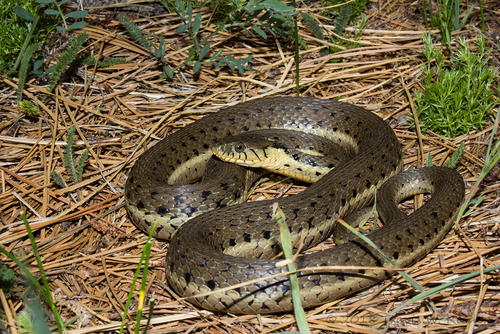
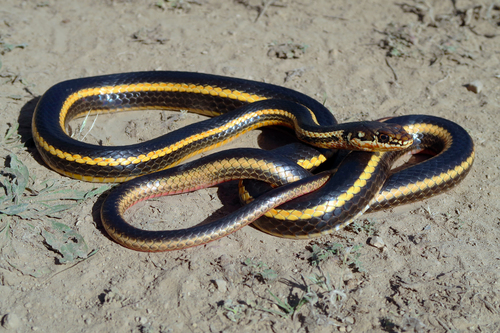
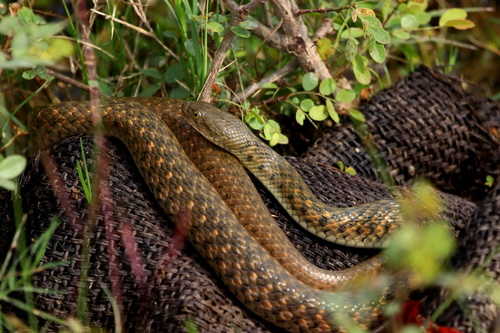
Fowlea piscator (Schneider, 1799), commonly called the checkered keelback, has the following characteristics. In adult individuals, the eye is rather small, and its length is shorter than the distance between the eye and the nostril. The rostral scale is visible when viewed from above. The internasal scales are heavily narrowed toward the front, are subtriangular in shape with a truncated anterior angle, and are the same length as the prefrontal scales. The frontal scale is longer than the distance between it and the tip of the snout, and is either as long as the parietals or slightly shorter than the parietals. The loreal scale is almost as long as it is deep. There is one preocular scale, and most often three postocular scales, rarely four. Temporal scale arrangement is 2+2 or 2+3. Normally, there are nine upper labial scales, with the fourth and fifth upper labials extending into the eye socket; five lower labial scales contact the anterior chin-shields, which are shorter than the posterior chin-shields. Dorsal scales are arranged in 19 rows, are strongly keeled, while the outermost rows of dorsal scales are smooth. There are 125–158 ventral scales, the anal scale is divided, and there are 64–90 subcaudal scales. This species has highly variable coloration: patterns can include dark spots arranged in a quincunx pattern, often separated by a whitish network; black longitudinal bands on a pale background; or dark crossbands, which may or may not have whitish spots. Two oblique black streaks, one below the eye and one behind the eye, are almost always present. The underside of the body is white, and the scales may or may not have black margins. The checkered keelback is a medium-sized snake that may occasionally reach a large size. Adult snout-to-vent length (SVL) can reach up to 1.75 m (5.7 ft). This species is active both during the day and at night, and its preferred habitat is located in or near freshwater bodies and paddy fields. The geographic range of F. piscator includes Afghanistan, Bangladesh, Pakistan, Sri Lanka, India, Myanmar, Nepal, Thailand, Laos, Cambodia, Vietnam, West Malaysia, the Chinese provinces of Zhejiang, Jiangxi, Fujian, Guangdong, Hainan, Guangxi, and Yunnan, Taiwan, and the Indonesian islands of Sumatra, Java, Borneo, and Sulawesi (formerly called Celebes). The original type locality was listed as "East Indies", which has been restricted by geographic inference to the northern coastal areas of Andhra Pradesh State, eastern India. Fowlea piscator is oviparous. Clutch size is typically 30 to 70 eggs, but can be as small as 4 or as large as 100. Eggs vary in size, ranging from 1.5–4.0 cm (0.59–1.57 in) in length. The female guards the clutch until the eggs hatch after 60–70 days of incubation. Each newly hatched hatchling measures approximately 11 cm (4.3 in) in length.