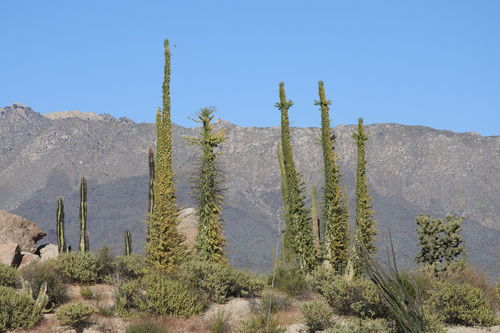
About Fouquieria columnaris Kellogg ex Curran
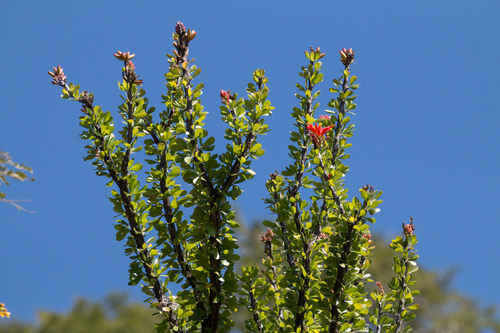
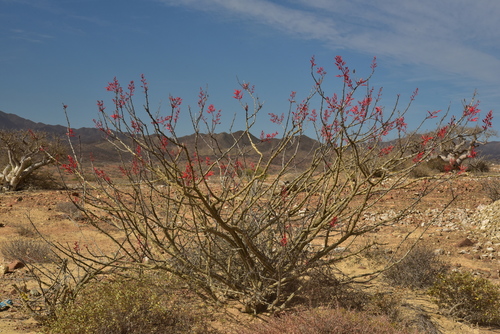
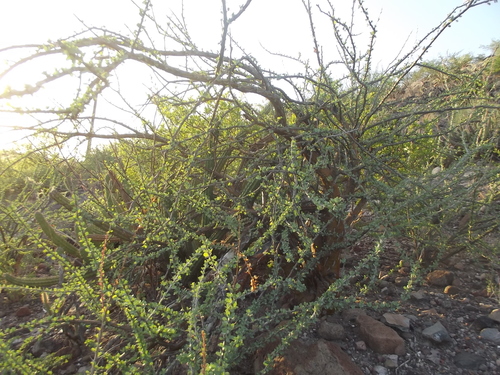
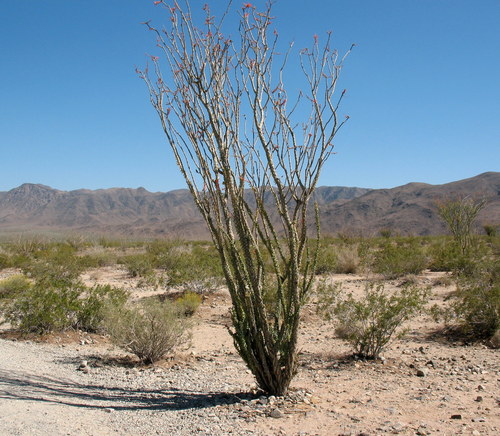
This species has the accepted scientific name Fouquieria columnaris Kellogg ex Curran. It is a column-shaped tree that tapers upward, and its central axis is homologous to the single stem of other tree species. It has a cortical water-storage network, a trait unique to its family. Its trunk can reach up to 24 inches (61 centimeters) thick, and is off-white in color. There are few or no major branches on the trunk, and numerous thin, twiggy branches grow outward at right angles; all of these branches are covered with small leaves that are 1.5–4 cm (0.59–1.57 in) long. Mature individuals can grow up to 20 meters (almost 70 feet) tall. The tallest recorded individual, located in Montevideo Valley between Mission San Borja and Bahia de los Angeles, reaches 86.5 feet (26.4 meters) in height, making this species the second tallest succulent after Euphorbia ampliphylla. Its flowers bloom in August and September regardless of rainfall. They grow in short racemes, and have a honey-like scent. The flowers have short, cream-yellow corollas, and the petal limbs curve inward around the stamen filaments. The anthers and stamens protrude outward, while the stigma is protected by the curved petal limbs. At least 15 species of bees from 11 genera visit these flowers; the bees pry open the curved corolla limbs to reach the sweet nectar, and in the process contact the protected stigma. This is one of the slowest-growing tree species. A 50-year-old individual may be only five feet (1.5 meters) tall, and after reaching 50 years of age, it averages just 12 inches (30 centimeters) of growth every ten years. In terms of distribution and habitat, this species grows from sea level up to 1450 meters in elevation. It occurs on deep to shallow volcanic loams, clays, and decomposed granite soils, in well-drained sites on hillsides, mesas, and alluvial plains. It ranges from the area around San Quintín in Baja California south to the Tres Vírgenes volcano complex in Baja California Sur, and a notable concentration of this species grows in what is called Boojum Forest. It also grows on Isla Angel de la Guarda in the Gulf of California. On the Mexican mainland, it is also found in a small area south of Puerto Libertad in coastal Sonora. The annual rainfall across its native range averages only 73 to 140 mm, falling mainly from January to April, with smaller amounts falling from August through September. Rainfall is unreliable in this region, and sometimes multiple years can pass without heavy rain. The unusual distribution pattern of mainland populations has led Mexican botanists to hypothesize that the species was most likely transplanted to the mainland by the indigenous Seri people, who historically lived in this area and currently reside on communal land south of the species' mainland range. The Seri name for this plant is cototaj, pronounced [ˈkototax]. In Seri traditional belief, touching this plant will cause strong, undesirable winds to develop. Because of this belief, the hypothesis that the Seri people transplanted this species is considered doubtful.