About Foudia madagascariensis (Linnaeus, 1766)
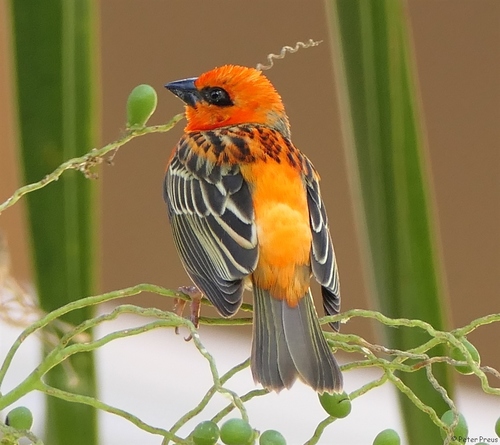
The red fody (Foudia madagascariensis) measures about 5 inches (13 cm) in length and weighs 14–19 grams (0.49–0.67 oz). Breeding males of the species are bright red with black markings around each eye, and have brown wings and brown tails. Their underparts are also red, a feature that distinguishes them from other fody species in regions where the red fody has been introduced. Females have olive-brown upper parts and greyish brown underparts. This is a common bird that inhabits forest clearings, grasslands, and cultivated areas, and it does not live in dense forest. It is native to Madagascar, where it is considered a pest of rice cultivation. It has also been introduced to other locations across the Indian Ocean, including the Amirantes, Comoros, Seychelles, Mauritius, Réunion, and Saint Helena. The red fody feeds mostly on seeds (especially grass seeds) and insects, but it also consumes other food types including fruit, nectar, household scraps, and copra. Outside of the breeding season, this species is gregarious. As the breeding season approaches, males establish territories that are roughly 30 meters (100 feet) in diameter. Red fodies are monogamous. The male begins building a nest in the center of his territory before courtship begins, and nests are clustered into loose colonies. Nests are globular in shape, with a side entrance that has a porch or short tube. Nests are built mostly by the male, woven together from rootlets, tendrils, grasses, and other long strands of vegetation. Nest construction takes around eight days, and many nests are abandoned if the male fails to attract a mate.