About Forsterygion nigripenne (Valenciennes, 1836)
Forsterygion nigripenne, commonly known as the estuarine triplefin, is a small fish species first described by Valenciennes in 1836.
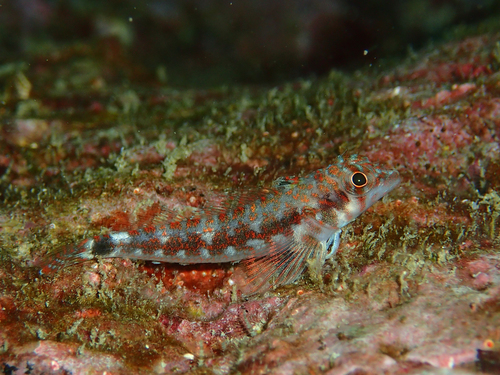
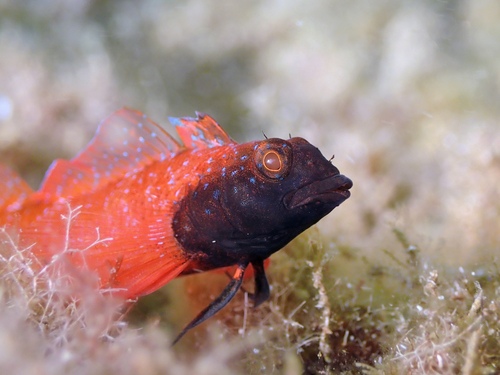
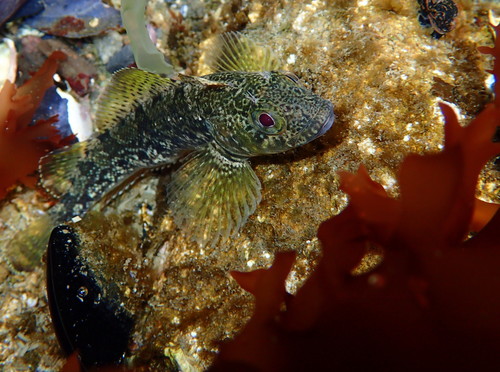
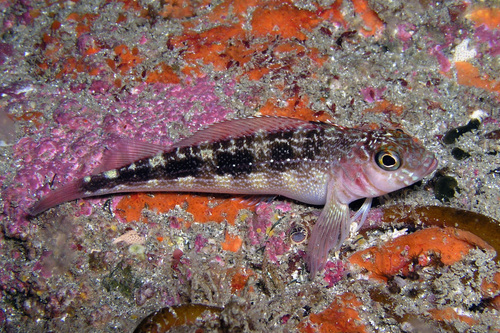
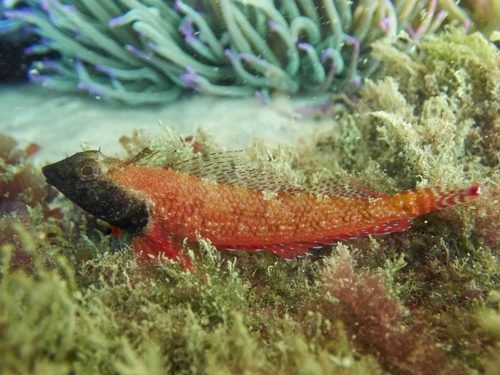
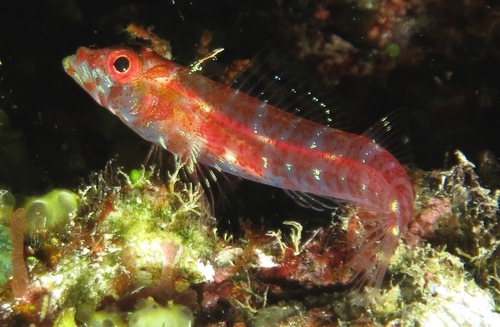
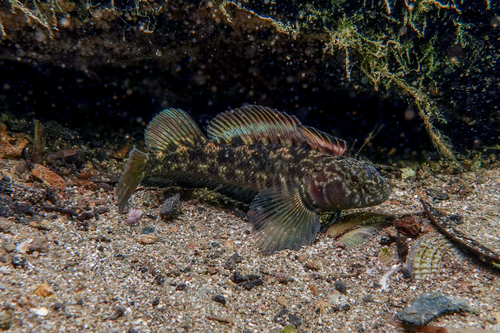
This fish has an elongated, slender body with only a few scales along its sides. Adult individuals typically reach around 5.5 cm (2.2 in) in length, and can grow up to 8–10 cm (3.1–3.9 in) total. Body color and patterning can change to match the surrounding environment. Heads can vary in shape between individuals, appearing either rounded or pointed. Its dorsal fins are split into three distinct sections: the first two sections are made of hard, spike-like spinous structures, and the third section has soft structures. The dorsal fin has between 24 and 27 spines and 11 to 13 soft fin structures. The spines of the first dorsal fin are notably long, reaching the same height as the spines of the second dorsal fin. The anal fins, located on the lower abdomen, have two spines and 24 to 26 soft structures. Pectoral fins, on the sides of the body near the pectoral region, contain both branched and unbranched structures. Pelvic fins, located below the belly, hold small spines and are positioned close to the throat. Caudal fins have 10 structures on the upper lobe and 9 on the lower lobe. Bony characteristics of this species include 42 to 44 vertebrae and 6 to 7 gill rakers. The operculum, or gill cover, is connected to membranous tissue. The lateral line, a sensory line running along the body, is interrupted in the middle; the front section has a row of indented scales, and the back section has a row of incised scales. Small tentacle-like projections are present on the head, and there are no sensory papillae on the sides of the head or around the gill region. Scales are generally comb-shaped, and are only faintly visible on the front part of the body. No scales are present under the dorsal fin or on the belly. The jaws lack large canine teeth, and palatal teeth on the roof of the mouth may be either present or absent. The head has 4 or 5 small suborbital bones.
This species is found primarily in tropical and temperate waters across the Atlantic, Indian, and Pacific Oceans, and occurs in coastal waters all around New Zealand. Estuarine triplefins live in saline brackish water near the seabed. They occupy shallow water, living on rocky, algal, and sandy seabed habitats at depths from 0 to 3 metres (0 to 10 ft) in temperate regions that experience four distinct seasons. Adults live in the lower reaches of estuaries, rivers, and streams, among rocks and submerged tree-covered areas. Larvae are planktonic, and mainly live in shallow coastal waters. The species is most commonly found on hard, uneven seabed terrain, particularly in the subtidal zones of rocky and coral reefs. Forsterygion nigripenne does not live in freshwater rivers, and only moves upstream within the tidal range, making it hard to capture with conventional methods in these tidal habitats. Individuals move between subtidal and intertidal zones with changing tides, and have been recorded at depths of at least 12 metres (40 ft).
Eggs start development in a planktonic state, after which larvae grow in shallow coastal areas. Distinct morphological characteristics develop in lateral and dorsal regions near the dorsal fins; the gas bladder and dorsal spinal rigidity both develop later in growth. During the extended breeding season, which runs through winter and summer and peaks from May to December, males establish and defend territories to attract multiple females. Eggs are generally laid in simple nests constructed behind large rocks; males stay to guard the eggs until they hatch. Eggs are hemispherical, with many adhesive threads on their surface that anchor them to algae. This species has external fertilization: females release eggs as they lay them, and males release sperm nearby. Nests are open and not fully enclosed. During the breeding season, males hold eggs under rocks and guard them through tidal changes.
Unique breeding-related traits occur in males: during the breeding season, males develop enlarged fin tips, and tall columnar cells proliferate in the fin epidermis (these cells are not found in females). The cells contain protein granules surrounded by a double membrane, and go through three developmental stages; the most mature cells rupture to release their contents. The function of this secretion is not fully confirmed, but one study observed that secretions are applied to egg masses, which may act to prevent infection. The average lifespan of this species is approximately 2.9 years, though lifespan varies widely between individual fish, from a minimum of around 2 months (0.2 years) to a maximum of around 7 months (0.6 years).
Estuarine triplefin populations have an intrinsic population growth rate (rm) 4.7 times faster than the recorded wild population growth rate. Fish reach a recruitment length of 3.8 cm (1.5 in), when they begin participating in breeding. Based on the species' biological traits, including early maturity, short lifespan, and relatively high reproductive capacity, FishBase rates Forsterygion nigripenne as highly resilient and productive. This assessment follows criteria from the American Fisheries Society, and is calculated using biological parameters specific to this species, such as growth coefficient K, age at first maturity tm, and maximum lifespan tmax. In this classification framework, the extinction decline threshold for estuarine triplefin is set at 0.99. This means the species is considered at high risk of extinction if its total biomass or mature population declines by more than 99% over 10 years or three generations, unless clear exceptional evidence shows otherwise. Currently, this species is classified as highly resilient, and is unlikely to go extinct without severe environmental changes or strong human-caused pressures. This assessment is specific to the estuarine triplefin, and is based on practical life history data and estimates for the species rather than generalizations.