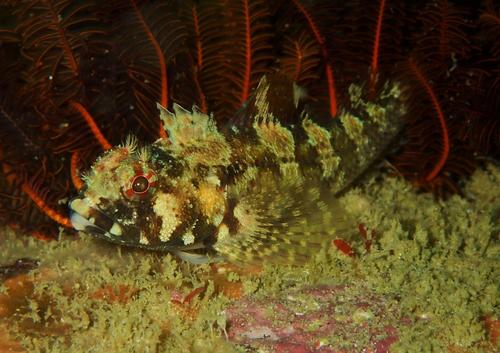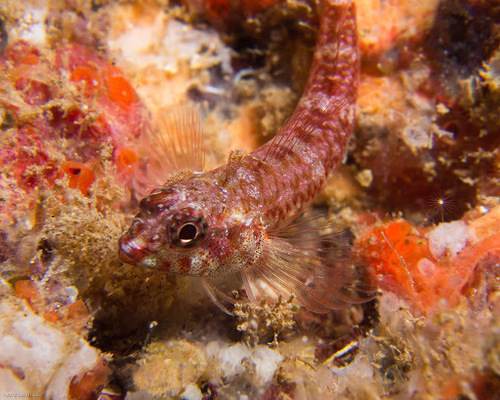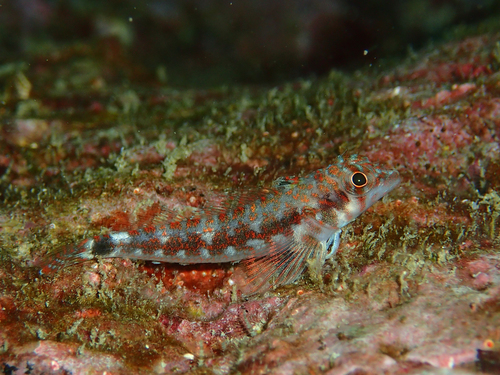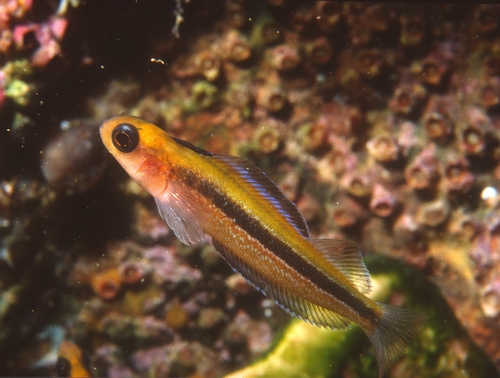
About Forsterygion lapillum Hardy, 1989
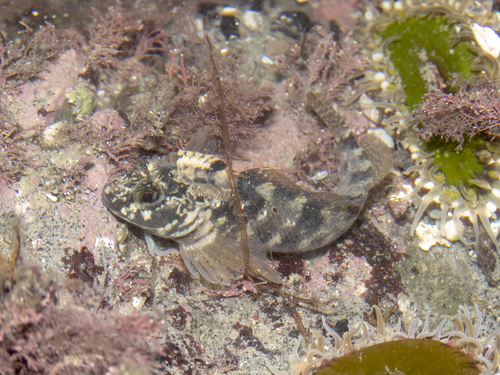
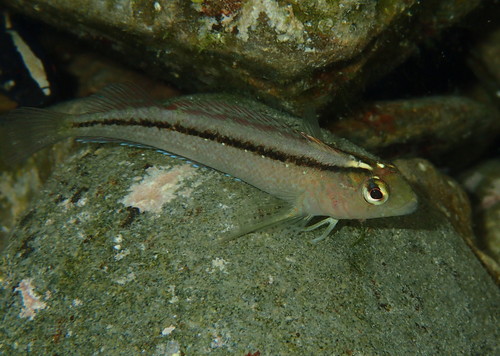
Common triplefin (Forsterygion lapillum Hardy, 1989) sexes have similar appearance for most of their reproductive cycle, though there is some morphological diversity between populations. Outside of the breeding season, both sexes usually have dappled light brown colouration and white undersides. The sides of females and younger males may have a longitudinal black stripe; this stripe is much fainter in South Island populations, and colouration tends to be darker in fish from more southern locations. When males are reproductively active, their bodies turn completely black and a pale blue streak develops on their anal fins. The common triplefin is one of the smaller triplefins in the family Tripterygiidae, reaching a maximum total length of 70 mm. Its maximum recorded lifespan is up to three years, which is shorter than most other triplefins, and individuals reach mature sizes within one year of hatching. The common triplefin is found across most of New Zealand's mainland coastline, and occurs much less frequently on New Zealand offshore islands; it has also been introduced to Australia. It is most abundant in subtidal depths up to 5 m. Unlike most other New Zealand triplefins, which prefer higher levels of cover, the common triplefin occupies a wide range of shelter levels. It can occasionally be found in intertidal rock pools during low tides, but this occupation is thought to be temporary, and is not associated with the reproductive activity that occurs in its usual habitat. Just prior to the breeding season, adult fish densely occupy habitats, and populations gradually become more sparse as adults spread out again after the breeding season ends. Adults and juveniles occupy similar habitats in terms of depth and substrate. However, the pattern of distribution density across different maturity levels changes with the number of adults in the habitat. While the number of juveniles will initially increase alongside the number of adults in a location, this relationship eventually flips, and the number of juveniles will decrease with any additional adults. The decrease in juvenile numbers at higher adult densities is partly due to cannibalism of smaller juveniles; it may also stem from competition with adults, or less effective camouflage that leads to increased predation. The initial positive relationship between juvenile and adult density could result from settling juveniles using adult counts as an indicator of good habitat quality. This species commonly inhabits substrates made of cobble and gravel. Settling juveniles show a strong preference for locations that host the algae Cystophora retroflexa and Cystophora torulosa. This preference may act as a limiting factor for population size of common triplefin in a given area, as these specific algae provide food, cover, or both for developing juveniles. Common triplefins are one of the least specialised New Zealand triplefin species in terms of habitat, and utilise a wide variety of substrates, depths, and cover levels. This lack of habitat specificity may help the species by allowing it to occupy microhabitats that are unused by other triplefins in the area, enabling multiple triplefin species to coexist without competition. It has also been suggested that habitat selection in New Zealand triplefins might act as a "magic trait", where traits under ecological selection create a reproductive barrier to gene flow. Under this hypothesis, despite potential gene flow between triplefin populations, the ecological boundary of habitat selection creates reproductive isolation between groups, allowing speciation to occur based on which fish inhabit different, highly specific habitats.