About Forsterygion capito (Jenyns, 1842)
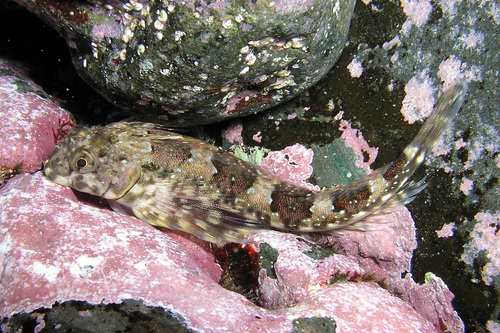
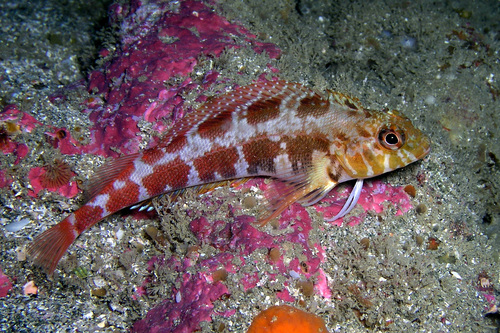
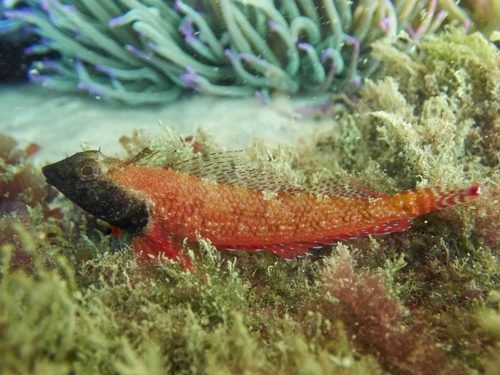
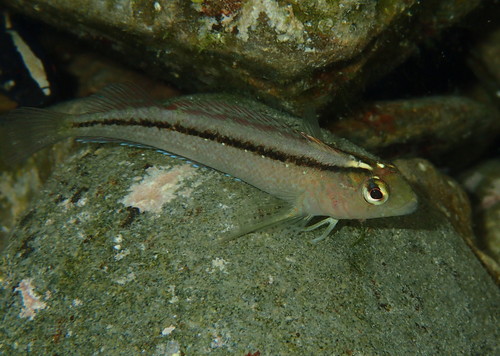
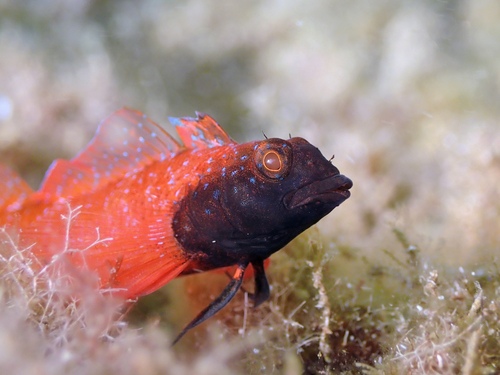
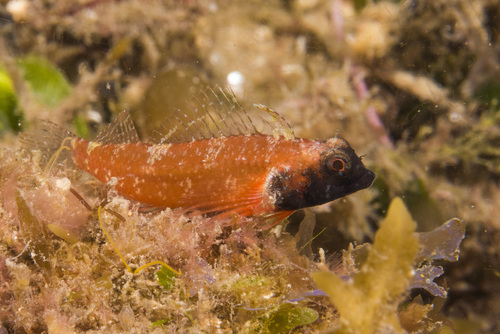
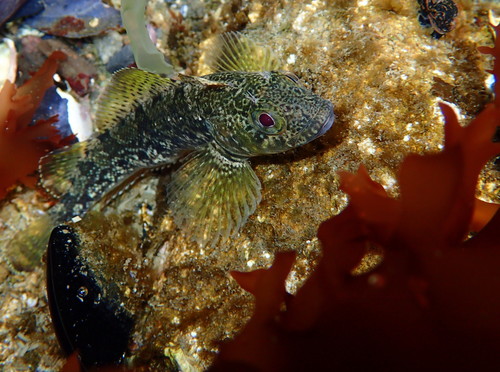
Forsterygion capito, commonly called the spotted robust triplefin, reaches a maximum total length of 9.4 cm (3.7 in) and has an average weight of approximately 4.4 grams (0.16 oz). Its body is typically mottled grey and brown, often with additional reddish or yellowish hues; this colouration provides effective camouflage against rocks and seaweed, making the fish nearly invisible to predators. Unlike some other triplefin species that display bright colouration, this species maintains its cryptic mottled patterning. As a member of the family Tripterygiidae, it has three separate dorsal fins, with the first dorsal fin being smaller than the other two. The middle dorsal fin holds 23 to 28 spines and 13 to 15 soft rays. Its anal fin has 1 to 2 spines and 24 to 27 soft rays. The pectoral fins are broad, supporting stability and movement along the seabed. It has a large head relative to its slender, elongated body, a slightly rounded tail fin, and a snout that usually has a concave, downward-sloping profile, rarely a steep profile. During the autumn reproductive season, most males develop dark spawning colouration. The spotted robust triplefin is endemic to New Zealand, meaning it occurs naturally nowhere else in the world. Globally, the triplefin fauna (family Tripterygiidae) includes around 30 genera and 130 species, with the highest diversity and abundance found in the New Zealand region. New Zealand is home to 14 triplefin genera and 26 species, and 12 of these 14 genera are entirely endemic to the country. While most New Zealand triplefin species remain confined to the region, three species have been accidentally introduced to Australia and now occur there as well. Within New Zealand, Forsterygion capito lives in temperate marine environments around the North Island, South Island, and multiple offshore islands including Stewart Island, the Auckland Islands, Snares Islands, Antipodes Islands, and Chatham Islands. Unlike most New Zealand coastal fish species, which have distributions limited to either northern or southern latitudes, spotted robust triplefins show no latitude preference, a trait that indicates high ecological adaptability. This species is endemic to New Zealand and its population is currently considered stable. The IUCN Red List categorises it as Least Concern, meaning it is not threatened with extinction or ongoing population decline; however, this classification is based on 2014 data and requires updating, as population status may shift with newer data. Forsterygion capito typically inhabits the marine neritic zone, coastal areas, and intertidal zones including tidepools, at depths of up to 12 metres (40 ft). It is most often found in sheltered waters such as harbours or bays, and thrives on subtidal rocks, rocky reefs, loose rocks, pebbles, and gravel. These habitats provide critical shelter and foraging grounds, and the species tends to select areas protected from larger predators. It prefers turbid water, which makes it difficult to observe in the wild. The species is common within several New Zealand marine protected areas, and prefers a water temperature of approximately 16 °C (61 °F). Across the entire Tripterygiidae family, around 10% of species are kelp-dependent or strongly associated with kelp during at least one stage of their life cycle. New Zealand's diverse triplefin species each have distinct habitat preferences, and these preferences are thought to be a major driver of species diversification within the group. In the same general location, different triplefin species can occupy separate habitat patches, and some species use different substrate types such as mud and rock. All triplefin species are highly philopatric, meaning individuals tend to stay in or return to the area where they hatched, and they mate within their own territory. Reported spawning seasons for triplefins vary: some spawn in spring and early summer, while others spawn in winter or early spring. Reproductive success is heavily influenced by three factors: body size, population density, and nest quality. When a female is ready to spawn, she moves into a male's territory. Females generally prefer larger males whose territories offer the widest selection of nesting sites. Once inside the nest, the female lays eggs in batches, and moves aside regularly to allow the male to fertilise the eggs. Eggs are 1 to 1.5 mm in diameter, hemispherical, and covered in numerous sticky threads that anchor them to the nesting site. After spawning, the female provides no parental care; the male guards the eggs until they hatch. Hatching takes around 7 to 10 days in warm northern New Zealand waters, and up to 18 days in colder waters. After hatching, newly emerged hatchlings, which are roughly 0.5 cm long, live a planktonic lifestyle in the water column for two to three months. Juveniles grow quickly and reach sexual maturity just before they reach one year of age. Juveniles settle into benthic habitats when they are 1.5 to 2 cm long, with settlement occurring between August and January. Adult triplefin populations tend to decline while hatchlings develop into juveniles, most likely due to physiological stress from a second cycle of spawning and nest guarding.