About Forpus conspicillatus (Lafresnaye, 1848)
The spectacled parrotlet, whose scientific name is Forpus conspicillatus (Lafresnaye, 1848), is a parrot species belonging to the family Psittacidae. It has three recognized subspecies: the nominate F. c. conspicillatus, the Cauca spectacled parrotlet (F. c. caucae), and the Venezuelan spectacled parrotlet (F. c. metae).
Spectacled parrotlets are endemic to Middle and South America. They can be found in eastern Panama, as well as northern and central Colombia and Venezuela, with each subspecies occupying specific regions within Colombia and Venezuela. Their natural habitats include lowland evergreen forest edges, thorn scrub, llanos, gallery woodland, heavily degraded former forest, and low-density woodland. This species does not live at altitudes above 1,600 metres (5,200 ft) above sea level.
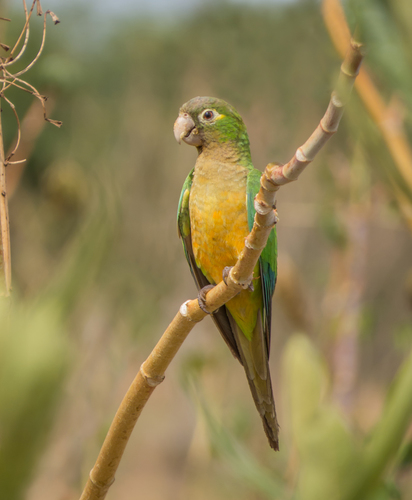
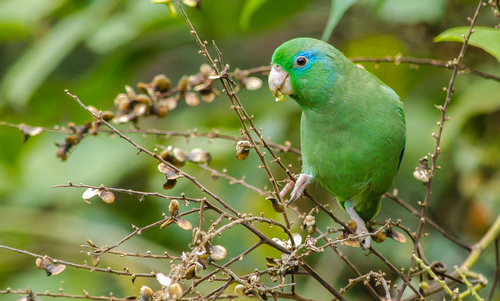
The species' natural green and blue colouring allows spectacled parrotlets to camouflage among tropical trees in their range. While colour mutations such as the yellow pied mutation can occur in captive populations, they are rare in wild populations, because brighter colouration reduces a bird's ability to hide from predators.
In reproduction, males attract females using their bright colouration and distinctive mating calls. Spectacled parrotlets typically breed between January and March. They nest in tree cavities and similar structures, often reusing abandoned tree holes or clay mountain nests built by other unrelated bird species, but they are also able to dig and build new nests.
During incubation, the female sits on the eggs, while the male guards the nest and feeds both the female and newly hatched chicks. Spectacled parrotlets are monogamous, and some pairs mate for life. After laying the first egg, the female lays one additional egg every two days until the clutch is complete. Clutches typically hold 4–6 eggs, which hatch after an 18-day incubation period. Chicks fledge at around five weeks old, and siblings remain in close contact for several weeks after fledging. Birds from the same clutch use unique calls, and continue to feed each other and play together until they become self-sufficient and mature.