About Forpus coelestis (Lesson, 1847)
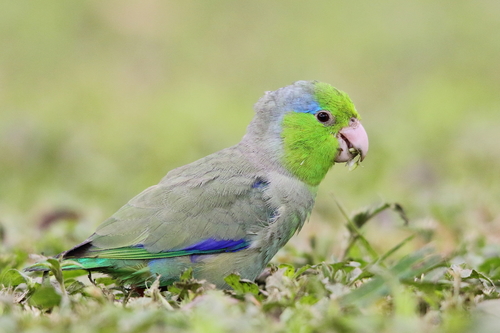
The Pacific parrotlet, scientifically named Forpus coelestis, is a small green parrot native to South America. A typical adult Pacific parrotlet measures 11–14 centimetres (4.3–5.5 inches) long and usually weighs 30 grams or more. Wild Pacific parrotlets have green plumage with a dusty grey cast across the body, a bright green mask, a pinkish beak, and pinkish-grey legs and feet. This species is sexually dimorphic: males have blue coloring on their wings. The blue can vary in intensity, from bright cobalt blue to a pale, almost lavender blue on American birds; for marbled birds, blue is almost non-existent, only visible on the underside of the wing at the joint. Males also have blue streaks behind the eyes, often called "eyeshadow", as well as blue rumps. Females have no blue on their wings at all, but can have blue eye streaks and a blue rump. Due to their small size, Pacific parrotlets are often nicknamed pocket parrots, and they are well known for their bold, larger-than-life personalities and feisty attitudes. In captivity, they are solitary, because they show aggressive behavior toward other birds when kept in a confined space. It is not recommended to house one Pacific parrotlet with other members of its species unless there is plenty of available space. Pet Pacific parrotlets should never be kept with other bird species, because aggression is very likely. While the base, wild-type plumage color of Pacific parrotlets is green, many color mutations exist: American Yellow, Green Marbled, American Yellow Marbled, Green Fallow, Green Fallow Marbled, American Yellow Fallow, American Yellow Marbled Fallow, Blue, American White, Blue Marbled, American White Marbled, Blue Fallow, American White Fallow, Blue Marbled Fallow, American White Marbled Fallow, Turquoise, American Turquoise, Turquoise Marbled, American Turquoise Marbled, Turquoise Fallow, American Turquoise Fallow, Turquoise Fallow Marbled, American Turquoise Fallow Marbled, Grey, American Grey, Grey Marbled, American Grey Marbled, Grey Fallow, American Grey Fallow, Grey Fallow Marbled, American Grey Fallow Marbled, Albino, Lutino Creamino, Cinnamon, Misty, Dark Factor, and Pied. The term "Dilute" is not used for Pacific parrotlet mutations. The term "Pastel" was previously used to describe feather and wing edging, but the preferred term for this pattern is now Marbled. Wild Pacific parrotlets are native to western Ecuador and northwestern Peru. They are most common in dry habitats such as deserts and deciduous forests, but they have spread into humid areas following deforestation. They have also been recorded in the middle Marañón valley, and in 2014 a small flock was reported near the Rio Mataje in Nariño, southwestern Colombia. The species is abundant across its native range, and its populations remain relatively undisturbed by human activity. Pacific parrotlets live in flocks of 40 to 50 individuals, and can be found on lowland and foothill borders, in woodlands, shrubby clearings, gardens, parks, and agricultural fields. Their typical habitats include subtropical or tropical dry forest, subtropical or tropical moist lowland forest, subtropical or tropical dry shrubland, and heavily degraded former forest. They are non-migratory, meaning they remain in the same area year-round. Pacific parrotlets are highly protective of their eggs and chicks. Each clutch contains 4–6 white eggs, which are incubated for an average of 18 days. In the wild, they nest in tree cavities or on fence posts, and have also been observed nesting in abandoned nests of necklaced spinetails and pale-legged horneros.