About Formicivora serrana (Hellmayr, 1929)
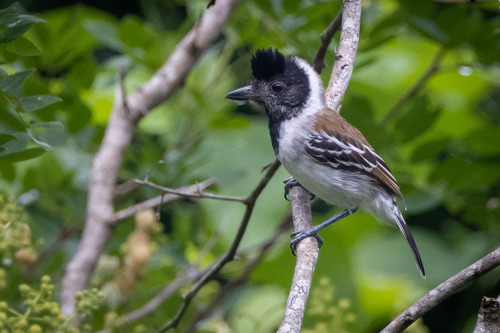
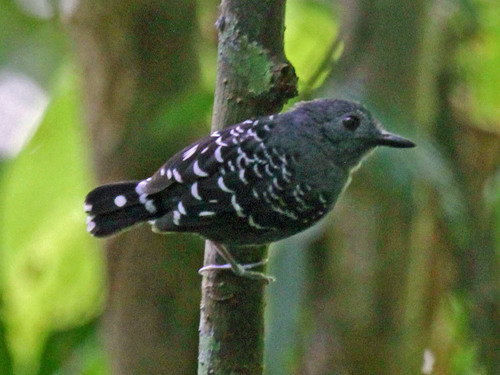
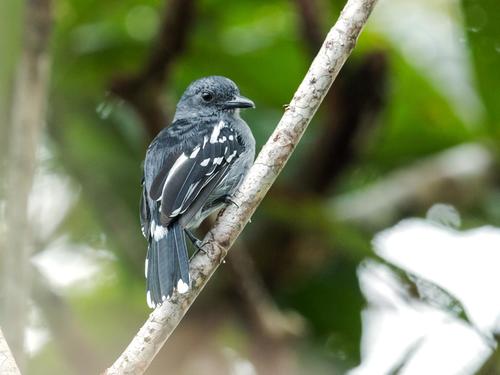
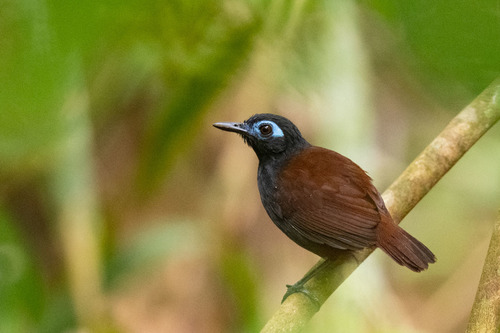
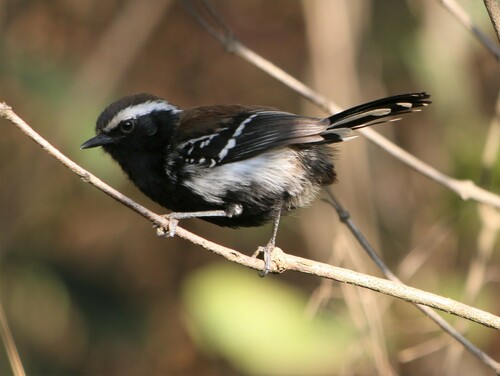
All antwrens of the genus Formicivora have relatively long tails, and males of the genus are unusual in that their underparts are darker than their upperparts. The serra antwren (Formicivora serrana) is 12 to 14 cm (4.7 to 5.5 in) long and weighs 10 to 13 g (0.35 to 0.46 oz). For the nominate subspecies F. s. serrana, adult males have a white supercilium that extends down the neck, along the sides of the breast, and becomes wider and grayer on the flanks. Their crown and upperparts are rufous-brown, with white edges on the outer scapulars and a hidden white patch between the scapulars. Their wings are brownish black, with white tips on the coverts, blackish bases on the flight feathers, and cinnamon-brown edges on the tertials. Their tail is black, with white feather tips that increase in size from the central feathers to the outer feathers. Their face, throat, and underparts are black, with white underwing coverts. Adult females of the nominate subspecies have a wide black band through the eye, and their underparts are entirely creamy white. Males of the subspecies F. s. interposita and F. s. littoralis differ significantly from nominate males. Males of F. s. interposita have very dark brown to black upperparts, a narrow and broken white supercilium, very small white tips on the wing coverts, and no white on the underparts. Males of F. s. littoralis also have very dark brown to black upperparts, with little to no supercilium, almost no white on the tail, no white on the underparts, and smaller white tips on the flight feathers than the other two subspecies. Females of F. s. interposita and F. s. littoralis are almost identical to one another. They differ only slightly from nominate F. s. serrana females, having pale buff rather than creamy white underparts. The three subspecies of serra antwren have separate distributions: F. s. serrana is found from eastern Minas Gerais to central Espírito Santo, F. s. interposita is found in the Paraíba do Sul valley in far southeastern Minas Gerais and northwestern Rio de Janeiro state, and F. s. littoralis occurs separately from the other two in coastal Rio de Janeiro state, including on nearshore islands. A 2011 survey collected F. s. serrana individuals in northern Espírito Santo, extending this subspecies' range approximately 200 km (120 mi) farther north than previously documented. It remains unclear whether these birds form a separate population, or are part of a somewhat continuous distribution across areas with suitable habitat. Subspecies F. s. serrana and F. s. interposita live in the understorey at the edges of semi-humid evergreen forest, secondary woodland, and drier scrublands. F. s. serrana specifically favors stunted forest on poor rocky soils, up to 1,550 m (5,100 ft) above sea level. F. s. interposita specifically favors secondary woodland near the Paraíba do Sul and in nearby foothills, and only reaches elevations of 700 m (2,300 ft). Both of these subspecies have colonized Eucalyptus plantations in Minas Gerais. Subspecies F. s. littoralis occurs only in restinga, a biome of the sandy coastal plain that is characterized by dense scrub, cacti, and bromeliads.