About Formicivora rufa (Wied-Neuwied, 1831)
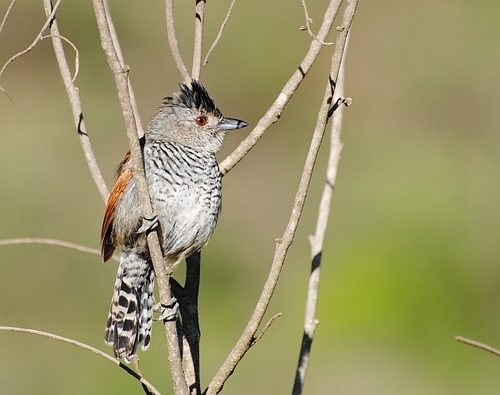
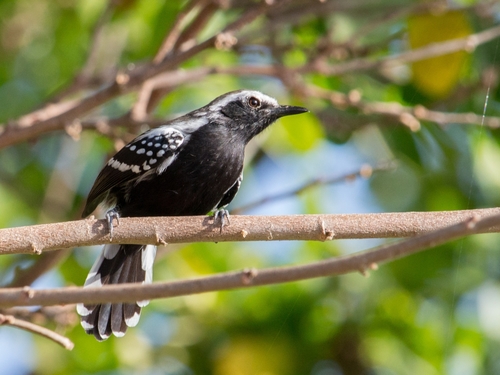
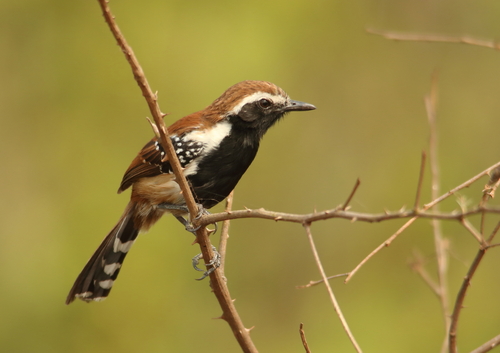
The rusty-backed antwren, scientifically named Formicivora rufa (Wied-Neuwied, 1831), is 12 to 13 cm (4.7 to 5.1 in) long and weighs 11.5 to 14 g (0.41 to 0.49 oz). Males of all three of its subspecies have a tawny rufous crown and upperparts. They have a white supercilium, while the rest of the face and the throat are black. The middle of the breast is black, with a white edge that separates this black area from the bird's cinnamon-buff flanks, and the belly is white. Lines of white dots are visible on the folded wings. The tail feathers are black, with chestnut fringes, white sides, and white tips. The female of the nominate subspecies has paler rufous upperparts than the male. Its face, throat, and chest have black and white streaks, and the rest of its underparts are cinnamon. The female of F. r. urubambae has much heavier streaking on the underparts than the nominate subspecies, and its tail is blacker. The female of F. r. chapmani is intermediate in appearance between the other two subspecies, but closer in appearance to F. r. urubambae. The nominate subspecies of rusty-backed antwren has a wide distribution across south-central and eastern Brazil, extending from the Atlantic Ocean west into extreme southeastern Peru, most of eastern Bolivia, and central and northeastern Paraguay. F. r. urubambae occurs discontinuously in the Peruvian departments of San Martín, Ucayali, and Cuzco. F. r. chapmani occurs discontinuously in southern Suriname and a few east-central states of Brazil. The species is believed to be resident throughout its entire range. The rusty-backed antwren lives in a variety of semi-open to open landscapes, including cerrado, campos with scattered trees, white sand forest, and scrublands. Its elevation range extends from sea level in the eastern part of its range up to 1,450 m (4,800 ft) in Peru and Bolivia.