About Formicivora melanogaster Pelzeln, 1868
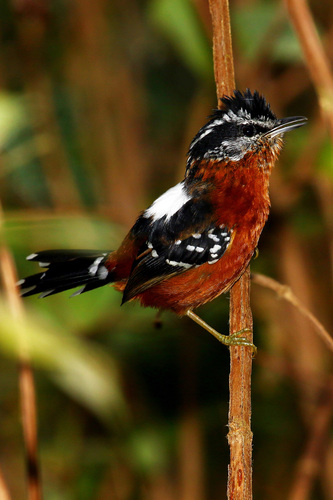
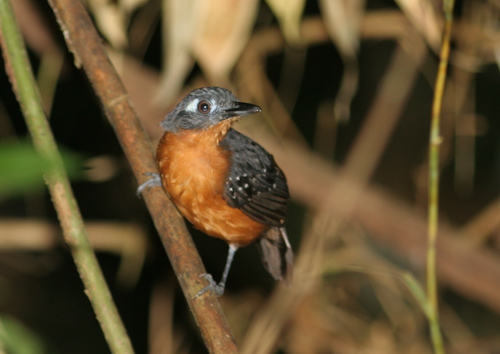
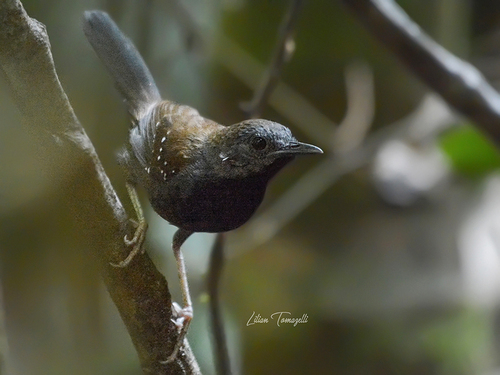
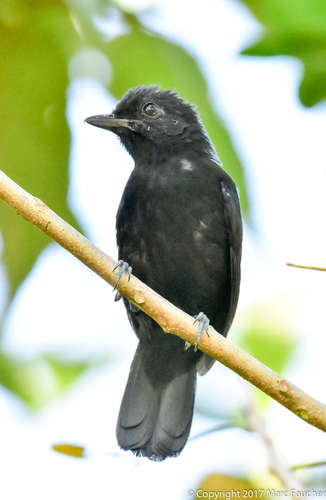
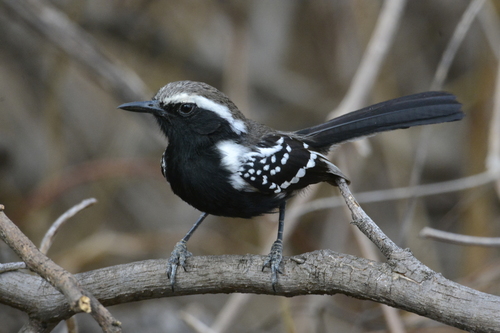
The black-bellied antwren (scientific name Formicivora melanogaster Pelzeln, 1868) measures 12 to 14 cm (4.7 to 5.5 in) in length. Adult males of the nominate subspecies have a wide white supercilium that extends down the neck, along the side of the breast, and widens on the flanks. Their crown and upperparts are dark grayish brown, with white edges on the outer scapulars and a hidden white patch between the scapulars. Their wings are blackish with white tips on the coverts, and their tail is black with white feather tips that grow larger from the central feathers out to the outer feathers. Their face, throat, and underparts are black, and their underwing coverts are white. Adult females have a browner crown and back than males, with little or no white between the scapulars. They have a wide black band running through the eye, a white throat, and white underparts with a faint buff tinge. Males of subspecies F. m. bahiae have a wider white line between the supercilium and the breast, paler upperparts, and smaller white spots on the tail than the nominate subspecies. Females of F. m. bahiae are identical to the nominate subspecies. The nominate subspecies of the black-bellied antwren is the more southerly of the two subspecies and has a wider distribution. It occurs in central Brazil, ranging from southern Bahia, northern Minas Gerais, and western São Paulo states west through far northern Paraguay into southeastern Bolivia's departments of Santa Cruz, Chuquisaca, and Tarija. Subspecies F. m. bahiae is found in northeastern Brazil, in an area roughly bounded by extreme eastern Maranhão, Rio Grande do Norte, and northern Bahia. The black-bellied antwren lives in the understorey to mid-storey of tropical deciduous forest, gallery forest, caatinga scrublands, and the ecotone between caatinga and cerrado. It also occurs in mata-de-cipó, a biome defined by a relatively open understorey and a small number of large emergent trees that stand above a dense mid-storey.