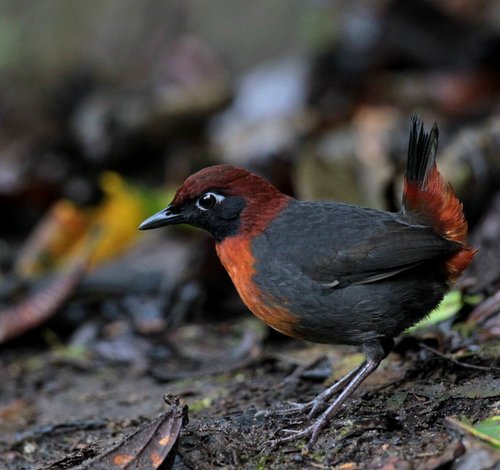
About Formicarius rufipectus Salvin, 1866
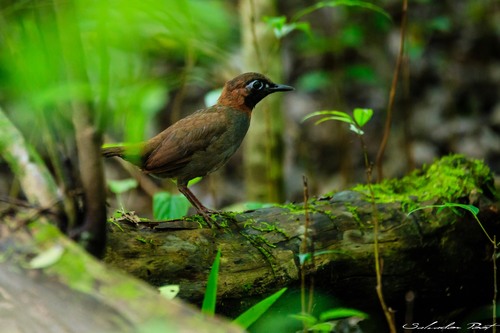
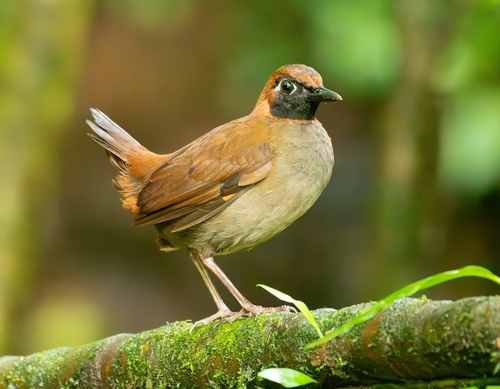
The rufous-breasted antthrush (Formicarius rufipectus Salvin, 1866) measures 18 to 19 cm (7.1 to 7.5 in) in length. Males weigh 70 to 78 g (2.5 to 2.8 oz), while females weigh 65 to 82 g (2.3 to 2.9 oz). Both sexes share identical plumage. For adults of the nominate subspecies F. r. rufipectus, the crown, nape, and sides of the neck are dark chestnut. The face and throat are blackish, and a ring of bluish white bare skin surrounds the eye. The back and wings are dark brown, the rump and uppertail coverts are dark rufescent brown, and the tail is blackish. The flight feathers have dusky inner edges and a wide cinnamon band at their base. The breast is rufous-chestnut, the belly is pale rufous, the flanks are olive-brown, and the vent area is dark chestnut. Their iris is brown or reddish brown, their bill is black, and their legs and feet are dusky brown or dark gray. Subspecies F. r. carrikeri has a dusky forecrown, more slaty upperparts, and paler underparts than the nominate subspecies. F. r. lasallei has a black crown and less red on the head than the nominate. F. r. thoracicus has a black crown, less red on the head than lasallei, and a more olive (less rufous) belly than the nominate. The rufous-breasted antthrush has a disjunct distribution, with each subspecies occupying a separate range: F. r. rufipectus is found on the Caribbean slope of Costa Rica from southern Guanacaste Province south, continuing across the Caribbean and Pacific slopes of Panama to Veraguas Province, with a separate population in eastern Panama's Darién Province; F. r. carrikeri ranges across Colombia's Western and Central Andes, and extends south through western Ecuador as far as El Oro and western Loja provinces; F. r. lasallei is found in two separate areas of Venezuela: the Sierra de Perijá in the northwest, and far western Táchira further south; F. r. thoracicus ranges from eastern Ecuador south to Peru's Department of Cuzco. This species inhabits humid to wet primary forest and mature secondary forest, and favors ravines, regrown landslide scars, steep slopes, and other areas with dense undergrowth. Its elevation range differs by country: between 800 and 1,800 m (2,600 and 5,900 ft) in Costa Rica, between 1,200 and 2,400 m (3,900 and 7,900 ft) in Colombia, mostly between 1,100 and 2,000 m (3,600 and 6,600 ft) in Ecuador, between 1,100 and 1,850 m (3,600 and 6,100 ft) in Peru, and between 1,100 and 2,200 m (3,600 and 7,200 ft) in Venezuela.