About Formicarius moniliger P.L.Sclater, 1857
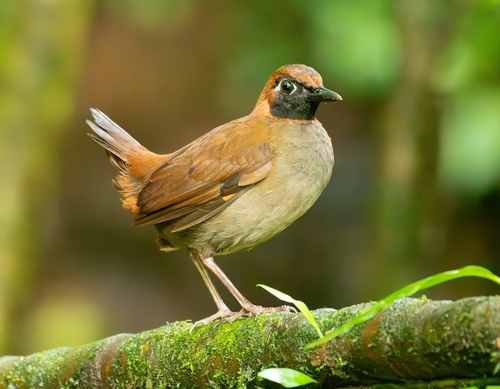
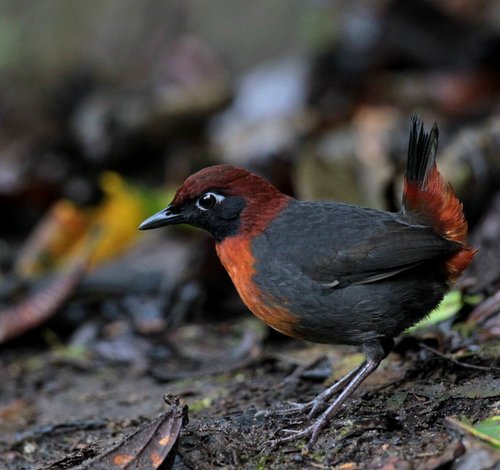
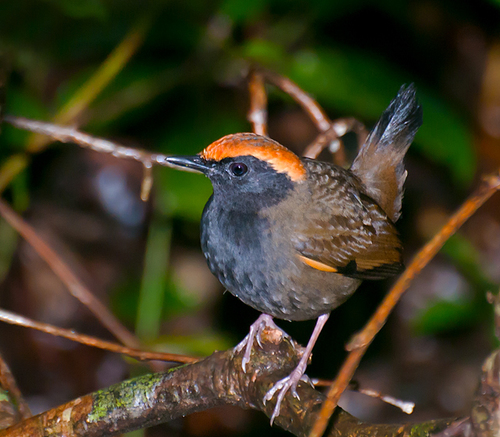
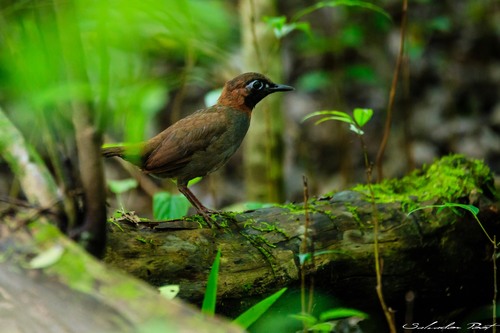
The Mayan antthrush (Formicarius moniliger P.L.Sclater, 1857) measures 15 to 19 cm (5.9 to 7.5 in) long and weighs approximately 56 to 64 g (2.0 to 2.3 oz). Males and females have identical plumage. Adults of the nominate subspecies have a dusky brown crown, a small white spot on the lores, and bare bluish skin surrounding the eye. The area of the face from the bill to the eye is black, and this black color extends downward to include the chin and throat. The sides of the neck are rufous, and this rufous coloring continues across underneath the black throat. The nape, back, rump, and uppertail coverts are brown, with a rufescent tinge on the uppertail coverts. The flight feathers are brown with dusky inner edges and a wide cinnamon band at the base. The tail is blackish brown. The upper breast and most of the remaining underparts are a uniform gray. The flanks have a brown wash, and the undertail coverts are dull brownish. This subspecies has a dark brown iris, a black bill, and gray to bluish legs and feet.
Subspecies F. m. pallidus is much paler than the nominate subspecies; its breast is light gray and its mantle is light olive brown. Subspecies F. m. intermedius is also paler than the nominate subspecies, with a mouse gray breast and an umber mantle.
The nominate subspecies of Mayan antthrush occurs on the Caribbean slope in the southeastern Mexican states of Veracruz, Oaxaca, Tabasco, and Chiapas. F. m. pallidus is found from the Yucatan Peninsula into northern Guatemala. F. m. intermedius is found on the Caribbean slope from Belize and eastern Guatemala to central Honduras. The species primarily lives in humid evergreen, semi-deciduous, and deciduous forest, and it also occurs in coffee plantations and mature secondary forest. Its elevational range extends from sea level to approximately 1,800 m (5,900 ft).