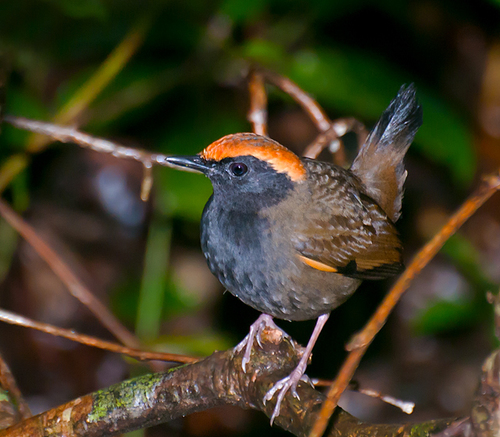
About Formicarius colma Boddaert, 1783
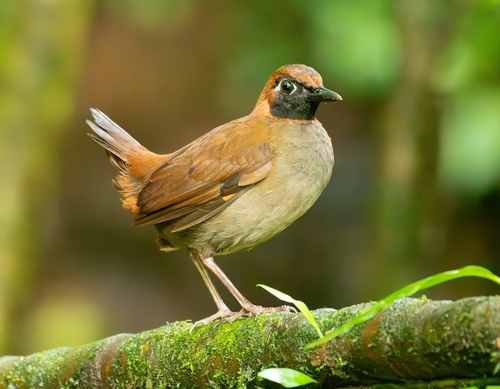
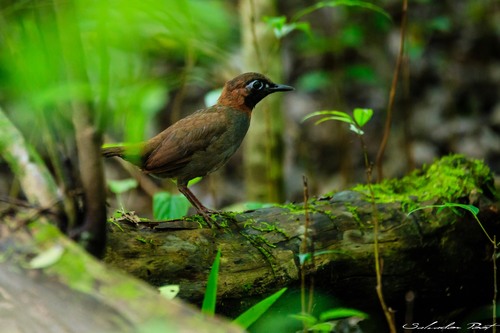
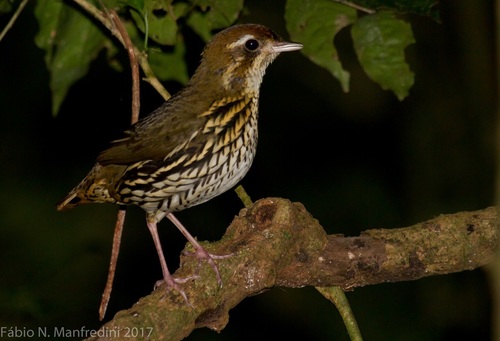
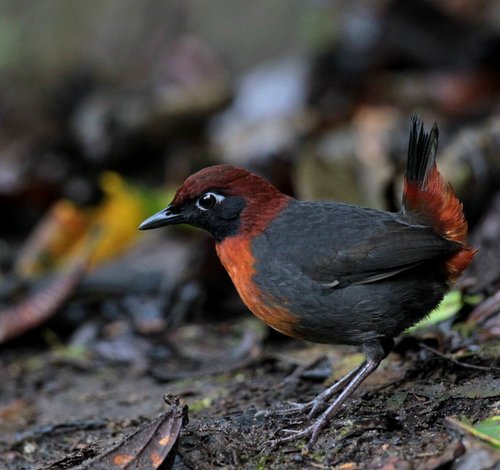
Formicarius colma, commonly called the rufous-capped antthrush, is generally a small bird. It averages around 18 cm in length; males weigh between 38 and 49 grams, while females weigh between 41 and 49 grams. Males have a black forehead, rufous (red-brown) crown and nape, with the crown holding a variable amount of black feathers. Their back, rump, and wings are olive-brown, with a dusky brown tail, and black on the neck, throat, and sides of the head. The upper breast is dark black, which blends into dark gray on the lower breast, while the belly and flanks are paler gray, occasionally with a brown wash. Underwing coverts have a mix of black and cinnamon, and the inner webs of the remiges are dusky with a broad cinnamon bar across the base. Facial features include a brown iris and black bill, while the tarsus ranges from light gray-brown to purplish-gray. Females are largely identical to males, except they have a white throat instead of the black throat seen in males. The four recognized subspecies differ slightly from one another. Subspecies nigrifrons largely resembles the nominate subspecies colma but has more black on the head. Subspecies amazonicus resembles nigrifrons but is smaller, with a deeper rufous-colored head, a shorter tail, and browner upperparts. Subspecies ruficeps has an extensively rufous head. Juvenile rufous-capped antthrushes have a white throat, similar to adult females, and have black spotting across their plumage. The song of the rufous-capped antthrush is typically a fast, even-paced trill 4 to 6 seconds long, with around 14 notes per second. The song falls between 2.2 and 3kHz, a frequency that has been speculated to be optimal for communication in thick, humid underbrush. The species' call is described as a single, clear "psee-eh" or "pier," while the song is transcribed as "re-e-e-e-e-e-e-e-e-e-e-e-e-e-ee-ee-ee-ee-ee". In terms of distribution, the nominate subspecies F. c. colma is found in east Colombia (south of Vaupés), south and east Venezuela, the Guianas, and in Brazil north of the Amazon. Subspecies F. c. nigrifrons occurs east of Ecuador, east of Peru, north of Bolivia (south to La Paz), and south of the Amazon. Subspecies F. c. amazonicus is found in Brazil south of the Amazon, from east of the Madeira River to northern Maranhão, and south of Ji-Paranã in Mato Grosso. Subspecies F. c. ruficeps is found on coastal eastern and southeastern Brazil, ranging from Pernambuco to Rio Grande do Sul. The rufous-capped antthrush is widespread across its range, and predominantly prefers the cool, shady floor of terra firme forests, though it can occasionally be found in traditional forests and savanna forests. While the species generally occupies lowlands up to 500m, and occurs locally up to 1100m, interspecies aggression between the rufous-capped antthrush and Formicarius analis has been observed to cause altitudinal displacement: F. colma flees to higher, drier ravines and ridges, while F. analis occupies the lower lands. Additionally, in Manu, the larger, more population-dense black-faced antthrush dominates over the rufous-capped antthrush. Though the two species frequently overlap due to the large distribution of F. colma, the song of F. colma has been reported to trigger an aggressive response from the black-faced antthrush, while the black-faced antthrush's song causes F. colma to retreat. This provides further evidence of interspecific aggression. Other than the effect of interspecies aggression, the factors that control the rufous-capped antthrush's distribution are poorly understood, as the species is believed to be sedentary. The diet of the rufous-capped antthrush consists of ants (Attinae) and grasshoppers (Locustidae and Tettigoniidae), and members of the genus Formicarius have also been recorded occasionally eating snakes. The species hunts by walking slowly and carefully on the forest floor, picking prey from leaf litter and flicking waste debris away with its beak. They usually hunt alone, but have been observed hunting near each other in small groups. They are frequently seen alone or in small groups on the periphery of ant swarms.