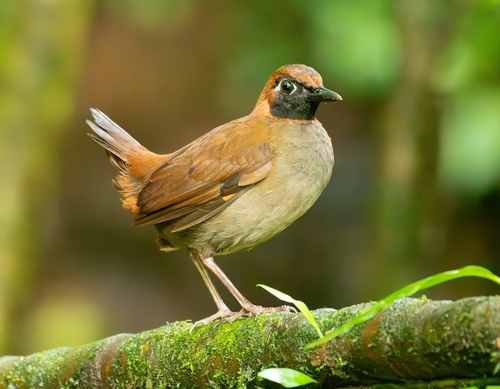
About Formicarius analis (Orbigny & Lafresnaye, 1837)
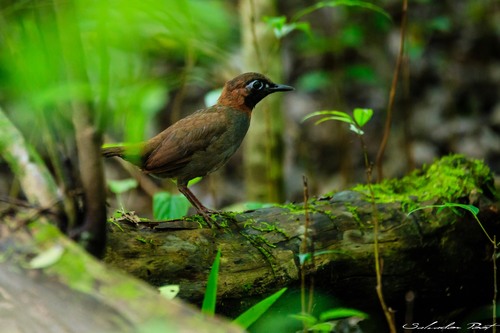
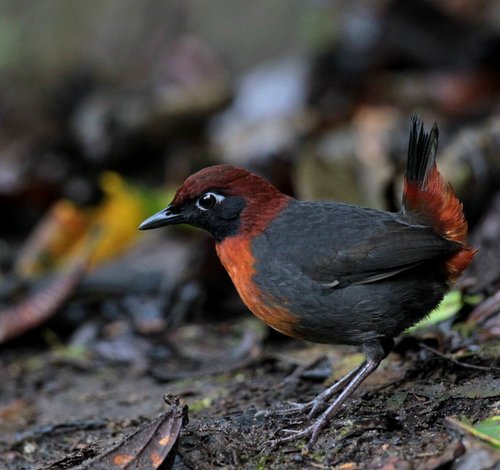
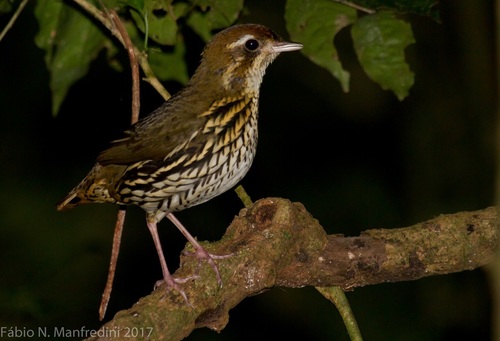
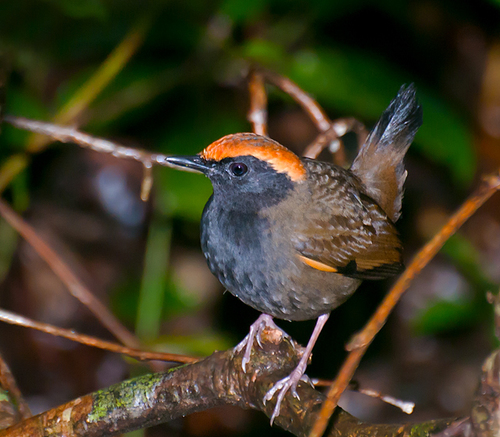
The black-faced antthrush (Formicarius analis, formally described by Orbigny & Lafresnaye in 1837) measures 15 to 19 cm (5.9 to 7.5 in) long and weighs approximately 50 to 75 g (1.8 to 2.6 oz). Males and females have identical plumage. For the nominate subspecies F. a. analis, adults have a dusky brown crown, a small white spot on the lores, and bare bluish skin surrounding the eye. The area from the bill to the eye is black, and this black color extends downward to cover the chin and throat. The remaining parts of the face, nape, back, and rump are brown. Flight feathers are brown with dusky inner edges and a wide cinnamon band at the base; wing coverts are brown with a rufescent tint. The tail is blackish brown. The upper breast is dark gray, and most of the rest of the underparts are a lighter gray that is palest at the center of the belly. Flanks have a brown wash, and the undertail coverts are rufous. This subspecies has a dark brown iris, a black bill, and gray to bluish legs and feet. Other recognized subspecies differ from the nominate and each other in the following ways: F. a. umbrosus matches the nominate but has brownish undertail coverts. F. a. hoffmanni has a pale rufescent or cinnamon crown, little to no white lores spot, and a dark cinnamon wash on its undertail coverts. F. a. panamensis has a pale rufescent or cinnamon crown, little to no white lores spot, an olive-tinged brownish breast, and tawny undertail coverts. F. a. virescens has a pale rufescent or cinnamon crown, little to no white lores spot, an olivaceous mantle, an olive-tinged brownish breast, and tawny undertail coverts. F. a. saturatus has a pale rufescent or cinnamon crown, little to no white lores spot, a cinnamon edge on the throat, a rufescent-brown mantle, a brownish gray breast, and tawny-rusty undertail coverts. F. a. griseoventris has a pale rufescent or cinnamon crown, little to no white lores spot, an olivaceous mantle, a gray breast, and tawny undertail coverts. F. a. connectens has a pale rufescent or cinnamon crown, little to no white lores spot, an olivaceous mantle, a slate-gray breast, and tawny-rusty undertail coverts. F. a. zamorae has a pale rufescent or cinnamon crown, little to no white lores spot, an olivaceous mantle, a slate-gray breast, a sooty slate vent area, and rich chestnut undertail coverts. F. a. crissalis has a pale rufescent or cinnamon crown, a prominent lores spot, vinaceous-rust ear coverts, a cinnamon edge on the throat, a rufescent-brown mantle, brownish rump and uppertail coverts, a brownish gray breast, a whitish vent area, and tawny undertail coverts. F. a. paraensis has a pale rufescent or cinnamon crown, a prominent lores spot, vinaceous ear coverts, a cinnamon edge on the throat, an olive-tinged rufescent-brown mantle, ferruginous rump and uppertail coverts, a brownish gray breast, a whitish vent area, and tawny undertail coverts. The black-faced antthrush has a disjunct distribution, with a large gap located north of the Amazon in northwestern Brazil, southern Venezuela, and eastern Colombia. Each subspecies has its own distinct range: F. a. umbrosus occurs on the Caribbean slope from eastern Honduras through Nicaragua and Costa Rica into western Panama. F. a. hoffmanni occurs on the Pacific slope from central Costa Rica to southwestern Panama. F. a. panamensis occurs from eastern Panama's Darién Province into northwestern Colombia. F. a. virescens occurs in the Sierra Nevada de Santa Marta in northeastern Colombia. F. a. saturatus occurs in Colombia's Magdalena River Valley, northwestern Venezuela north of the Orinoco River, and Trinidad. F. a. griseoventris occurs in Serranía del Perijá and nearby border areas of northeastern Colombia and northwestern Venezuela. F. a. connectens occurs east of the Andes in eastern Colombia. F. a. zamorae occurs in eastern Ecuador, northern Peru, and northwestern Brazil. F. a. crissalis occurs on the Guianan Shield from eastern Venezuela's Bolívar state east through the Guianas into northeastern Brazil north of the Amazon. F. a. analis (the nominate subspecies) occurs in the Amazon Basin of eastern and southeastern Peru, northern Bolivia, and central Brazil. F. a. paraensis occurs in southeastern Amazonian Brazil. This species inhabits primary forest and mature secondary forest, primarily favoring várzea and transitional forest, and occurring much less commonly in terra firme. In parts of Brazil, it is associated with bamboo. Its maximum recorded elevation varies by region: it reaches up to 500 m (1,600 ft) in eastern Costa Rica, up to 1,500 m (4,900 ft) in western Costa Rica, up to 1,000 m (3,300 ft) in Colombia, Ecuador, and Brazil, up to 1,150 m (3,800 ft) in Peru, up to 800 m (2,600 ft) in Venezuela south of the Orinoco, and up to 1,700 m (5,600 ft) in Venezuela north of the Orinoco.