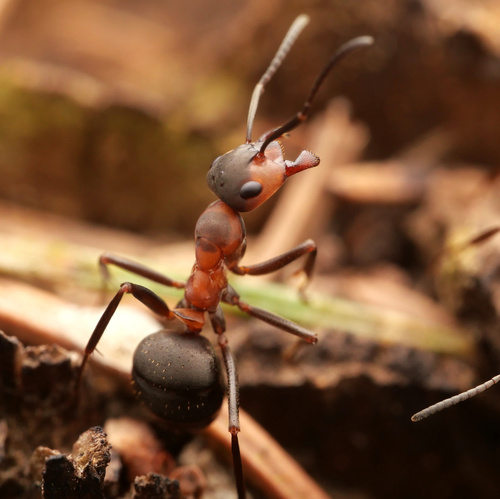
About Formica polyctena Foerster, 1850
Formica polyctena Foerster, 1850 is a species of European red wood ant that belongs to the genus Formica within the large ant family Formicidae. This species was first formally described by Arnold Förster in 1850. Its specific epithet polyctena originates from Greek, and translates literally to "many cattle"; this name refers to the species' habit of farming aphids to obtain honeydew as a food source. F. polyctena occurs across many European countries, specifically recorded in Austria, Belgium, Bulgaria, the Czech Republic, Estonia, Finland, France, Germany, Hungary, Italy, Latvia, Lithuania, Luxembourg, the Netherlands, Norway, Poland, Romania, Russia, Serbia and Montenegro, Slovakia, Spain, Sweden, Switzerland, and Ukraine. It is a eusocial species with a distinct caste system made up of sterile worker ants and a very small reproductive caste. This ant uses a genetically based cue to distinguish between nestmates and foreign individual ants. When encountering foreign invading ants, F. polyctena has an alarm activation system: it can release pheromones that trigger an alarm response in other nearby ants of the same species.