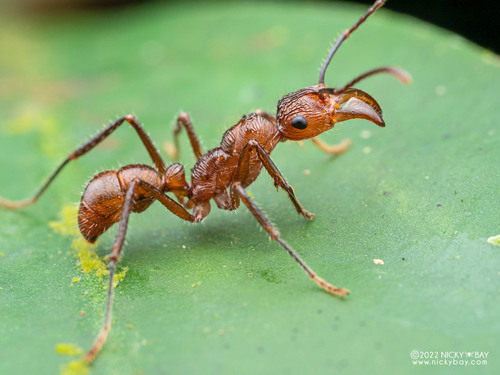
About Formica exsectoides Forel, 1886
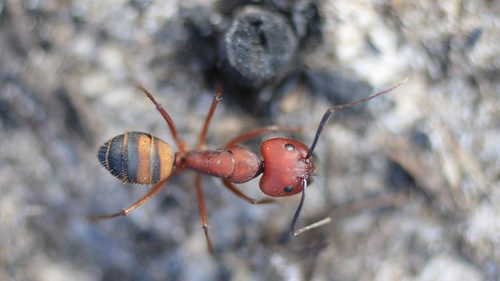
The Allegheny mound ant (Formica exsectoides) is an ant species native to the Atlantic region of North America. Its native range stretches from Nova Scotia down to parts of Georgia. Like other field ants, this species builds large mounds, and it tends to create some of the largest mounds among this group. To keep their mounds fully exposed to sunlight, the ants kill surrounding vegetation within 40 to 50 feet (12 to 15 meters). They achieve this by injecting formic acid into plant stems, which kills small trees and shrubs. All members of the formic acid-producing genus Formica are known to have a citrus taste. The Allegheny mound ant has a very striking appearance: both its head and thorax are red-orange, while its gaster is black-brown. This species forms complex ant colonies, where multiple separate mounds may be interconnected. Tunnels can extend 3 feet (0.91 m) deep into the ground, while the mound itself can reach 4 feet (1.2 m) above ground. The mound functions as a solar incubator for the species' eggs and larvae. Unlike most other ant species, Allegheny mound ant colonies have multiple queens. Development from an egg to a fully mature adult takes between 2.5 and 3 months. The ants hunt a wide variety of arthropods to get protein, and they collect aphid honeydew to obtain sugars. They are very aggressive and will bite if their mound is disturbed. In the Northeastern United States, Allegheny mound ants are recorded to cause stem lesions on small young trees of many species, including both hardwoods and conifers such as white pine and Scots pine. These lesions typically take the form of a deep constriction around 10 cm long on the tree's main stem. Spruces were not mentioned in these observations, and Peirson did not state whether spruces had been examined for damage. Mounds change in size based on their age; many mature mounds reach 1 meter in height and 2 meters in diameter. No live trees or shrubs of any height grow in close proximity to these ant mounds.