About Forficula auricularia Linnaeus, 1758
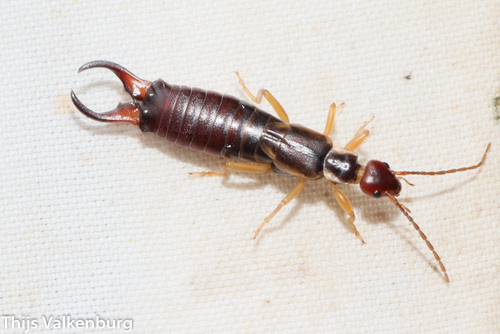
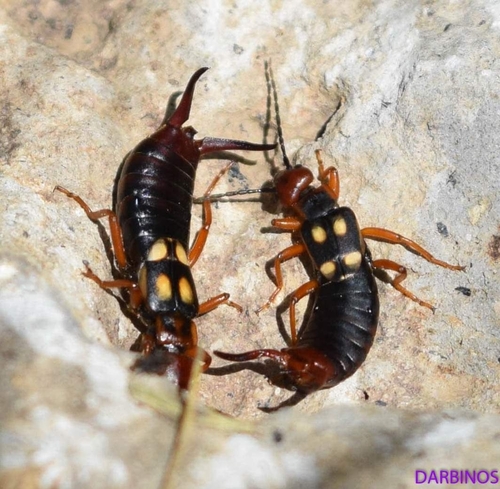
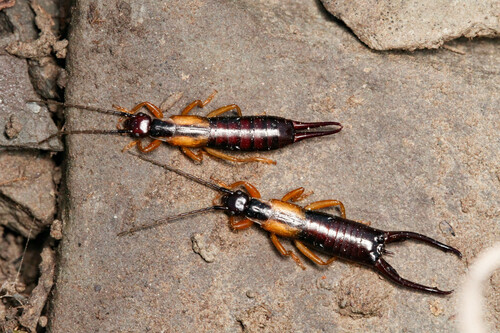
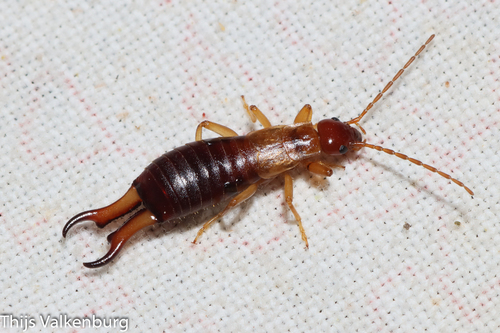
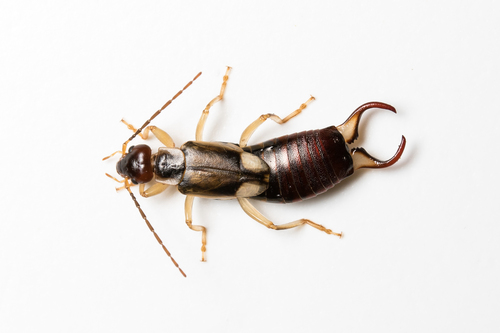
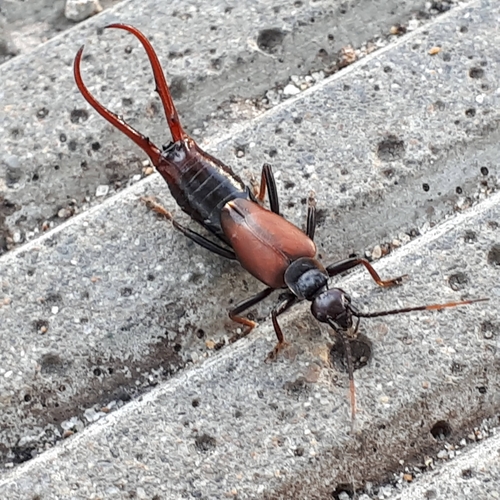
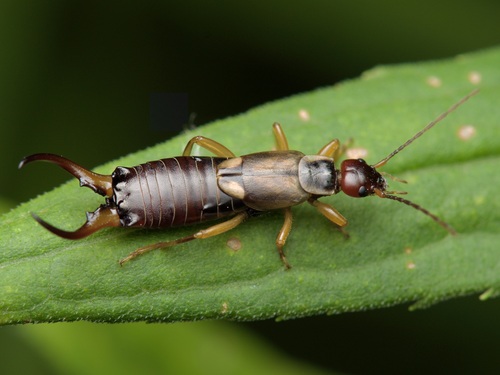
Forficula auricularia Linnaeus, 1758, commonly called the common European earwig, has elongated, flattened brownish bodies, a shield-shaped pronotum, two pairs of wings, and a pair of forceps-like cerci. Adults measure 12–15 mm (0.47–0.59 in) long. On its leg, the second tarsal segment is lobed, extending distally below the third tarsal segment. Its antenna has 11–14 segments, and it has chewing-type mouthparts. In the anatomical diagram placed to the right of this description, A marks the head, B marks the thorax, and C marks the abdomen. Numbered labels mark distinct body parts: 1 points to the pronotum, a plate-like structure that covers the thorax; 2 points to the elytra, the tough outer wings that protect the more delicate hind wings; 3 points to the delicate hind wings peeking out from under the elytra; 4 points to the abdomen; and 5 points to the cerci, the paired appendages on the abdomen of many insects. This species originated in Europe, western Asia, and possibly North Africa. It was introduced to North America in the early 20th century, and has since spread across most of the continent. It was also accidentally introduced to New Zealand by early European settlers. Common earwigs are most often found in temperate climates, as the species originated in the Palearctic region, and are most active when daily temperature fluctuation is minimal. Common earwigs thrive in cool, moist habitats, with optimal growth occurring at a mean temperature of 24 °C (75 °F). Annual daily abundance of the species in a given location is linked to temperature, wind velocity, and the prevalence of easterly winds. Development of European earwigs also depends on temperature, and the presence of the species can be predicted using weather parameters. Hibernating adult earwigs can tolerate cool temperatures, but their survival is lower in poorly drained soils like clay. To avoid excessive moisture, earwigs seek out the southern side of well-drained slopes. When soil is poorly drained, they may sometimes occupy the hollow stems of flowers. The species' eggs are resistant to damage from both cold and heat. Common earwigs can produce one or two broods per year. Females and males often hibernate together in pairs inside underground nests. Females lay their eggs at the end of winter or the beginning of spring, then expel the male from the nest. The eggs are pale yellow or cream-colored, and elliptical in shape. The mother incubates and cares for the eggs until they hatch. After hatching, nymphs go through four nymphal instars before reaching sexual maturity and adulthood. The common earwig's life cycle has two distinct phases: the nesting phase and the free-foraging phase. During the nesting phase, family units first consist of a male-female pair, then of only the female and her nymphs. Group members may leave the nest at night to forage, but the mother and her nymphs return to the nest and remain there during the day. In the free-foraging phase, different family units interact, and nymphs no longer return to their nests after foraging. Instead, nymphs go on long foraging trips and shelter in trees and crevices. At this stage, females that have finished raising their first brood may produce a second brood.