About Forestiera reticulata Torr.
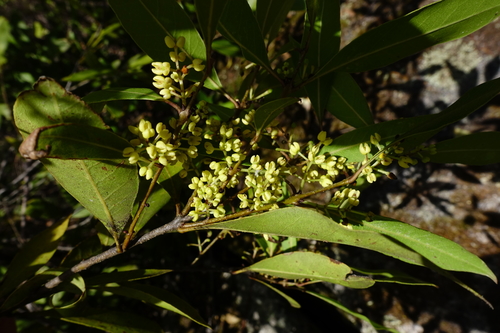
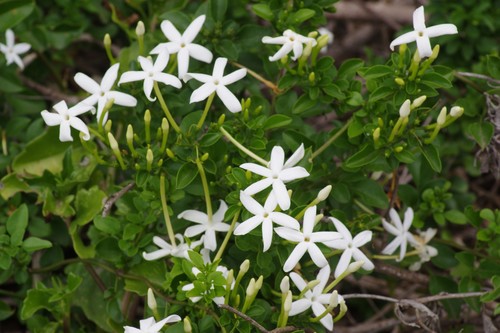
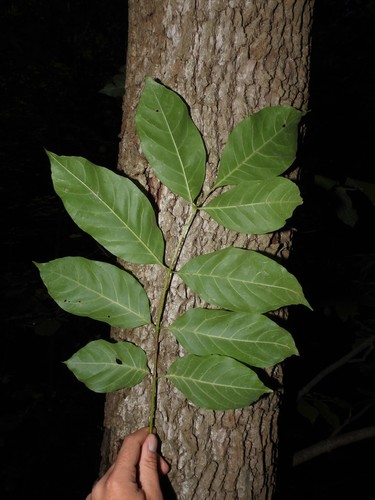
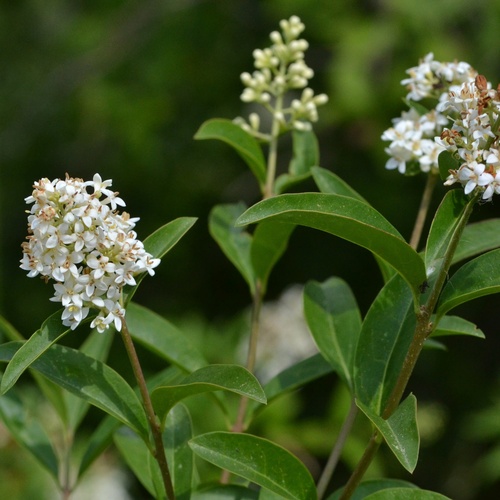
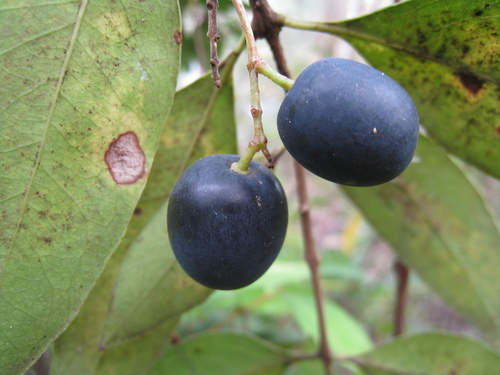
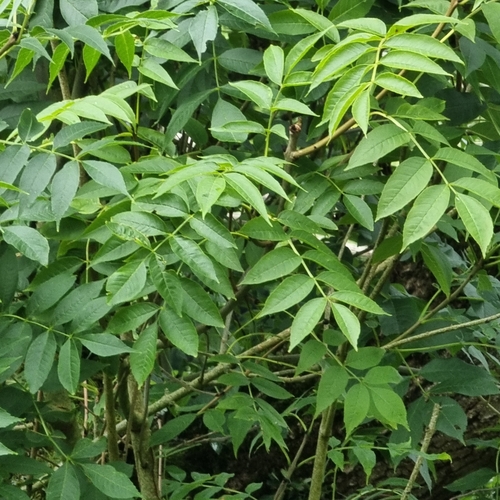
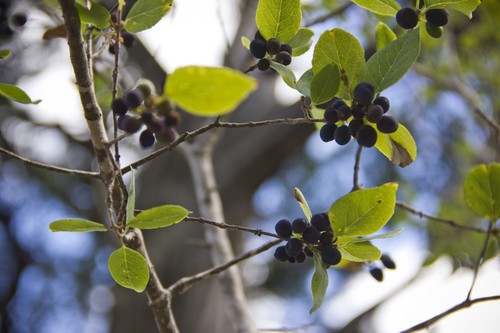
Forestiera reticulata Torr., commonly called netleaf forestiera, has several key features that help distinguish it from other species in the Forestiera genus. It can grow up to 8 meters (around 26 feet) tall, with branches that are hairless or nearly hairless, and covered in tiny whitish warts. Its short-petioled leaves grow in opposite arrangements, with leathery, undivided leaf blades ranging from egg-shaped to almost rounded, reaching up to 7.5 cm (about 3 inches) long. Leaf blade margins lack indentations or projections, though they occasionally develop a small number of tiny teeth. The blades are dark green and somewhat shiny on the upper surface, and paler on the underside; both surfaces have a distinct visible network of reticulate veins, and can range from variously hairy to completely hairless. Flowers grow in clusters of up to 9 flowers, and do not produce corollas. Each flower has 4 sepals, and is subtended by bracts that grow up to 2.5 mm (around 1/10 inch) long. Netleaf forestiera is dioecious, meaning individual plants produce flowers that are functionally either male or female. Each male flower has up to 4 stamens, with filaments reaching up to 3 mm (around 1/10 inch) long; female flowers typically have a pistil, and sometimes also develop staminodes. The fruits are drupes, ranging from ellipsoid to nearly spherical, growing up to 10 mm (2/5 inch) long. They are hairless, and often retain the original flower's style and sepals. When mature, the fruits are dark blue to black, with only a thin layer of sweet-tasting flesh (mesocarp). Netleaf forestiera is primarily a Mexican species. In the United States, it only occurs in a portion of southwestern Texas. In Mexico, it is found from the Texas border region in the states of Coahuila, Nuevo León, and Tamaulipas, south through most of the country to the southernmost state of Chiapas. It also occurs in the Mexican states of Oaxaca, Puebla, and Veracruz, but is not present in northwestern Mexico, Baja California, or the Yucatán Peninsula. In Texas, netleaf forestiera grows in rock crevices and ravines. The images on the associated page show a shrub growing on a limestone ledge in Texas at an elevation of approximately 1750 meters (around 5750 feet). In the Central Mexican Plateau, where the species is classified as a calcicole (a plant that favors calcium-rich, typically calcareous soils), it grows mainly in the pine-oak forests of the Sierra Madre Oriental. It can also be found in other relatively cool, moist mountain forests, pine forests, tropical deciduous forests, and dry scrub in the foothills. In Texas, all Forestiera species are recognized as important food sources for many species of birds and small mammals. Some Forestiera species are among the most preferred browse plants in southern and western Texas, and tend to be eliminated from areas that experience over-browsing. Livestock feed on the twigs and fruits of Forestiera species, and the flowers provide an important source of nectar for bees early in the growing season.