About Fontitrygon margaritella (Compagno & Roberts, 1984)
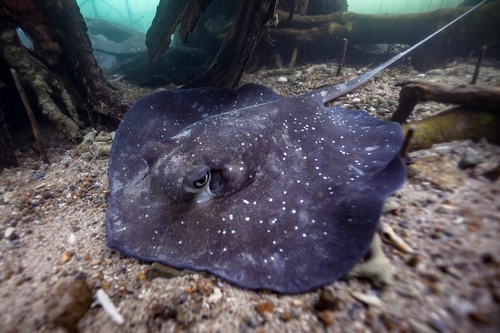
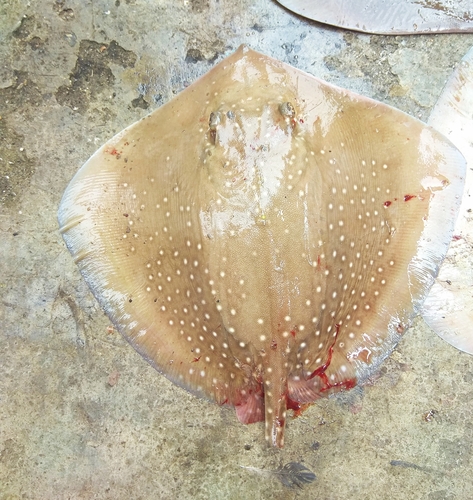
The pearl stingray (Fontitrygon margaritella) has a moderately thin, oval pectoral fin disc that is roughly as long as it is wide. Its narrow snout tapers to a point that protrudes slightly from the disc. The spiracles sit immediately behind the eyes, and are approximately the same size as the eyes. A flap of skin between the nares has a weakly curved, lobed, and fringed back margin, and a pair of grooves runs between this flap and the corners of the gently bow-shaped mouth. Five papillae are arranged in a row across the floor of the mouth. There are 24 to 41 upper tooth rows and 34 to 50 lower tooth rows. The blunt, ridged teeth form pavement-like arrangements in a quincunx pattern; adult males have longer teeth than females, but these teeth are not pointed. The pelvic fins are short and triangular, with their tips extending just slightly past the margin of the disc. The tail is broad and flattened at the base, and becomes thin and whip-like beyond the usually single, slender stinging spine located on its upper surface. Beyond the stinging spine, the tail has a low dorsal keel and a well-developed ventral fin fold. A medium-sized oval pearl spine sits in the center of the ray's back. Rays with a disc width over 13–14 cm (5.1–5.5 in) also develop a band of small, heart-shaped or flattened circular dermal denticles that covers the median third of the disc, running from between the eyes to the base of the tail. The section of the tail behind the stinging spine is covered in small prickles. The dorsal side of the ray is plain grayish brown, and its ventral side is entirely white. This species is the smallest stingray found in West Africa, growing to a maximum disc width of 30 cm (12 in) and a maximum weight of 1 kg (2.2 lb). The pearl stingray can be distinguished from the daisy stingray by its much smaller overall size, relatively smaller oval pearl spine, higher number of tooth rows, and fewer pectoral fin radials (113–127 compared to 129–136 in the daisy stingray). The pearl stingray occurs along the western coast of Africa, ranging from Cape Blanc in Mauritania to Angola. A bottom-dwelling species, it lives in shallow coastal marine and brackish waters, and has been recorded in lagoons, estuaries, including the mouth of the Congo River. Very little is known about the natural history of the pearl stingray. Like other stingrays, it is aplacental viviparous, and females likely produce litters of 1 to 3 pups. Individuals reach sexual maturity when their disc width is approximately 20 cm (7.9 in).