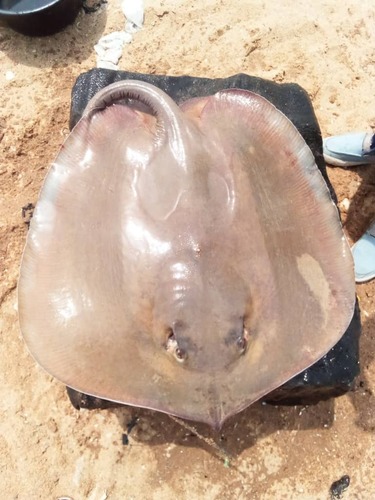
About Fontitrygon margarita (Günther, 1870)
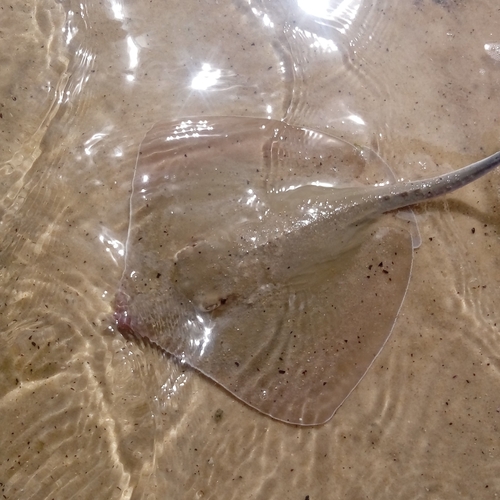
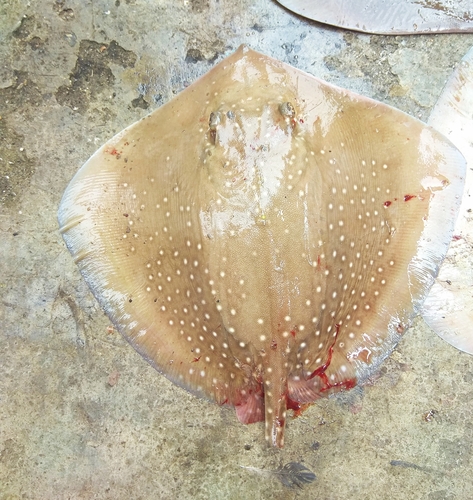
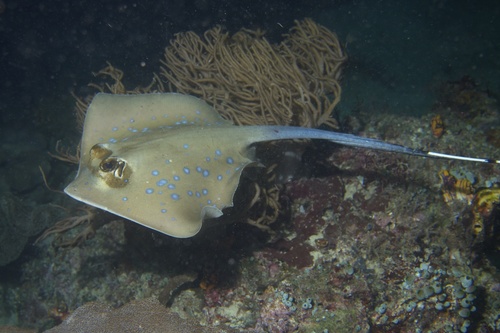
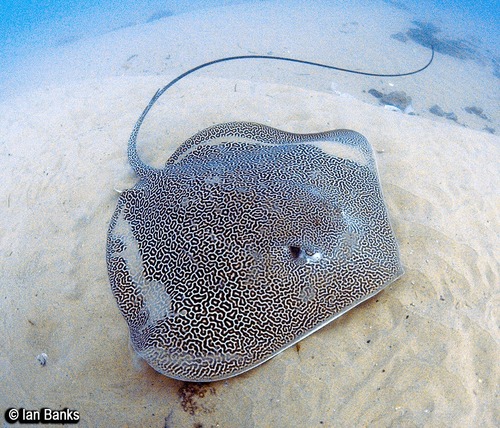
The pectoral fin disc of the daisy stingray (Fontitrygon margarita) is moderately thin, rounded, and approximately as wide as it is long. The leading margins of the disc are concave, converging at a pointed, slightly projecting snout tip. The species has medium-sized eyes, followed by somewhat larger spiracles. A curtain of skin sits between the nares, with a fringed, subtly three-lobed posterior margin; a pair of shallow grooves run from this skin flap to the corners of the bow-shaped mouth. Five papillae are arranged in a transverse row across the mouth floor, with the outermost pair spaced apart from the other three. There are 24 to 32 tooth rows in the upper jaw and 28 to 36 tooth rows in the lower jaw, arranged in a quincunx pattern to form pavement-like surfaces. The pelvic fins are short, with their tips projecting just past the disc margin. The tail is longer than the disc, and usually has a single long, thin stinging spine on its upper surface. The tail is broad and flattened at the base, becoming slender and whip-like after the spine, with a low dorsal keel and a well-developed ventral fin fold. A large, circular pearl spine sits at the center of the disc. Young daisy stingrays have otherwise smooth skin, while older individuals with a disc width over 20 cm (7.9 in) develop a wide band of small, flattened, circular dermal denticles covering the median third of the back from between the eyes to the tail base, plus small prickles covering the tail behind the sting. This ray is plain grayish brown on its upper surface and whitish below. The maximum known disc width for this species is 1 m (3.3 ft), with a maximum weight of 17 kg (37 lb), though most individuals have a disc width no larger than 60 cm (24 in). Females grow larger than males. Compared to the related pearl stingray, the daisy stingray is much larger, and can be distinguished by its relatively larger, round pearl spine, fewer tooth rows, and more pectoral fin radials (129–136 versus 113–127). The confirmed known range of the daisy stingray runs from Senegal to the Democratic Republic of the Congo; records of the species occurring as far north as Mauritania or as far south as Angola are likely mistaken, based on misidentification of the pearl stingray. This bottom-dwelling species lives in marine and brackish waters with a salinity between 20 and 40 ppt. It prefers sandy habitats in shallow coastal waters down to a depth of 60 m (200 ft), though most individuals are found between 11 and 20 m (36 and 66 ft) deep. The daisy stingray has been reported to frequent lagoons and estuaries, but this observation has not been confirmed due to past confusion with the pearl stingray. Little is known about the natural history of the daisy stingray. It feeds mainly on shrimp, crabs, bivalves, and annelid worms. Off the coast of Nigeria, around three-quarters of the species' diet consists of the shrimp Farfantepenaeus duorarum. Like other stingrays, the daisy stingray is aplacental viviparous. Females produce litters of 1 to 4 pups, and coastal lagoons and estuaries act as breeding grounds for the species. Reproductive activity peaks during the rainy season from April to September, which likely aligns with higher prey abundance in this period.