About Fomes fasciatus (Sw.) Cooke
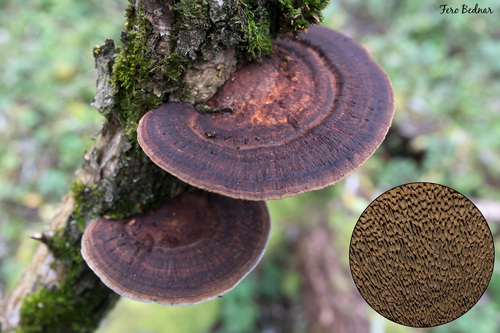
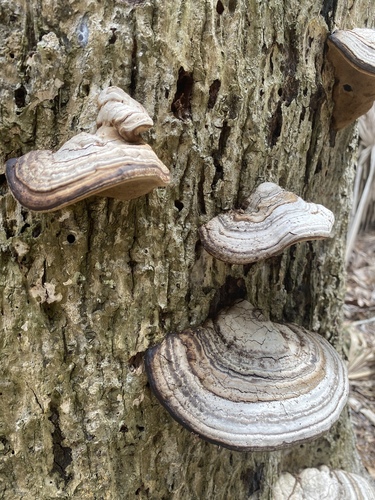
This fungus, Fomes fasciatus (Sw.) Cooke, grows on both living and dead broad-leaf hardwood trees. Its fruiting body is sessile and semicircular clam-shaped, measuring 7–18 cm wide, with a flat to convex poor pore surface on its underside. The upper surface of the fruiting body has concentric zones in gray, brown, or black. When young, it is finely tomentose, and it becomes hard and smooth as it ages. The flesh can reach up to 4 cm thick at the base and is golden brown in color. Pores are circular, with 4–5 pores per millimeter; they are white when young, turn brown with age, and stain dark brown. Its spores are cylindrical, smooth, hyaline, and inamyloid, measuring 10–14 x 4–5 μm. Fomes fasciatus has a distribution ranging from subtropical regions to the southern hemisphere. It has been recorded as far north as the coastal plains of North Carolina and as far south as southern South America. Specimens have also been documented in Australia, southern Asia, and Indonesia. In North America, this fungus is commonly found growing on host trees including hackberry, hickory, maple, and oak. It has been recorded on at least ten genera worldwide, and it contributes to the loss of commercially viable wood. Ecologically, Fomes fasciatus is very similar to Fomes fomentarius. Both are economically important wood-decay fungi that grow on various hardwood trees, and both produce large, woody, clam to hoof-shaped conks that contain trimitic hyphae. However, Fomes fasciatus is largely distributed in tropical zones, while Fomes fomentarius occurs in more temperate regions. Fomes fasciatus is further set apart by its smaller spore size, the shape of its fruiting body, and its more convex pore surface. By contrast, Fomes fomentarius tends to be more ungulate (hoof-shaped) and shows more vertical growth. These physical features can vary greatly depending on environmental factors including host, temperature, and elevation.