About Fomes arctostaphyli Long
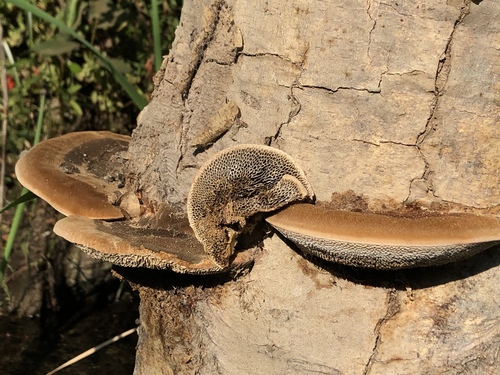
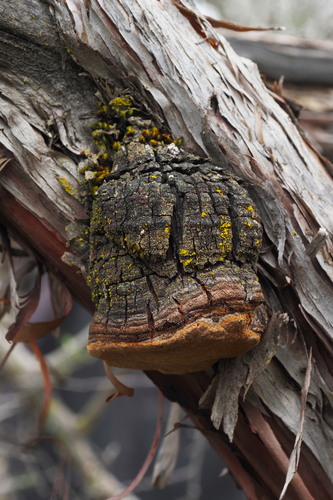
Phellinus arctostaphyli, commonly called the manzanita conk or manzanita hoof polypore, is a species of shelf fungus. It is native to western North America, and this saprotrophic fungus only colonizes the wood of plants from the genera Ceanothus, Adenostoma, and Arctostaphylos. P. arctostaphyli is closely related to three other North American Phellinus species, including Phellinus tremulae and Phellinus tuberculosus. However, in part because of the "economic insignificance of its hosts", P. arctostaphyli remains relatively poorly studied as a distinct species. Its fruiting bodies, called conks or hoofs (basidiocarps), grow perennially. They are tough and woody, with tiny pores on their underside, and black to gray concentric rings on their upper surface that tend to fracture longitudinally. This species was first formally described by William Henry Long in 1917 under the name Fomes arctostaphyli. In 1954, mycologist Josiah L. Lowe proposed that it was a synonym of Fomes igniarius. Tuomo Niemelä reclassified it into the genus Phellinus in 1975. The presence of P. arctostaphyli has been linked to manzanita mortality in Mexico.