About Fluvicola pica (Boddaert, 1783)
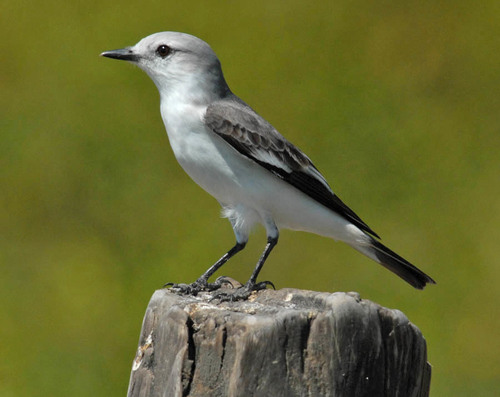
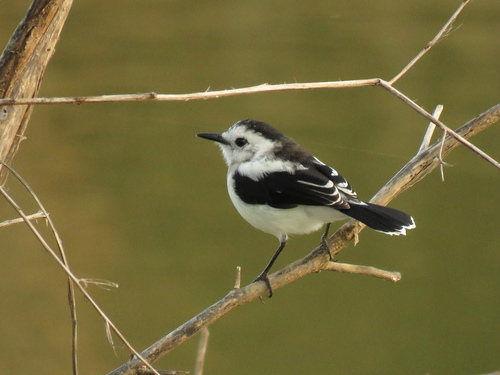
The pied water tyrant (Fluvicola pica) measures 12.5 to 13.5 cm (4.9 to 5.3 in) in length and weighs 11 to 16 g (0.39 to 0.56 oz). Both sexes have prominent rictal bristles, a dark iris, a sharply hooked black bill, and black legs and feet. Adult males are mostly white: they have a black hindcrown and nape, a mottled black and white back, black wings with small white tips on the tertials, a black tail with small white tips, and entirely white underparts. Females have brown mixed into the black on the hindcrown, nape, and back. Juveniles share the same pattern as adults, but are brown in all areas where adult birds are black. The pied water tyrant has a disjunct distribution that has not been fully defined. All sources agree the species is found in eastern Panama, from northern and central Colombia into northwestern Venezuela, on Trinidad, and from eastern Colombia across northern Venezuela, the Guianas, to the mouth of the Amazon in extreme northern Brazil. Sources disagree on records of the species outside this core range. The IOC, Clements taxonomy, and the North American Classification Committee of the American Ornithological Society (AOS) do not list the species from any additional countries. BirdLife International (BLI) adds Aruba, Bonaire, Curaçao, Ecuador, and Peru as countries where the species is resident. The IUCN, which generally uses BLI range data, lists the species as resident in Ecuador and Peru, and as a vagrant in Aruba, Bonaire, Sint Eustatius, and Curaçao. The Cornell Lab of Ornithology's Birds of the World references refereed papers, other published works, and eBird data to note that the species has a minor presence in Ecuador and Peru. The South American Classification Committee of the AOS lists the species as confirmed in Peru, present as a vagrant in Ecuador, and does not mention any other Caribbean islands. The pied water tyrant primarily lives in freshwater marshes and the margins of lakes and ponds; it can also be found in adjacent grasslands and gardens. Most of its population occurs below 450 m (1,500 ft) in elevation, but it can reach up to 1,000 m (3,300 ft) in Colombia.