About Flourensia cernua DC.
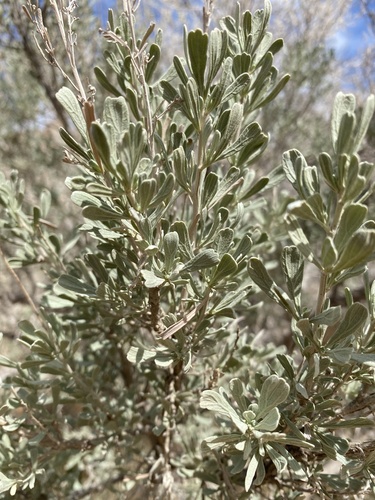
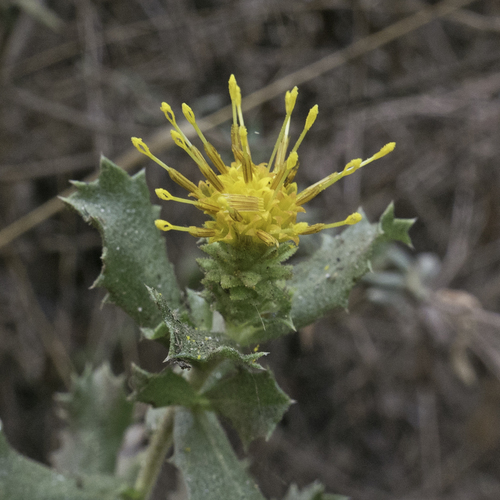
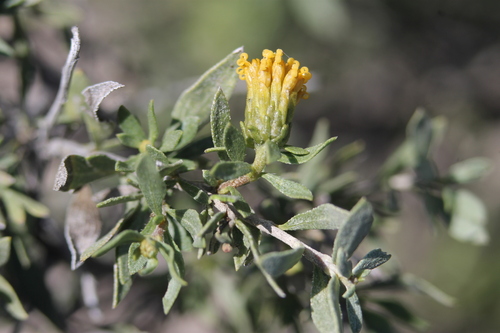
Flourensia cernua DC. is a species of flowering plant in the aster family, with English common names American tarwort and tarbush, and Spanish common names hojasé, hojasén, and hoja ancha. It is native to the Chihuahuan Desert of North America, where it occurs in the U.S. states of Arizona, New Mexico, and Texas, and the Mexican states of Sonora, Chihuahua, Coahuila, Durango, San Luis Potosí, and Zacatecas. Most species in the Flourensia genus are found in Latin America; this species and F. pringlei are the only two whose ranges extend into the United States. Flourensia cernua is a shrub that grows from a root network that can extend up to 4 meters (over 13 feet) horizontally. Most of its roots are shallow, but a few reach as deep as 5 meters (over 16 feet) into the soil. It usually reaches a maximum height of around 1 meter (40 inches), though it can grow up to 2 meters (7 feet) tall. It can grow in an erect or spreading form, with many branches that branch from the base of the stem. The branches are covered in alternately arranged, thick, oval leaves that are up to 2.5 centimeters (0.98 inches) long, sometimes reaching 4 centimeters (1.6 inches). The edges of the leaf blades are smooth or wavy. Its hanging flower heads hold several yellow disc florets and no ray florets. The fruit is a hairy achene up to 1 centimeter (0.39 inches) long including its pappus. Most parts of the plant are very resinous, with a tarlike or hoplike scent, and it has a bitter taste. Flourensia cernua is winter-deciduous across most of its range, but may keep its leaves in areas with enough moisture. Leaf production is affected by moisture levels: the plant has been observed to grow a first set of small, scalelike leaves during a dry spring, then produce a second set of larger leaves later in the season as moisture increases. Growth occurs earlier in the year when rainfall is abundant. Flowering takes place in the fall, and the plant generally produces few flowers during dry years. Its vast, mostly shallow root network with a few very deep roots helps it collect water from a wide area of soil, an adaptation to its dry native habitat. Flourensia cernua grows in desert scrub and desert grassland. It has become more abundant in these habitats in recent times due to overgrazing, which reduced native grasses, particularly grama grasses and tobosa. It is an indicator of Chihuahuan Desert scrub, which covers roughly 70% of the Chihuahuan Desert. There, it is a codominant species alongside creosotebush and viscid acacia. Other common plants associated with tarbush include whitethorn acacia, catclaw acacia, honey mesquite, Berlandier wolfberry, mariola, Wright's beebrush, littleleaf sumac, broom snakeweed, winterfat, and smooth-leaf sotol. It is part of many plant communities and is dominant in many types of desert habitats and ecotones. It is often the main shrub in landscapes otherwise populated by grasses. It can be sparse or locally abundant, growing scattered across terrain or in dense stands. It may form single-species (monotypic) stands in clay and silt soils, such as those found on bottomlands. It is most common on alluvial soils derived from limestone, which is the main parent material for soils of the Chihuahuan Desert. The species is described as long-lived. Flourensia cernua has documented medicinal uses. In Mexico, it is steeped to make a tea consumed to treat various gastrointestinal conditions including indigestion and diarrhea. It is also used to treat respiratory disorders, and its extracts have shown the ability to kill multidrug-resistant Mycobacterium tuberculosis in vitro. Its leaves and flower heads are sold in farmers' markets in Mexico and the United States. In agriculture, this shrub has been studied as a potential supplemental forage for livestock such as sheep. Its increasing abundance in the Chihuahuan Desert has sparked interest in its value as food for local domestic animals. It is similar to alfalfa in nutritional value, with a high protein content. However, it contains compounds that reduce its palatability to animals, giving it a bitter and "peppery" quality. In addition, its flowers and fruits are toxic to sheep, goats, and cattle, so livestock naturally avoid the plant. Its leaves can be consumed in moderation for their nutritional value, but a diet made up entirely of tarbush can be fatal. Compounds isolated from the plant include flavonoids, sesquiterpenoids, monoterpenoids, acetylenes, p-acetophenones, benzopyrans and benzofurans. Extracts of the plant have shown antifungal, anticyanobacterial, and antitermite effects. Many of the isolated compounds are phytotoxic.