About Florometra serratissima (AH Clark, 1907)
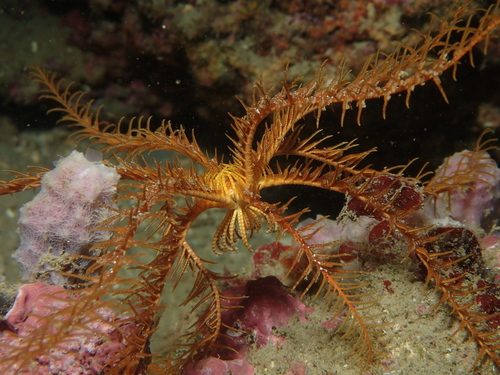
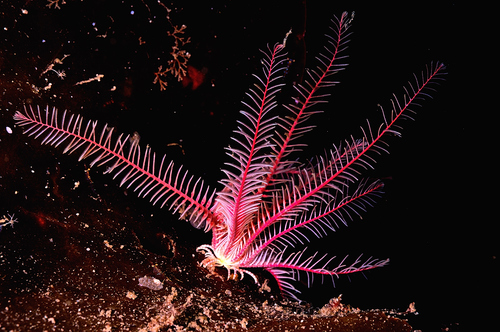
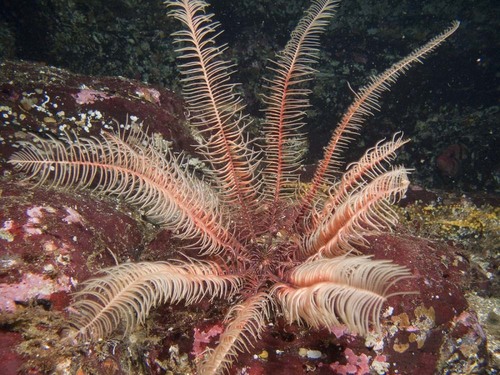
Like other feather stars, Florometra serratissima has a stalk, a calyx, and a set of arms. Its mouth sits on the upper side at the center of the calyx, with the anus located close by. Five jointed limbs surround the calyx; these branch at the base to form ten or more arms. Each arm grows jointed appendages called pinnules arranged in a feather-like pattern. A central ambulacral groove runs down the length of each arm, and cilia move food particles along this groove toward the mouth. When the arms are fully extended out to either side, this crinoid can measure 25 cm (10 in) across. Clawlike cirri on the aboral (under) surface let it grasp the seabed. This feather star is reddish-brown in color, and juvenile individuals have a long stalk. Florometra serratissima is native to the Pacific coast of North America. Its range stretches from the Shumagin Islands and Sanak Islands off Alaska southward to Isla Natividad off Baja California. It occurs at depths between 11 and 1,252 m (36 to 4,108 ft), and is most commonly found in deep water. These crinoids can live on both rocks and soft sediment. They can move around by using their cirri as feet, or swim by beating their arms. They are suspension feeders, selecting locations with strong currents and extending their arms to catch passing plankton. The arms of F. serratissima have special joints called syzygies that are meant to separate when under stress. However, when researchers grasped this crinoid, they found its arms always broke off at the base instead. If the crinoid loses an arm through autotomy or predation, it can regenerate a new arm. The speed of this regeneration does not depend on whether regrowth occurs from a long or a short stump.