About Flindersia maculosa (Lindl.) F.Muell.
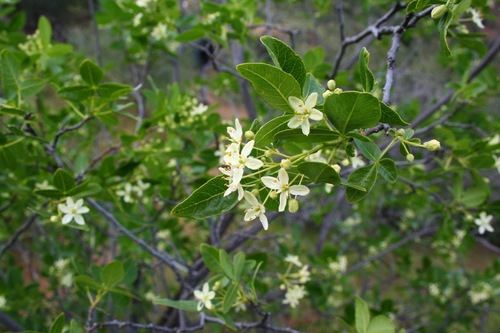
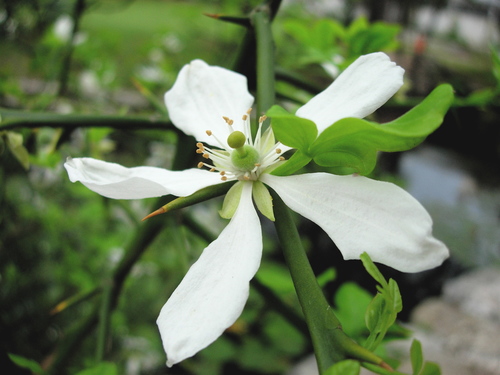
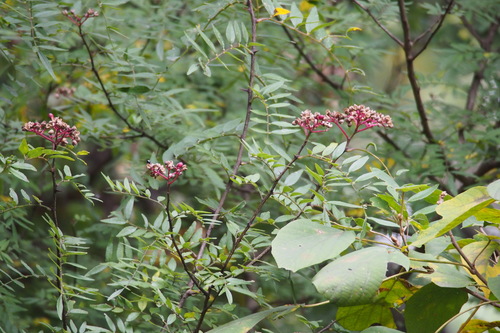
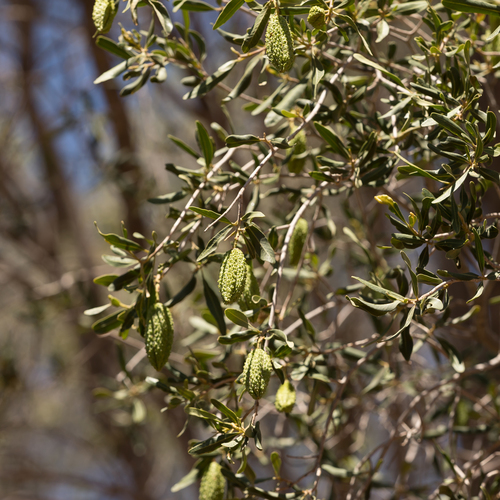
Flindersia maculosa is a tree that typically reaches 15 meters (49 feet) in height. Juvenile plants develop from a tangled mass of spiny branches, and the trunk is mottled because the bark sheds in patches. Its leaves are simple, arranged in opposite pairs, and shaped as narrow oblong, lance-shaped, or linear. The leaves are 10–80 mm (0.39–3.15 in) long and 2.5–10 mm (0.098–0.394 in) wide, growing on a petiole 2–15 mm (0.079–0.591 in) long. The upper leaf surface is shiny and dark green, while the lower surface is dull and paler. Flowers are arranged in panicles 10–80 mm (0.39–3.15 in) long at the ends of branchlets. Sepals are 1–1.5 mm (0.039–0.059 in) long, and petals are white to cream-coloured and 3–4 mm (0.12–0.16 in) long. Flowering occurs from September to December. The fruit is a woody capsule covered in rough points that splits open into five sections to release winged seeds approximately 18 mm (0.71 in) long. This species grows on stony hills and sand plains, ranging from Hughenden in central Queensland to the Riverina district in south-western New South Wales, and also from Walgett to Ivanhoe and Broken Hill within New South Wales. In its ecology, larvae of the moth Opodiphthera astrophela feed on this tree, commonly called leopardwood. An unidentified beetle in the genus Anilara can cause serious damage to leopardwood, and the mistletoe Amyema lucasii grows almost exclusively on F. maculosa. Leopardwood is a useful fodder tree during drought periods, but it does not recuperate well after heavy use, so it should only be pollarded. Its wood is sometimes used to build fence posts and pick handles. Nectar from the buds and gum from the bark have been used to make a sweet drink, and the drink made from the gum has been used as a remedy for diarrhea.