About Flavocaranx bajad
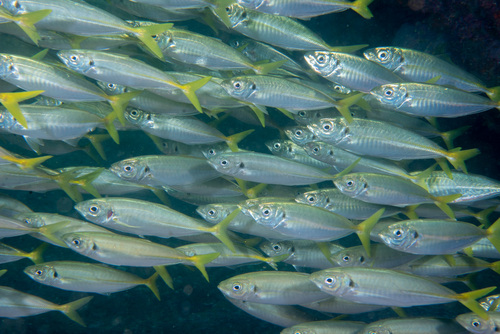
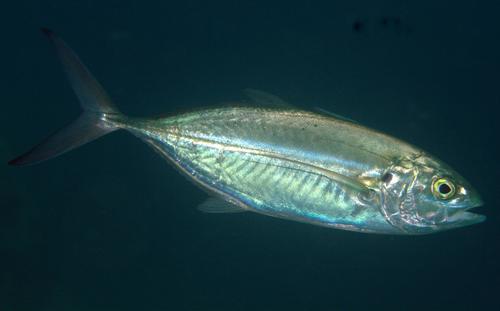
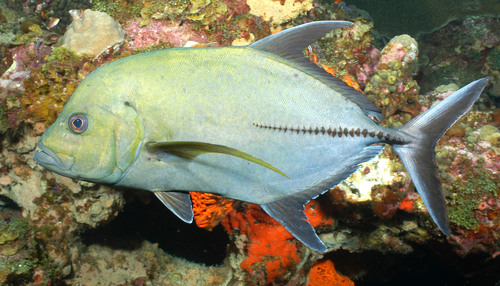
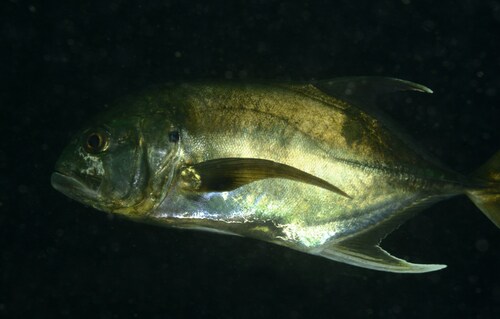
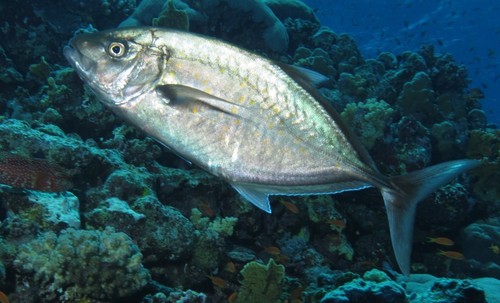
Flavocaranx bajad, commonly known as the orange-spotted trevally, has the characteristic body profile of its genus: it is moderately deep, compressed, and oblong in shape, with a dorsal profile that is more convex than the ventral profile. This is a moderately large fish. Adults typically grow to 45 to 60 cm; the largest individual ever recorded measured 72 cm, though most individuals found are smaller than 40 cm. The dorsal profile of the head is fairly straight from the snout to the nape, and the eye has a smaller diameter than the length of the snout. Both jaws hold narrow bands of villiform teeth, which become wider toward the anterior end. The dorsal fin is split into two distinct parts: the first part holds eight spines, while the second part has one spine followed by 24 to 26 soft rays. The anal fin has a similar structure to the second dorsal fin, but is slightly shorter; it consists of two anteriorly detached spines, followed by one spine and 21 to 24 soft rays. A key diagnostic feature for the species is the relationship between head length and anal fin lobe length: for F. bajad, head length is longer than the anal fin lobe. The lateral line has a slight, broad curve in its anterior section, and this curved section is longer than the straight posterior section. The straight section of the lateral line holds 14 to 26 scales, followed by 20 to 30 scutes. The chest of the orange-spotted trevally is almost entirely covered in scales, and only occasionally has a narrow unscaled (naked) area on the underside near the ventral fins. This species has 24 vertebrae, and between 25 and 43 gill rakers. The body of the orange-spotted trevally is silvery grey to brassy in colour, fading to a paler silvery white on the ventral side. Many distinct orange to yellow spots cover the sides of the fish, which gives the species its common name and makes it easy to identify in the field. A fully yellow colour variant of this species has been reported, and it is thought the fish can rapidly change between its normal colouration and this all-yellow form. Fin colour ranges from transparent (hyaline) to lemon yellow, and the species does not have a dark spot on the operculum. The orange-spotted trevally lives in tropical to subtropical waters of the Indian and western Pacific Oceans. Its range extends west to Madagascar and the Comoros Islands, north to the Red Sea, Gulf of Aden, and Persian Gulf, and likely extends east toward India, though very few individuals have been recorded in this region. It is commonly found from the Gulf of Thailand east to Okinawa, Japan, and south to Indonesia, the Philippines, and New Britain. In 2005, a report claimed this species had been caught in the Mediterranean Sea, suggesting it had become a Lessepsian migrant that extended its range by passing through the Suez Canal. This claim has been disputed, however, because the photograph provided as evidence of the catch includes other species that are not known to occur in the Mediterranean, putting the original report's source in question. The orange-spotted trevally is a coastal species that is most common in inshore waters over rocky and coral reefs. It can be found either solitary or in schools at depths of 2 to 50 m. Individuals are often observed patrolling the edges of seaward reefs, and are known to mingle with the fish species Parupeneus cyclostomus.