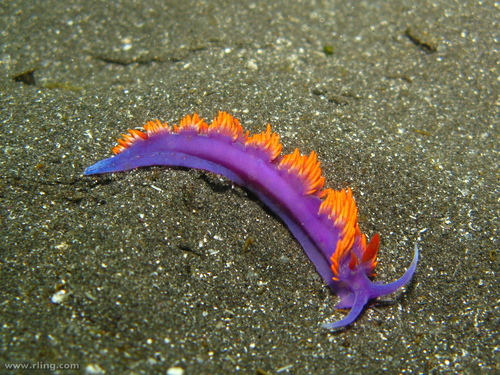
About Flabellinopsis iodinea (J.G.Cooper, 1863)
This species, commonly called the Spanish Shawl nudibranch, has a striking color pattern: its body is purple, its cerata are orange, and its rhinophores are scarlet. The bright orange cerata located on its back are appendages that absorb oxygen from the surrounding seawater. The cerata are also extensions of the nudibranch's digestive system, and they store the stinging cells from the anemones and fan-like hydroids that this species eats. The red rhinophores are sensory structures that the nudibranch uses to detect potential mates and prey. All three of its distinct purple, red, and orange colors come from a single carotenoid pigment called astaxanthin; the pigment develops three different modified states that produce each of the three distinct colors. This nudibranch grows to approximately 70 millimeters in length, and can be found at depths ranging from the intertidal zone down to around 40 meters. Scientists hypothesize that the orange color of the gills (cerata) helps this nudibranch camouflage against its prey while feeding. The orange gills on its back also act as a warning to potential predators, signaling that the nudibranch is either poisonous or distasteful. This species is native to the west coast of North America and waters further south. Its recorded range extends as far north as British Columbia, Canada, and as far south as Punta Asunción, Baja California Sur, Mexico. It also occurs in the Gulf of California and the Galapagos Islands, and has been recorded off the coasts of Santa Catalina Island, the Palos Verdes Peninsula, and San Diego, California.

