About Fissidens taxifolius Hedw.
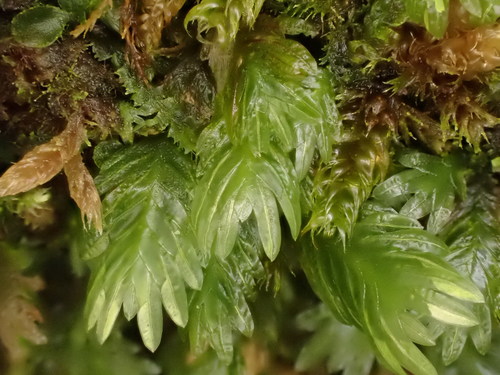
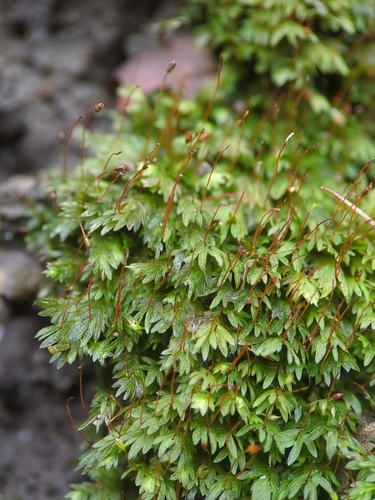
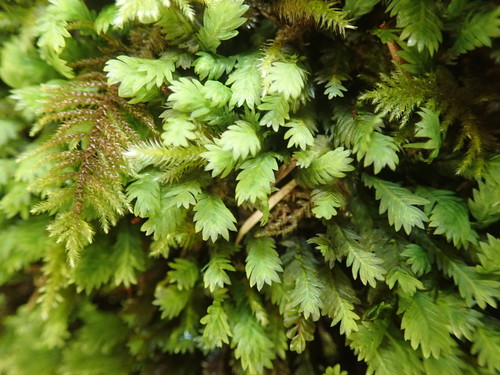
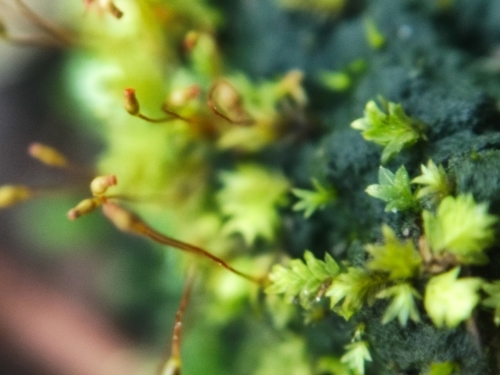
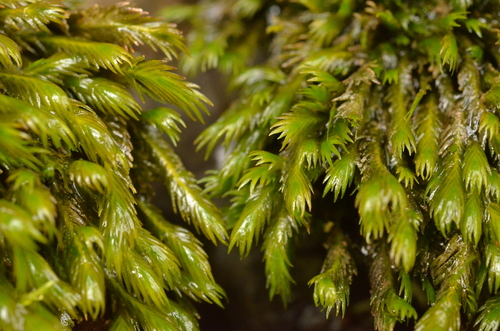
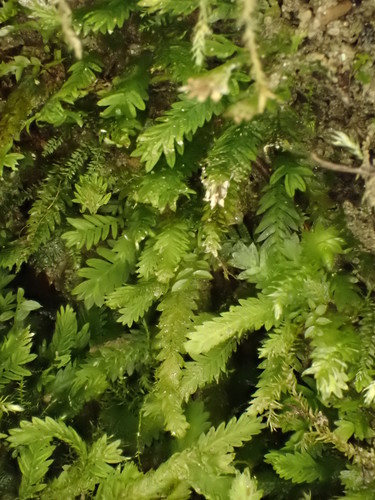
Fissidens taxifolius Hedw. is a small to medium-sized moss that usually grows in dense, yellowish-green to dark green tufts. Its upright stems reach 5–22 mm tall and up to 4 mm wide, and often branch from the base. Like other species in the genus Fissidens, it has a distinctive flattened appearance, with leaves arranged in two opposite rows that look like a tiny fern frond. Individual leaves are oblong-lanceolate, or spear-shaped, and measure 1.4–2.4 mm in length. A key characteristic is the leaf tip, which ends in a sharp (acute) point and usually extends out into a small projection called a mucro or cusp. Leaves have the unique folded structure common to all Fissidens species, with the lower portion forming a sheath that wraps around the stem for half to two-thirds of the leaf's total length. Unlike some related species such as F. osmundoides, which has papillose (small-bump-covered) rhizoids, Fissidens taxifolius produces smooth rhizoids. Each leaf has a strong central nerve, or costa, that typically extends past the leaf tip. Leaf margins are finely toothed, or serrulate. The cells that make up the leaf surface are small, square to hexagonal in shape, and slightly bulging, which gives the leaves a cloudy or opaque look. These cells measure around 8–10 micrometres (μm) in length, with some variation between individuals.
Fissidens taxifolius can reproduce both sexually and asexually. For asexual reproduction, it sometimes produces small structures called rhizoidal tubers, which are 150–380 μm in diameter. Old shoots often show signs of animal grazing, with eroded leaf surfaces. In New Zealand populations of this moss, only female plants have ever been found; no male organs or spore capsules have been observed, indicating that reproduction here is entirely vegetative. When present, archegonia (female reproductive structures) are about 300 μm long, and antheridia (male reproductive structures) are 120 μm long. When dry, the leaves stay relatively straight or only become slightly twisted in their upper sections, rather than curling dramatically like the leaves of many other moss species. This species can be told apart from similar Fissidens species by its tufted growth habit and its distinctive pointed leaf tips with a projecting central nerve. There is clear variation in morphological features across the species' global range. For example, the roughness of leaf cells and how far the central nerve projects past the leaf tip can vary substantially between different populations. European and North American specimens usually have bumpy (mammillose) leaf cells, while some Pacific populations have less pronounced cell surface features.
Fissidens taxifolius has an incompletely cosmopolitan distribution, and is especially common in the Northern Hemisphere. It has been recorded across Europe, North and South America, Asia, Africa, and the Pacific region. It is absent from Antarctica, very rare in sub-Saharan Africa, and has not been recorded in Australia. It is also rare or absent from boreal and arctic regions. Confirmed locations where it occurs include Algeria, Armenia, Austria, Bermuda, Brazil, Burma, Canada, Chad, Cuba, Denmark, Dominican Republic, Egypt, France, Germany, Guatemala, Haiti Islands, Honduras, Ireland, Japan, Mexico, Netherlands, New Zealand, Norway, Papua New Guinea, Poland, Portugal, Russia, Spain, Sweden, Switzerland, Taiwan, Thailand, Turkey, United Kingdom, and the United States of America. This species is able to grow using artificial light in areas that would otherwise have no natural light, such as Crystal Cave in Wisconsin.
The species usually grows on bare earth in lightly shaded conditions, and forms extensive turfs that can cover several square metres when growing conditions are good. It is especially characteristic of woodland and forest growing on base-rich and neutral soils, and is commonly found in stream valleys and on rocky slopes. It grows in both modified and natural environments, including urban parks, gardens, suburban lawns, roadside areas, forest tracks, and shaded banks. While it primarily grows on soil and soil-covered rocks in wet, shaded areas, it occasionally grows epiphytically on tree bark. Fissidens taxifolius commonly grows alongside other moss species, particularly Fissidens pungens, Fissidens leptocladus, and Stokesiella praelonga. It has adaptations for survival and spread, including vegetative reproduction through plant fragments and specialised underground rhizoidal tubers. Recorded evidence of animal grazing on its leaves indicates it is part of the diet of small invertebrates.
In North America, the species is widespread in eastern regions, ranging from Nova Scotia, Quebec, and Ontario, south to Florida, and west to Texas, Oklahoma, Kansas and Nebraska, with isolated disjunct populations in Arizona, from Washington to California, and in the Northwest Territories. In the Pacific region, elevation ranges vary widely. Hawaiian populations grow primarily at high elevations within 300 metres of the timber line, on loose, protected soil banks. In Papua New Guinea, it has been found in 28 localities between 1,400 and 2,900 metres elevation, mostly in forests. In New Zealand, F. taxifolius is an introduced species, found from sea level up to 325 metres elevation. It shows a clear preference for warmer regions, occurring mostly in areas with mean annual temperatures above 12.5°C, particularly in the northern regions of New Zealand's North Island, with scattered populations extending south to Nelson. Multiple factors support its classification as an introduced species in New Zealand: the moss is found almost exclusively in disturbed habitats and modified environments, only female plants have been documented (so reproduction is solely vegetative), and no specimens were collected there before 1966, despite extensive botanical surveys. Additionally, its distribution is limited by its temperature requirements, which further supports its non-native status.
This species exhibits different reproductive patterns across its range. In Europe and North America, it is autoicous, meaning both male and female reproductive organs grow on the same plant. In other regions including New Zealand, Hawaii, and Papua New Guinea, populations are generally dioicous, with male and female reproductive organs growing on separate plants. In some Pacific regions, only female plants have been found, so the species reproduces primarily through vegetative means rather than spore production.