About Fissidens dubius P.Beauv.
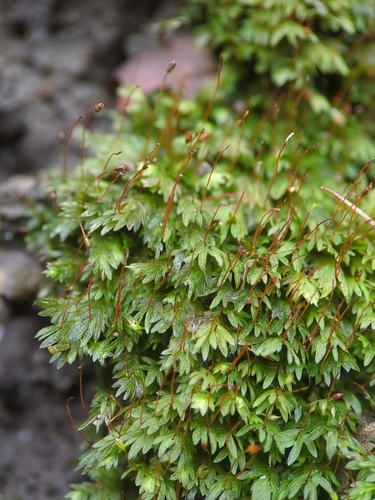
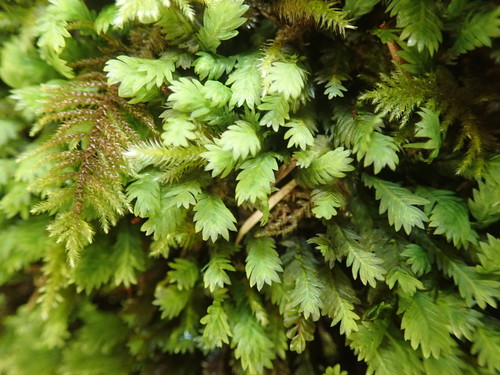
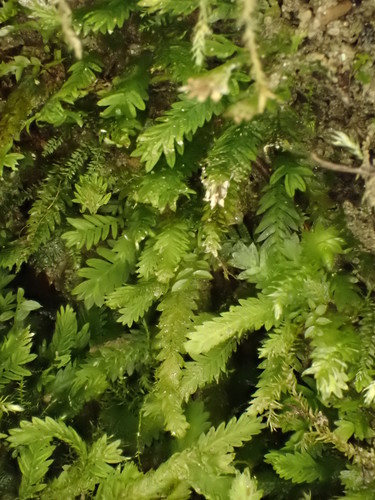
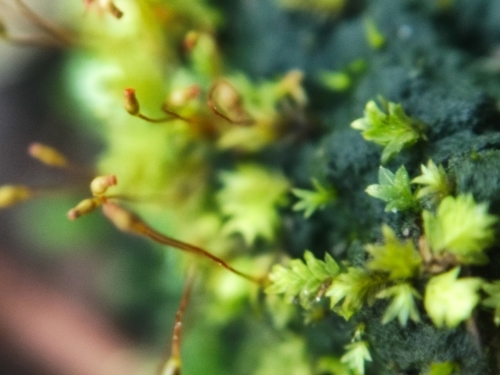
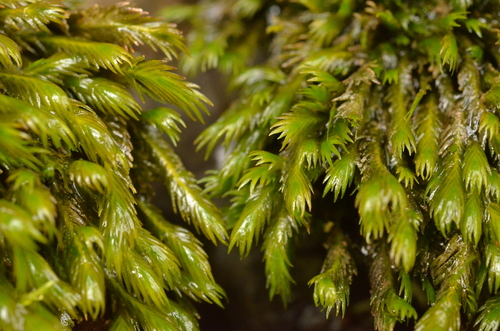
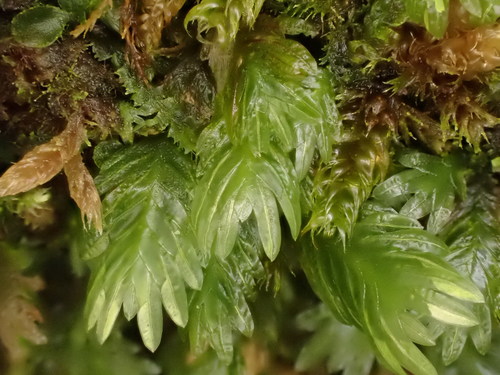
Fissidens dubius P.Beauv. is a relatively large moss that forms loose to dense mats on growing surfaces. Its color ranges from light green to dark green; specimens growing at higher elevations often develop a brownish tinge. Individual stems can reach up to 5 cm (2 in) in length, with leaves arranged in two opposite rows along each stem. The leaves themselves are 2–3.5 mm long, with an elongated tongue-like (tongue-lanceolate) or egg-like (ovate-lanceolate) shape. They have several distinct characteristics: each leaf edge has 3–4 rows of thick-walled cells that form a pale border, and the upper portions of the leaf are marked by coarse, irregular teeth. The leaf blade is partially double-layered, which gives it a somewhat opaque quality, and its surface cells measure 6–12 μm in width. This moss’s reproductive structures, called gametangia, develop in small buds that form in the leaf axils, which are the angles between leaves and the stem, concentrated around the middle section of stems. While this species can occasionally be autoicous, meaning it bears both male and female reproductive organs on a single plant, it is most commonly dioicous, with male and female organs growing on separate plants. When spore-producing capsules form, they grow on reddish stalks and are held at a slight angle.
Fissidens dubius grows primarily on calcareous, or lime-rich, rock formations, as well as other base-rich environments in forested areas. It occurs from lowland to alpine elevation zones, and prefers shaded growing locations. It can colonize a range of substrates, including carbonate rock, base-rich silicate rock, humus-rich soil in limestone areas, dead wood, and the bases of trees. It grows in moderately dry to moist conditions in environments with a pH ranging from neutral to basic. This species has a broad global distribution, found across Europe, North America, South America, Asia, North Africa, and New Zealand. Across its range, it occurs in multiple habitat types including moist grasslands, rock crevices, woodlands, and areas near water courses. European populations of Fissidens dubius are considered stable and face no major threats to survival. In Switzerland, the species has been recorded at elevations from 200 to 2,400 m (660 to 7,870 ft) above sea level, and occurs across all of the country’s major geographical regions, including the Jura Mountains, the Swiss Plateau, and the Alps. Genetic diversity studies of Chinese Fissidens dubius populations, carried out using inter-simple sequence repeat molecular markers—DNA fragments located between microsatellite sequences that are amplified via PCR to study genetic diversity—found high genetic variation between different geographic populations. Analysis of 14 populations across five Chinese provinces showed that over 72% of total genetic variation occurs between populations rather than within them, indicating that geographic isolation strongly shapes the species’ genetic diversity.
Fissidens dubius reproduces primarily sexually via spores. Male and female reproductive organs are usually borne on separate plants (dioicous), and only rarely occur on the same individual. Reproductive structures develop in specialized buds that form in the angles between leaves and stems, concentrated in the middle portion of the plant. When fertilization is successful, spore capsules develop, which are carried on reddish stalks called setae and positioned at a slight angle. While the species is capable of producing spores, spore production occurs only moderately often.