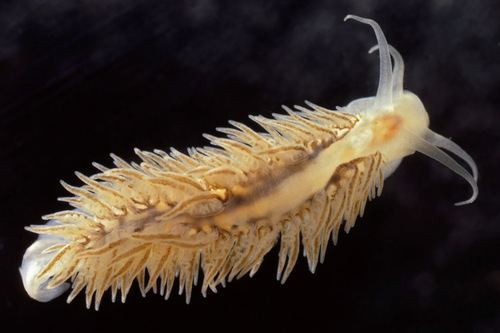
About Fiona pinnata (Eschscholtz, 1831)
Fiona pinnata (Eschscholtz, 1831) has an elongated, oblong-elliptical body. Individuals are typically around 20 mm long, with the largest recorded specimen reaching 50 mm. For a specimen with a total length of 31.7 mm, the distance from the body to the tip of the cerata is 17.7 mm, the foot length is 14.4 mm, and the tail at the end of the foot measures 14 mm. The color of the head and body ranges from white to brown or purple, and this variation depends on the species' food source. The foot is long and lanceolate, rounded at the front and tapering to a fine point at the back. The foot margin is thin, fringed, and crumpled, except near the head where it has a simple structure. The front of the foot is divided, but it does not form propodial tentacles. The cerata are numerous and elongated, with a membranous fringe along their inner sides. While they may appear to be arranged randomly, they actually grow in oblique rows that hold four to six cerata each. Smaller cerata are also present near the body margins. Cerata on the back sides are dark brown, with each bordered by white. The cerata do not have cnidosacs, and are noticeably compressed toward their base. Fiona pinnata has no eyes. Its rhinophores are simple, similar in appearance to the oral tentacles. They are spaced apart, subulate, tapering, and project outward. They are not retractile, and do not have associated pockets. The oral tentacles are shorter, thickened at the base, tapering, project laterally and horizontally, and curve backward. The mouth is located on the underside of the head; it is small, and the external lip is divided along the midline at the back. The anus sits between the cerata on the right side of the body, with its opening facing dorsally. The genital opening is separate. In 1851, Joshua Alder and Albany Hancock described the tissues of Fiona pinnata as very tough and firm. Fiona pinnata occurs in all seas worldwide, where it lives on many different types of floating objects. Its type locality is Sitka, Baranof Island, Alaska, on the extreme northwestern coast of North America. This nudibranch is pelagic, similar to the nudibranch Glaucus atlanticus. Unlike many other pelagic animals, this species cannot swim or even float on its own. Because of this, while it is pelagic, it is not classified as planktonic. Individuals have even been found on both adult and juvenile loggerhead sea turtles from the Canary Islands. The veliger larval stage of Fiona pinnata lasts five days, after which the larva undergoes metamorphosis into a slug. In 1979, New Zealand malacologist Richard Cardeu Willan published a theory that veligers can delay metamorphosis if they do not find a suitable floating habitat to attach to. Fiona pinnata grows very rapidly, and has one of the highest recorded growth rates among nudibranchs (this comparison is only with benthic nudibranchs, the only group for which growth rate data is available). The only species recorded to grow faster than Fiona pinnata is Doridella obscura. Fiona pinnata can grow from 8 mm to 20 mm in just 4 days.

