About Fimbriaphyllia ancora (Veron & Pichon, 1980)
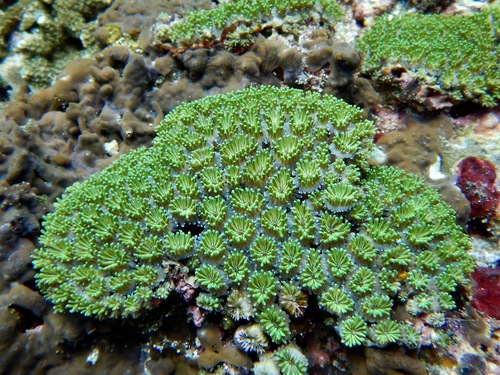
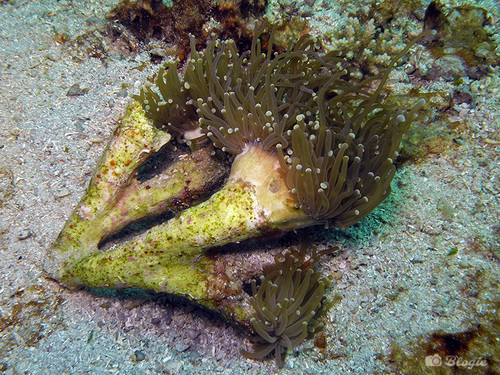
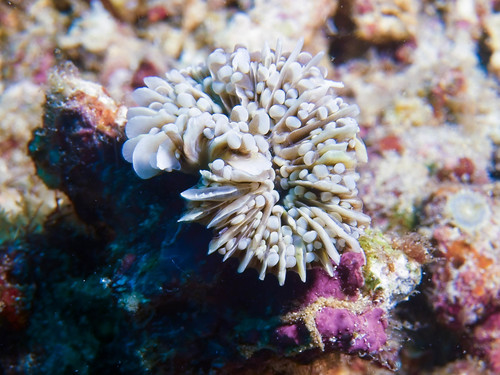
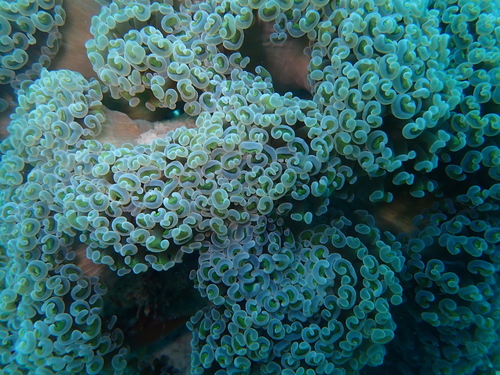
This species of madreporal coral colony is easy to identify by its puffy, tubular tentacles with T-shaped tips. Fimbriaphyllia ancora ranges in color from blue-gray to orange, and sometimes has green coloring on its tentacles. It can show full or partial viral infection of green fluorescent protein, a trait that is very desirable for aquarium specimens. Colonies can be flabelloid, phaceloid, or flabello-meandroid in shape. Walls are thin and solid, and columellae are mostly absent. Septa are exsert, solid, and have smooth edges. Tentacles are large, fleshy, and extended both day and night. Tentacle shape varies across species of this genus; in Fimbriaphyllia ancora, tentacles have a T or boomerang shape. Colonies are usually no more than one meter across, but may occasionally reach several meters across. As a cnidarian, all individuals are symmetric around a central axis, and have a sac-like body cavity with only one opening that functions as both mouth and anus. This opening is surrounded by tentacles that bear stinging cells. Like comb jellies and no other animal group, its body wall is made of two cell layers: the outer ectodermis and inner gastrodermis, separated by a jelly-like layer called the mesoglea. The anchor coral, the common name for this species, is widespread across the tropical waters of the Indo-West Pacific, ranging from the Maldives to the Solomon Islands, with a large population in Indonesia. It is common in some regions, but multiple threats have reduced its overall global population, and its coral reef habitat has been degraded and destroyed in many areas. Fimbriaphyllia ancora is gonochoristic. In Taiwan, this species spawns via external fertilization in late spring. As documented by Twan, Fimbriaphyllia ancora engages in mass spawning matching the definition of Harrison and Wallace: "the synchronous release of gametes by many species of corals in one evening between dusk and midnight". New colonies also form from tentacle tips that break off from parent colonies. Major spawning events occur on the 3rd and 6th nights after a full moon, during a period of neap tides.