About Ficus racemosa L.
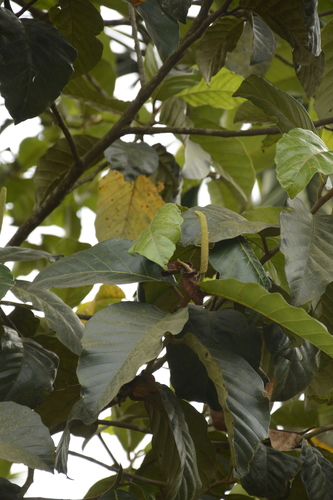
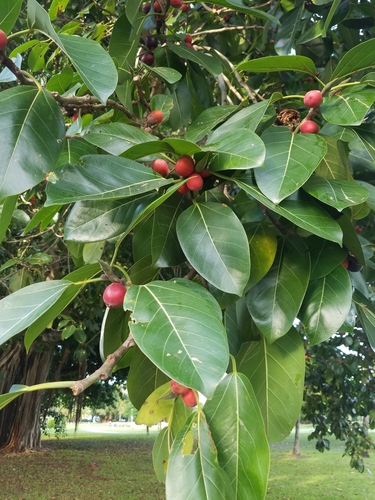
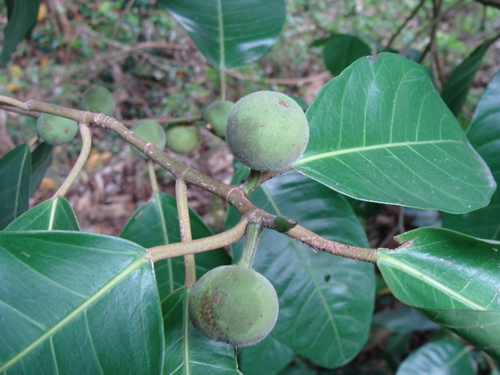
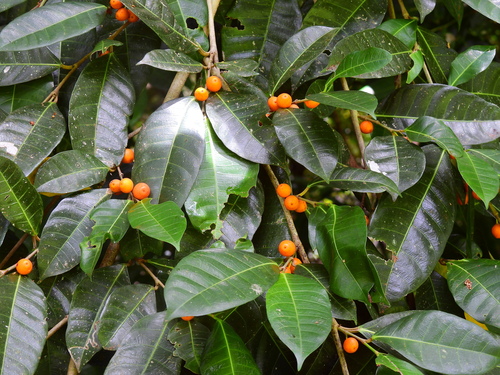
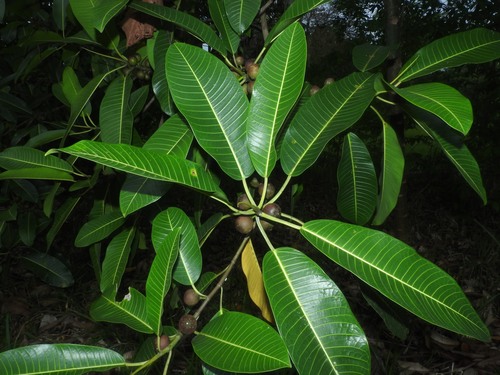
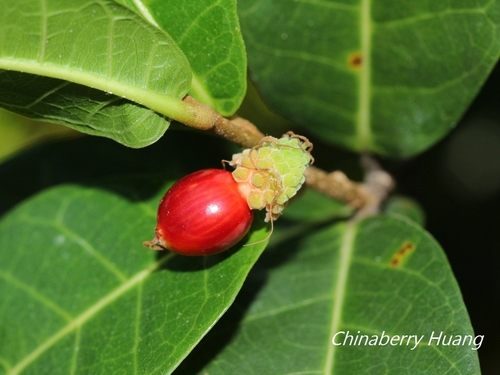
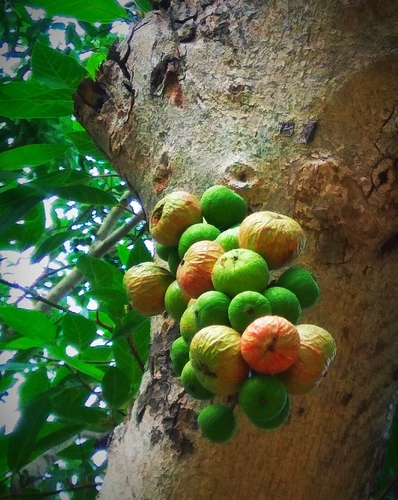
Ficus racemosa L., commonly known as the cluster fig, is a deciduous or semi-deciduous tree that typically reaches 15–20 metres (49–66 ft) in height. Older, mature specimens can grow to be quite large and gnarled, reaching up to 30 metres (98 ft) high. It has a wide-spreading crown with irregular branches, and a thick, often buttressed trunk covered in smooth greyish bark that may flake as the tree ages. Like other species in the genus Ficus, this tree produces milky latex that can irritate human skin. It has a shallow, extensive root system, and often develops aerial roots when grown in humid environments. The leaves of the cluster fig are simple and arranged alternately, with lanceolate pubescent stipules that measure 1–2 centimetres (0.39–0.79 in) in length and often remain persistent on young shoots. The petiole is slender, grooved along its upper side, 1–5 centimetres (0.39–1.97 in) long, and turns brown and scurfy with age. The leaf blade (lamina) is 6–15 centimetres (2.4–5.9 in) long and 3.5–6 centimetres (1.4–2.4 in) wide, and can be ovate, obovate, elliptic-oblong or elliptic-lanceolate in shape. The leaf surface is membranous and glabrous, and often develops a blistered appearance when dried. Its flowers are unisexual and borne inside a syconium, which develops on short leafless branches, warty tubercles of the trunk, or on larger branches. The syconia are subglobose to pear-shaped, attached by a stout peduncle. Fig wasps of the genus Ceratosolen pollinate the flowers by entering the flat or slightly sunken ostiole. When mature, the syconium measures about 3 centimetres (1.2 in) in diameter, turns orange or dark crimson when ripe, and contains granulate achenes. The cluster fig is native to South Asia, Southeast Asia and northern Australia. Its natural range extends from Pakistan, India, Sri Lanka, Nepal and Bangladesh through Myanmar, Thailand, Laos, Cambodia, Vietnam, Malaysia and Indonesia, and eastwards to Papua New Guinea and northern Australia. It grows best in tropical and subtropical climates, and is commonly found in lowland forests, along riverbanks, in open woodlands, and in rural villages and temple grounds, where it is often cultivated for its religious significance, shade, and edible figs. This species grows well in moist, well-drained soils, tolerates both periodic flooding and dry conditions, and is often found growing along roadsides and near watercourses. Ripe cluster figs can be eaten directly, while unripe green figs can be cooked as a vegetable in stir-fries and curries, or processed into preserves. The tree's shoots and young leaves are also edible. The Ovambo people call the fruit of the cluster fig eenghwiyu, and use it to distill ombike, a traditional liquor. In India, a home remedy is made by rubbing the bark on a stone with water to create a poultice used to treat boils and mosquito bites; the poultice is left to dry on the skin and reapplied after a few hours. The plant's leaves can also be used to remove caterpillar hairs that have become lodged in the skin: rubbing the affected skin lightly with a leaf effectively dislodges the stinging hairs. In Vietnam, the leaves are called lá sung, and are eaten raw with meat dishes. They are used with rice paper and other edible leaves, such as those of woolly sewervine, shiso or Ming aralia, to wrap pieces of chicken, pork or goat, eaten in a style similar to Korean ssam. In Vietnam, the unripe figs, called quả sung, are harvested and pickled in a mixture of salt and sugar, then seasoned with chilli, garlic, lime juice and fish sauce.