About Ficus microcarpa L.fil.
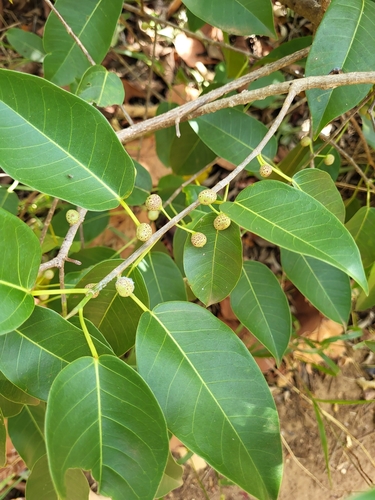
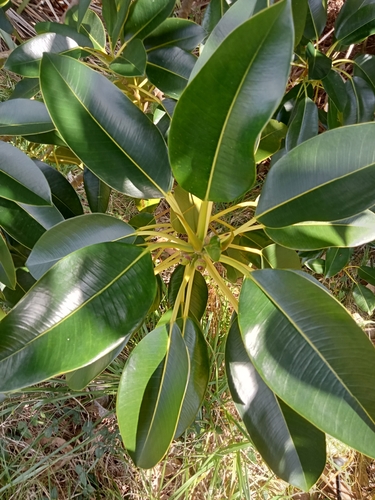
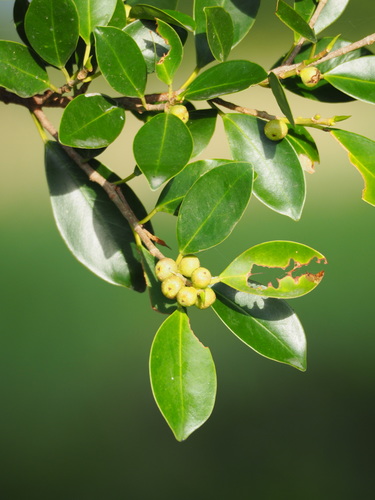
Ficus microcarpa L.fil. is a large tropical tree that typically grows to 25 m (82 ft) tall, and may occasionally reach 35 m (115 ft). Countless aerial roots grow downward from its branches; these roots are capable of developing into accessory trunks, also called prop roots. Individuals may start life as epiphytes, lithophytes, or terrestrial plants. Its leaves range from narrowly to broadly elliptic, and grow up to 12 cm (4.7 in) long by 9 cm (3.5 in) wide. The leaves are glabrous, meaning they have no hairs, and have 5–9 pairs of main lateral veins on each side of the midrib. These veins form distinct loops within the leaf margin.
Ficus microcarpa is native to tropical Asia, southern China, Taiwan, Western Pacific islands, and Australia. As a tropical and subtropical species, it needs a warm climate and humid atmosphere, but can tolerate temperatures close to 0 °C. It grows mainly at low elevations, and its natural habitats include tropical rainforests, river edges, coasts, swamps, and mangroves.
Ficus microcarpa was widely distributed as an ornamental plant, and is one of the most common street trees in warm climates. It has been introduced to multiple countries in the Mediterranean, Central America, South America, the Caribbean, as well as Hawaii, California, and Florida in the United States. In urban areas, it can grow in cracks of walls, buildings, and other masonry structures. It tolerates urban pollutants including sulfur dioxide, lead, and cadmium in soil moisture, and also tolerates salt. Its symbiotic pollinating fig wasp, Eupristina verticillata, was introduced alongside F. microcarpa, though this introduction can be delayed. In Brazil, where the tree has been used in gardening since the nineteenth century after architect Auguste François Marie Glaziou introduced it to public parks in Rio de Janeiro, saplings did not start appearing until the 1970s. These saplings are considered very aggressive, as they can grow on the walls of buildings, bridges, highways, and other concrete structures. The species is classed as a major invasive species in Hawaii, Florida, Bermuda, Central America, and South America.
F. microcarpa is widely used as a street and ornamental tree in frost-free areas of coastal California. Its strong roots can lift sidewalks and pavements, so many California cities no longer recommend planting it. A population of its symbiotic fig wasp is now established in Southern California, allowing the ornamental trees to produce fertile fruit. Fruit-eating birds spread the seeds, so F. microcarpa can now spread without direct human assistance. Naturalized populations have been recorded in Los Angeles, Orange, Riverside, San Diego, and Ventura counties, growing on buildings, bridges, other structures, and as an epiphyte on other trees, especially palm trees. It is commonly used as an ornamental tree along most of Spain's Mediterranean coast, and in the Balearic and Canary Islands. It can also be found on the southern coast of Sicily, on Rhodes, and in Cyprus. It is considered an invasive plant in Israel, though it is not widespread there.
The pollinating fig wasp associated with Ficus microcarpa is Eupristina verticillata. Additionally, 19 species of non-pollinating fig wasps parasitize the figs of Ficus microcarpa. These non-pollinating wasps belong to multiple families, including Eurytomidae and Pteromalidae. In some parts of its introduced range, it is very attractive to avian wildlife. In São Paulo, Brazil, ten bird species were recorded feeding on its fruits, especially Turdus rufiventris, Pitangus sulphuratus, Turdus leucomelas, Thraupis sayaca, and Celeus flavescens. Its fruit and leaves are also eaten by the parrot Aratinga leucophthalmus. Despite being invasive, its hardiness makes it an important species for attracting avian wildlife in urban areas.
Ficus microcarpa is cultivated as an ornamental tree for planting in gardens and parks, and is also grown in containers as an indoor plant and bonsai specimen. In Southeast Asia, it is cultivated as a shade tree due to its dense foliage. Its ability to produce new growth from cuttings makes it easy to maintain as a hedge or trimmed bush. As a tropical and subtropical tree, it is suited to year-round temperatures above 20 °C, which is why it is generally sold as a houseplant. However, it can tolerate relatively low temperatures, and only suffers damage when temperatures drop below 0 °C. High humidity between 70% and 100% is preferable, and appears to encourage aerial root development. The species can be propagated easily from cuttings, either placed in water or planted directly into sand or potting substrate.
The plant is also used in traditional medicine in India, Malaysia, China, and Japan. In Japan, the bark, aerial roots, and dried leaves are traditionally used to treat pain and fever. In China, it is traditionally used to treat conditions including influenza, malaria, bronchitis, and rheumatism. Identified pharmacological properties of Ficus microcarpa include antioxidant, antibacterial, anticarcinogenic, and antidiabetic activities.