About Ficus macrophylla Pers.
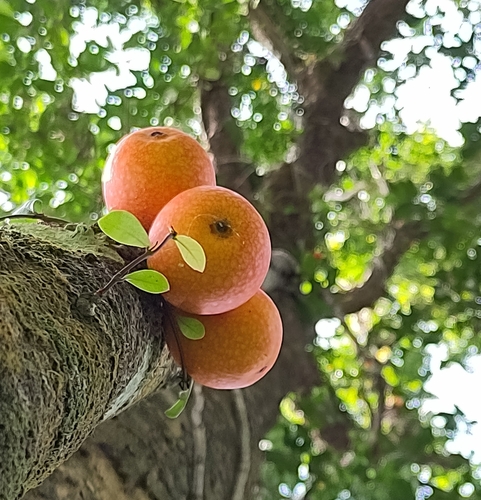
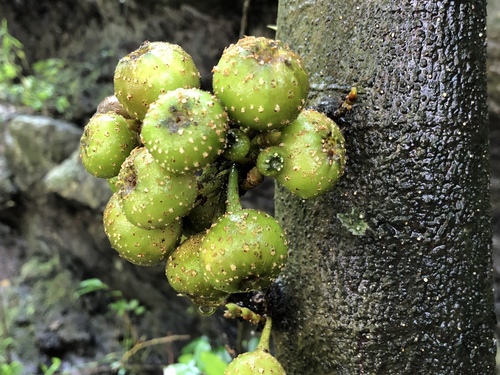
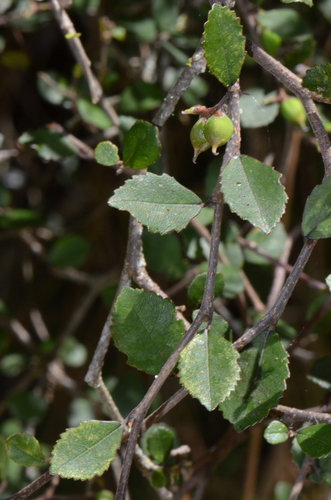
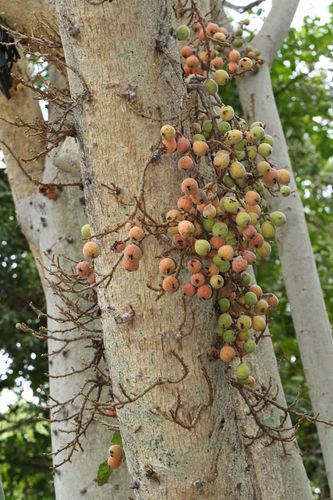
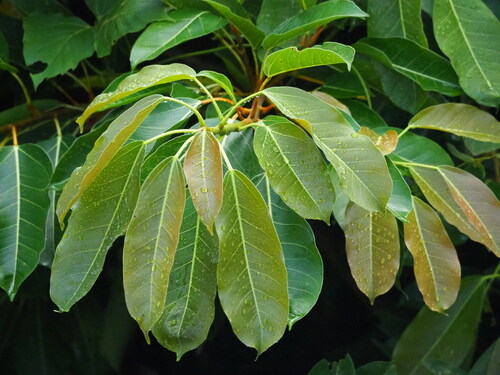
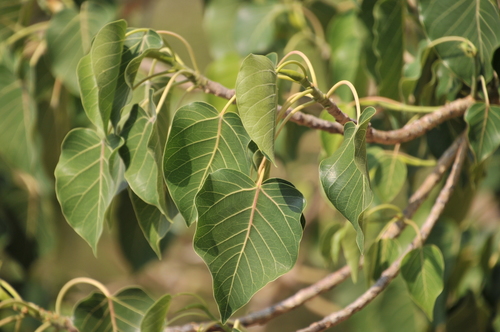
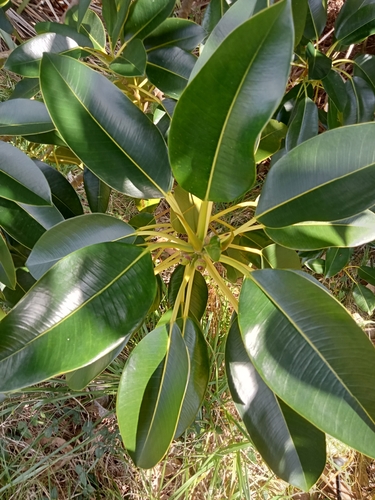
Ficus macrophylla Pers., commonly known as the Moreton Bay fig, is an evergreen tree that can reach heights of 60 m (200 ft). Its trunk is often massive, with thick, prominent buttressing, and can reach a diameter of 2.4 m (7.9 ft). The bark is rough, grey-brown, and marked with various blemishes. The Lord Howe Island form of Moreton Bay fig regularly drops aerial roots from its branches; when these roots reach the ground, they thicken into supplementary trunks that help support the weight of the tree's crown. Cut or broken leaves and branches bleed a milky sap. The tree's figs (syconia) are 2–2.5 cm (0.8–1 in) in diameter, turning from green to purple with lighter spots as they ripen. Ripe fruit can be found year-round, though it is most abundant from February to May. As a rainforest plant, Ficus macrophylla more often grows as an epiphytic strangler vine than a standalone tree in its natural environment. When its seeds land on a branch of a host tree, it sends aerial "strangler" roots down the host trunk, eventually killing the host and growing as a standalone tree. Ficus macrophylla is monoecious, meaning each individual tree bears both functional male and female flowers. As its specific epithet macrophylla indicates, this species has large, elliptic, leathery, dark green leaves that are 15–30 cm (6–12 in) long, arranged alternately along stems. Its fruit is classified as a syconium, which is an inverted inflorescence with flowers lining an internal cavity. The Moreton Bay fig is native to eastern coastal Australia, ranging from the Wide Bay–Burnett region in central Queensland to the Shoalhaven River on the south coast of New South Wales. It grows in subtropical, warm temperate, and dry rainforest, where it often acts as an emergent tree whose crown rises above the surrounding canopy, particularly along watercourses on alluvial soils. In the Sydney region, F. macrophylla grows from sea level up to 300 metres (980 feet) altitude, in areas with an average annual rainfall of 1,200–1,800 mm (47–71 in). It commonly grows alongside other tree species including white booyong (Argyrodendron trifoliolatum), Flindersia species, giant stinging tree (Dendrocnide excelsa), lacebark (Brachychiton discolor), red cedar (Toona ciliata), hoop pine (Araucaria cunninghamii), green-leaved fig (Ficus watkinsiana) and Cryptocarya obovata. It grows on nutrient-rich soils including those derived from Bumbo Latite and Budgong Sandstone. As rainforests were cleared, isolated individual trees were left standing in fields as remnant trees, valued for the shade and shelter they provide for livestock. One such remnant tree was a local landmark that gave its name to Figtree, a Wollongong suburb in New South Wales. The huge volume of fruit produced by the Moreton Bay fig makes it a key food source in rainforest ecosystems. It is an important food source for the green catbird (Ailuroedus crassirostris), fruit-eating pigeons including the wompoo fruit-dove (Ptilinopus magnificus) and topknot pigeon (Lopholaimus antarcticus), and an occasional food source for the rose-crowned fruit-dove (Ptilinopus regina). Other bird species that eat its fruit include the yellow-eyed cuckoo-shrike (Coracina lineata), pied currawong (Strepera graculina), Australasian figbird (Sphecotheres vieilloti), Regent bowerbird (Sericulus chrysocephalus), satin bowerbird (Ptilonorhynchus violaceus), and Lewin's honeyeater (Meliphaga lewinii). Fruit bats such as the grey-headed flying-fox (Pteropus poliocephalus) also feed on its fruit. In addition to its pollinating fig wasp Pleistodontes froggatti, the syconia of the Moreton Bay fig host multiple species of non-pollinating chalcidoid wasps, including Sycoscapter australis (Pteromalidae), Eukobelea hallami (Sycophaginae), and Meselatus sp. (Epichrysomallinae). Two nematode species, Schistonchus macrophylla and Schistonchus altermacrophylla, are found in the syconia, where they parasitize P. froggattii. The thrips species Gynaikothrips australis feeds on the underside of new leaves of F. macrophylla, as well as new leaves of F. rubiginosa and F. obliqua. When plant cells die from feeding, nearby cells are induced to form meristem tissue, resulting in galls that distort and curl the leaves. Thrips begin feeding when the tree produces flushes of new growth, and their life cycle lasts around six weeks. At other times, thrips live on old leaves without feeding. This species pupates sheltered in the tree's bark. Thrips stay in galls at night, wander during the day, and return to galls in the evening, often moving to different galls across the tree. Stressed F. macrophylla trees can also be attacked by psyllids to the point of defoliation. Psyllid grubs hatch from eggs laid on leaf edges and burrow into the leaf to suck nutrients, and the tree's latex provides shielding for the insect. Caterpillars of the moth species Lactura caminaea (Lacturidae) can completely strip a tree of its leaves. This tree is also a host for the longhorn beetle (Cerambycidae) species Agrianome spinicollis. The fungal pathogen brown root rot (Phellinus noxius) can infect and kill this species. Figs share an obligate mutualism with fig wasps of the family Agaonidae: figs are only pollinated by fig wasps, and fig wasps can only reproduce in fig flowers. Generally, each fig species depends on a single wasp species for pollination, and the wasps similarly depend on their host fig species to reproduce. Both mainland Australian and Lord Howe Island populations of Moreton Bay fig are pollinated by Pleistodontes froggatti. Like all figs, the Moreton Bay fig's fruit is an inverted inflorescence called a syconium, with tiny flowers growing from its inner surface. Ficus macrophylla is monoecious: both male and female flowers grow on the same plant, and even within the same syconium, though they mature at different times. Female wasps enter the syconium and lay eggs in the female flowers as the flowers mature. After the eggs hatch, the new wasp progeny mate. The new generation of female wasps collects pollen from the now-mature male flowers, then leaves to visit other syconia and repeat the reproductive cycle. A field study conducted in Brisbane found that F. macrophylla trees often bear both male and female phase syconia at the same time, a trait that could benefit reproduction in small, isolated populations such as those found on islands. The same study found that male phase syconia development continues through winter, which indicates that the species' wasp pollinator tolerates cooler weather than pollinators of more tropical fig species. F. macrophylla itself can tolerate cooler climates than many other fig species. Wild Moreton Bay fig trees live for over 100 years. The Moreton Bay fig has been widely cultivated in public parks across frost-free areas, and was popular with early Australian settlers. Around the start of the 20th century, Joseph Maiden, director of the Royal Botanic Gardens in Sydney, advocated for planting uniform rows of single species as street trees, and recommended that Moreton Bay figs be spaced at 30 m (100 ft) intervals: far enough apart to avoid crowding as the trees mature, but close enough for their branches to eventually interlock. Cultivated specimens can reach massive proportions and have thrived in drier climates; impressive mature specimens grow in Waring Gardens in Deniliquin and in Hay. They tolerate light frosts, can withstand salt-laden coastal spray, and their fruit supports urban wildlife. However, their very large size means they can only be grown in the largest gardens, and their highly invasive roots can damage piping and disrupt footpaths and roadways; large quantities of fallen crushed fruit also leave messy residue on the ground. Due especially to their tendency to form pronounced root buttressing, Moreton Bay figs are frequently used for bonsai, though they are much more suited to larger bonsai styles because their large leaves do not reduce much in size and their stems have long internodal spaces between leaves. They can also be grown as indoor plants in medium to brightly lit indoor spaces. The soft light timber of the Moreton Bay fig has a wavy texture and is used to make cases. Aboriginal people traditionally use the tree's fibres to make fishing nets. Its fruits are edible and taste similar to other fig varieties.