About Ficus insipida Willd.
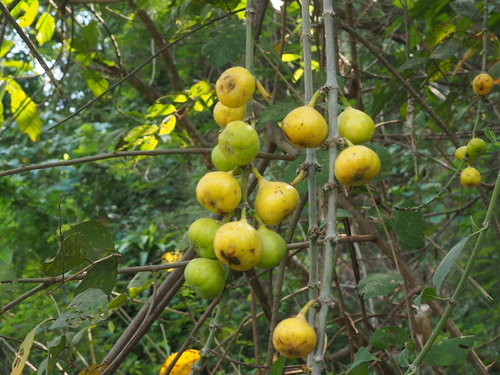
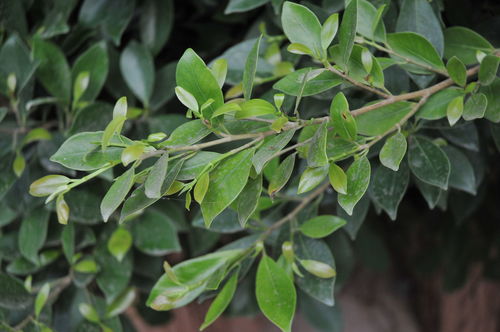
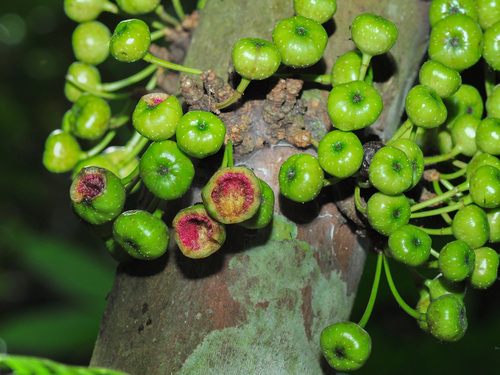
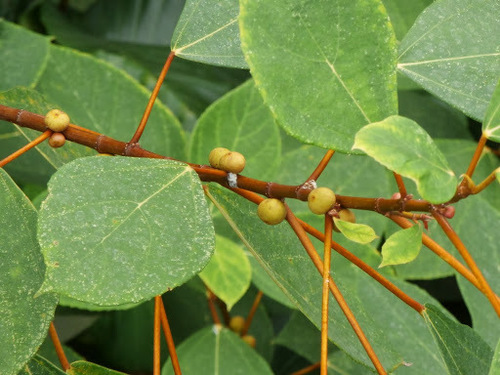
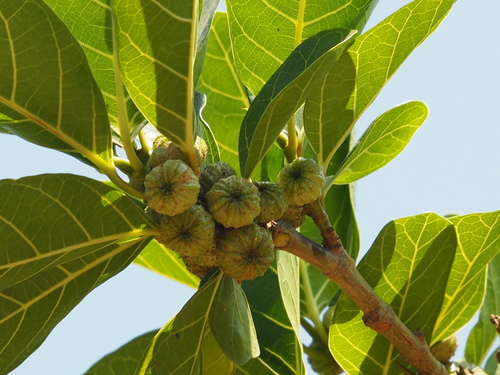
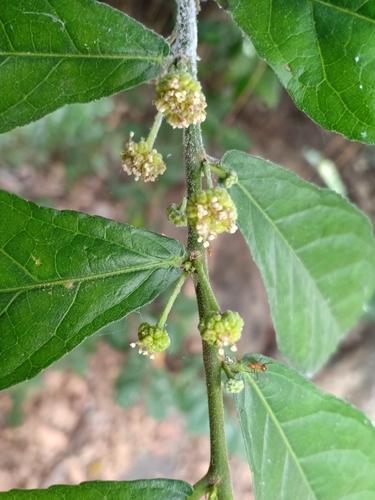
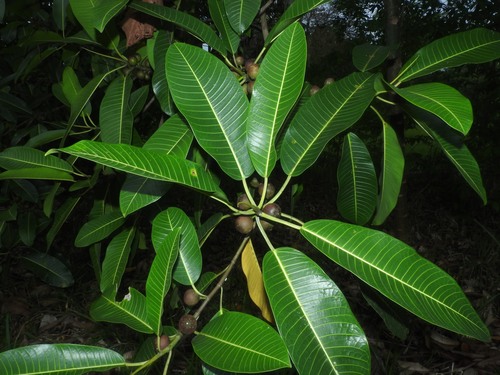
Ficus insipida Willd. is a tree with buttress roots that grows 8 to 40 m (26 to 131 ft) tall. It is a fast-growing pioneer species that quickly colonizes secondary forest, and can grow into a large tree in approximately 100 years. As a result, it is typically easy to recognize as the largest trees in these secondary woodlands. Its leaves range in shape from narrow to elliptical, and measure 5 to 25 cm (2.0 to 9.8 in) long by 2 to 11 cm (0.79 to 4.33 in) wide. The nominate subspecies occurs from Mexico south through Central America to Colombia and Venezuela, continuing on to Ecuador, Bolivia, Peru and Amazonian Brazil, and north from Venezuela to Trinidad and Tobago and the Lesser Antilles. Subspecies scabra occurs from the Guianan Shield of northeast Venezuela east through the Guianas to northwestern Brazil in the states of Amapá and Pará. In Mexico, it has been recorded in the northern states of Chihuahua, Durango, San Luis Potosí, Sinaloa, Sonora, Tamaulipas and Zacatecas, ranging south to Campeche, Chiapas, Colima, Guerrero, Hidalgo, Jalisco, México, Michoacán de Ocampo, Morelos, Nayarit, Oaxaca, Puebla, Querétaro, Tabasco and Veracruz de Ignacio de la Llave. In both Costa Rica and Nicaragua it is found in lowlands along both the Atlantic and Pacific coasts, as well as in the central valleys. In Bolivia it has been recorded in the northern and eastern departments of Beni, Cochabamba, La Paz, Pando and Santa Cruz, meaning it occurs across most of the country except for the Andes in the southwest. In Ecuador it is known from the provinces of Esmeraldas, Imbabura, Manabí, Morona-Santiago, Napo, Pastaza, Sucumbíos and Zamora-Chinchipe. In Colombia the species has been recorded in the departments of Amazonas, Antioquia, Bolívar, Boyacá, Caquetá, Casanare, Cauca, Chocó, Cundinamarca, La Guajira, Guaviare, Huila, Magdalena, Meta, Nariño, Norte de Santander, Putumayo, Risaralda, Santander, Tolima and Valle. Besides the previously mentioned Amapá and Pará, its distribution in Brazil also includes the states of Acre, Amazonas and Rondônia. It remains unclear whether both subspecies occur in the state of Pará, as has been suggested. While the Amazon rainforest is often described as ancient, much of it actually grew quite recently, after the end of the last Ice Age, with a large expansion to the south occurring 3,000 years ago. During the Ice Age, large areas of the Amazon were covered in savanna, and forest retreated to numerous refugia. Traces of this history have been found in the genetic structure of nominate subspecies populations: while populations from Mexico to the Andes are reasonably genetically diverse, populations across most of the Amazon are genetically similar to one another, with a single widespread haplotype, and tested genetic sequences from trees across much of Bolivia showed no discernable genetic diversity at all. This indicates the species only recently colonized this region, a pattern it shares with other lowland rainforest trees. The nominate subspecies is quite common in Nicaragua and Panama, while subspecies scabra is reported to be a rare tree in the Guianas. The typical habitat of the nominate subspecies is lowland forests down to the coast. In Costa Rica, Ficus insipida subsp. insipida does not grow above 1,100m, and occurs down to 50m, or sea level. In Nicaragua it grows between 0–700m in altitude, and exceptionally up to 1300m. It can be found in very humid, humid, or dry climates, but it is almost always found growing along rivers, and often on slopes. In Atlantic Costa Rica, it occurs on thickly wooded small hills adjacent to the coast. Subspecies scabra has a slightly different habitat preference, and is typically found on slopes in rainforest or mountain savannas in the Guianas. Like many figs and other rainforest fruit trees, F. insipida is a 'mass-fruiter' species. Unlike many rainforest fruit trees, but like many tropical rainforest figs, individual F. insipida trees fruit on a staggered, asynchronous schedule relative to other neighboring individuals of the same species. This means there is always a fig flowering and fruiting somewhere regardless of the season, which is beneficial to wildlife, and forces its wasp pollinators to seek out a new tree, fostering cross pollination. Like its fruit, new leaves are produced in asynchronous flushes. It is a monoecious species. Its figs are actually specialized inflorescences called syconia, which are densely covered on the inside with tiny florets that include both functionally male and female flowers. The female flowers mature first, and occur in two forms, with either a short or long style. The stigmas of the female flowers are thickly intertwined and connected to each other at the same height, with short-styled florets positioned somewhat higher using pedicels and longer ovaries to maintain the stigma surface. This forms a continuous surface layer a set distance from the inner wall of the fig called the synstigma, which acts as a platform that pollinating wasps walk across and use as a surface from which to oviposit their eggs. The synstigma is so connected that pollen tubes may grow from one stigma into the ovule of another neighboring floret. The distance between the synstigma and the ovules helps determine which wasp species can live in a particular fig species, and causes females to mostly lay their eggs in short-styled florets. In F. insipida, this pattern is not strict, and both types of florets are fertile and both can host a wasp larva. The flowers inside F. insipida figs are pollinated by female wasps of the genus Tetrapus, which complete most of their lifecycle inside developing figs. Female wasps have weak jaws, and depend on males to free them from their figs and the individual fruit where they develop and pupate. Only females are winged, so only they can fly to a new fig to lay eggs. Males develop first: they are wingless but have stronger jaws, which they use to chew their way out of their host ovule. Once free, they chew the females free and copulate with them while the females are still mostly trapped in their ovules. This ensures every female mates; females that do not copulate will only produce male offspring. Males also chew holes through the fig walls and open the ostiole, a small opening at the apex of the fig, to allow females to escape. At the same time, the male flowers inside the fig finally shed their pollen, which adheres to the females in specialized pockets or simply on their body surface. Females search for a new fig to lay their eggs, and upon arriving, must force their way inside through the ostiole. Although the wasps are very small, they regularly travel reasonably long distances, which is visible in the genetic structure of fig tree populations: there is clear evidence of abundant outcrossing in nuclear DNA, which is carried on pollen carried by females, unlike mitochondrial DNA. The ostiole is blocked by a series of bracts, but unlike many other Ficus species, only the uppermost ostiolar bracts are interlocking and open, while inner bracts are positioned inward and relatively open, forming a long slit-like tunnel that gives access to the central cavity. Even so, entering the cavity is strenuous, and females often die in the tunnel or are damaged by the experience, always losing their wings when forcing their way through the bracts. Once inside, females inject their eggs with their ovipositor, through the styles of the correct length, into the ovules, laying one egg per ovule. While doing this, females pollinate other flowers as they walk across the synstigmatic surface. Seeds and larvae mature in a few weeks, at approximately the same rate. The species uses zoochory to disperse its seeds. Figs are eaten by bats, howler monkeys, spider monkeys, and capuchin monkeys in the Guianas. In Costa Rica, the large, common trout-like fish Brycon guatemalensis is possibly a particularly important endozoochorous dispersal agent; adult B. guatemalensis primarily feed on fallen F. insipida leaves and figs. F. insipida seeds can survive passing through the fish's gut, although their viability is significantly reduced. Even so, the fish may have specific value as a dispersal agent for this fig, because the species is primarily and typically found along rivers, and fish generally disperse seeds along rivers. Furthermore, fish can disperse seeds upriver, which helps maintain upriver populations, while dispersal by floating figs via water (hydrochory) alone is generally only downriver in most habitats. The leaves and especially the fruit of F. insipida and F. yoponensis are a preferred food of howler monkeys (Alouatta palliata) in Panama; one troop on Barro Colorado Island spent one quarter of its time feeding on these two tree species. The asynchronous fruiting schedule of F. insipida combined with the monkeys' food preference leads the monkeys to use specific foraging routes to efficiently check the status of as many potential trees as possible. The latex of Ficus insipida is sold in South America as an anthelmintic, marketed as 'doctor oje' (ojé in Brazil). An analysis of overdoses in one region of Peru recorded only 3 apparently fatal cases and 39 cases requiring hospitalization over a 12 year period. Based on an analysis of probable sales in the region, this corresponds to a very low fatality rate of 0.01–0.015% and hospitalization rate of 0.13–0.2%. The study authors concluded the product is safe when used at the correct dose. No serious adverse effects were observed in any of several clinical trials of the product conducted in Peru, with the possible exception of one miscarriage in an 18-year-old woman who did not disclose her pregnancy to trial staff and received a very low dose of ojé. The latex can be purified to leave a complex of enzymes called ficin, a white powder first produced in 1930. This product is considered likely safe. Early researchers observed that intestinal nematodes dissolved in a ficin solution, which sparked interest in the product as an anthelmintic, although it was never widely adopted. Ficin is a mixture of different enzymes and can be produced from many different Ficus species. The main proteolytic enzyme in ficin obtained from F. insipida is officially named ficain. Purified ficin has numerous medical and industrial uses. It is used for cleaning during the production of stitching material for sutures, to prepare animal arteries before transplantation into humans, and to unmask antigens in serology. It is also used to clean animal intestines that are used as sausage or cheese casings. It is added as an ingredient to make freeze-resistant beer, and has been added to some meat tenderizer formulations alongside related protease enzymes. According to Schultes and Raffauf in their 1990 book The Healing Forest, the fruit of Ficus anthelmintica, an outdated synonym for Ficus insipida, has been used by an unknown group of people in an unspecified location in the northern Brazilian Amazon as an aphrodisiac and for what the authors categorize as a 'memory enhancer'.