About Ficus ingens (Miq.) Miq.
Scientific name: Ficus ingens (Miq.) Miq.
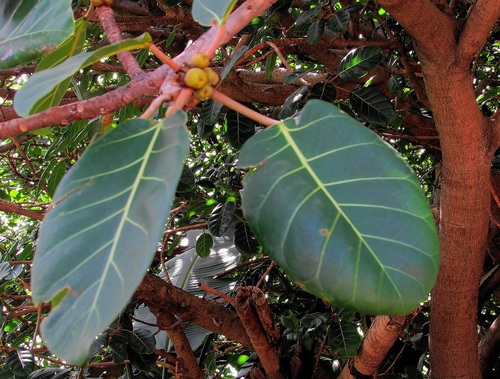
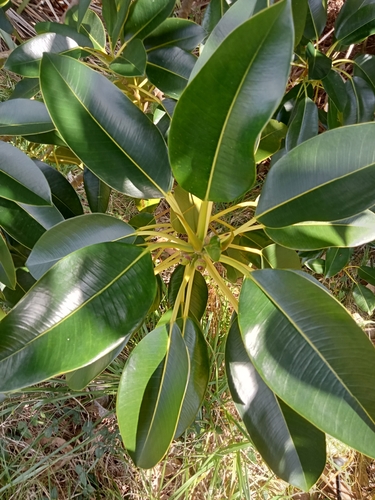
Ficus ingens has smooth, leathery, dull-green leaves that are narrowly ovate oblong. New leaves are bright red brown, and old leaves turn reddish-copper in autumn. The leaves have conspicuous yellow veins that are prominent on the underside and curve to form loops along the leaf margin. Leaves are roughly 16.5 by 8.5 centimetres (6.5 by 3.3 in) in size; their base is most often square or cordate, sometimes broadly rounded, and the apex tapers to a blunt point.
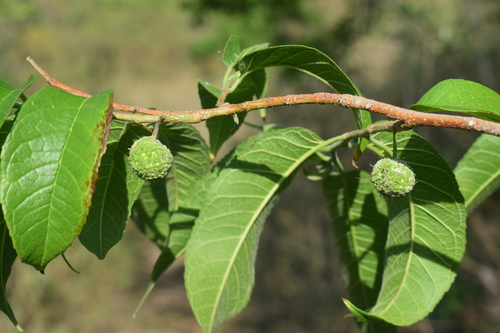
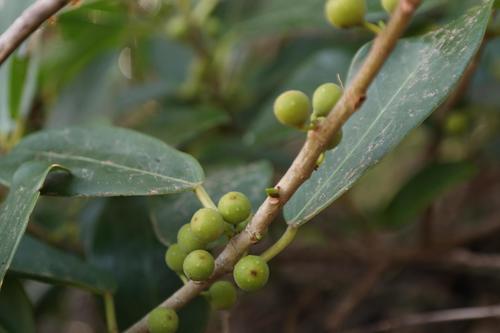
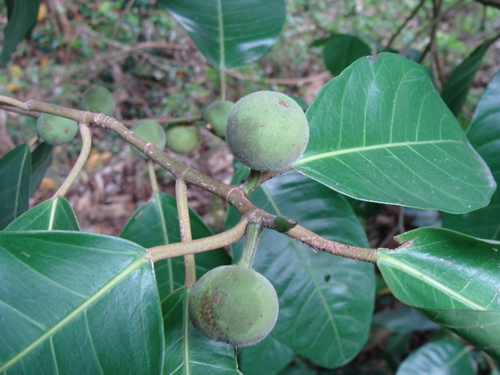
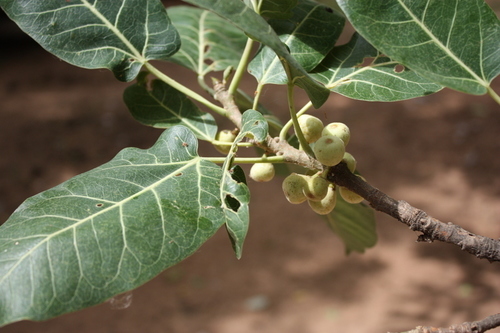
Its almost spherical figs are produced throughout the year, with main production in summer. The figs measure 0.9 to 1.2 centimetres (0.35 to 0.47 in) in diameter, and grow on very short stalks just below or among the terminal cluster of leaves. As they ripen, figs first turn white, and eventually mature to purple or yellowish-brown.
Ficus ingens has smooth, pale grey bark; younger branches carry a yellow tinge. When stems or leaves are cut or bruised, they release a non-toxic milky latex.
This species is widespread across northern and eastern sub-Saharan Africa, with a largely continuous range that extends from Senegal in the west, east to Eritrea, and south to the Eastern Cape of South Africa. It grows in the Saharo-montane woodlands of the Tassili n'Ajjer, the Hoggar, Aïr, and Tibesti mountains, and the Kerkour Nourene massif. It also occurs in southernmost Oman, mostly in the Salalah region south of Dhofar. Habitats for Ficus ingens include rock faces and outcrops, rocky slopes, riparian and wadi fringes, and dense woodlands. It can be found growing on substrates including lava flows, coral, and limestone in drier, exposed areas, and sandstone or dolomite in bushveld.
Recorded uses and species interactions for Ficus ingens are as follows: in northern Nigeria the figs, and in Kenya the leaves and figs, are recorded as a famine food. In South Africa, a decoction of the bark mixed into cow feed is claimed to increase milk production, though leaves have been shown to be toxic to cattle, and sometimes toxic to sheep. Ripe figs are readily eaten by multiple bird species. The species' pollinator wasp is Platyscapa soraria Wiebes., while Otitesella longicauda and O. rotunda are its non-pollinating wasp associates.