About Ficus grossularioides Burm.fil.
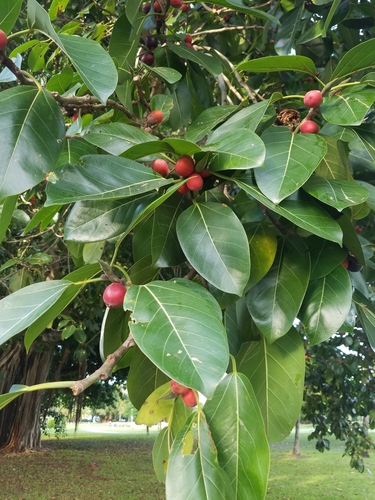
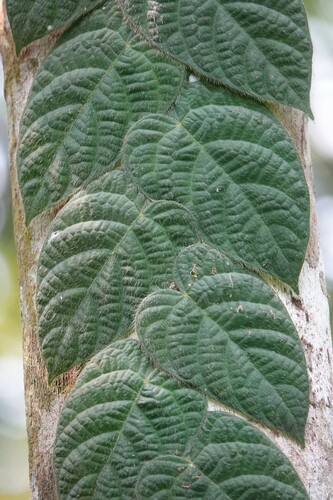
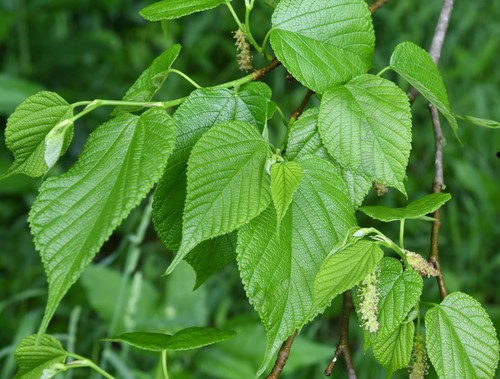
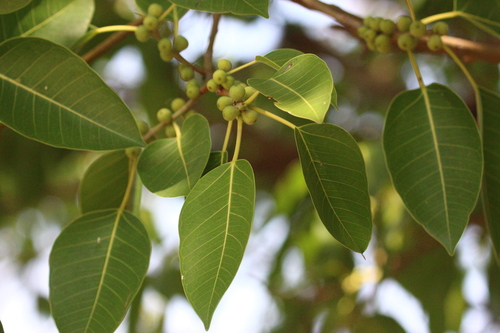
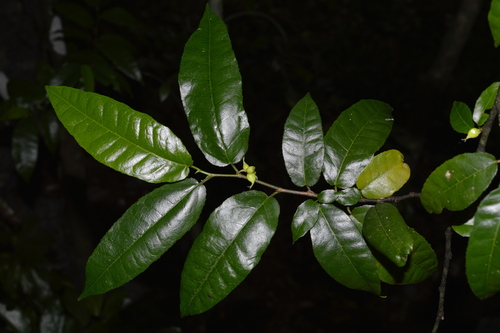
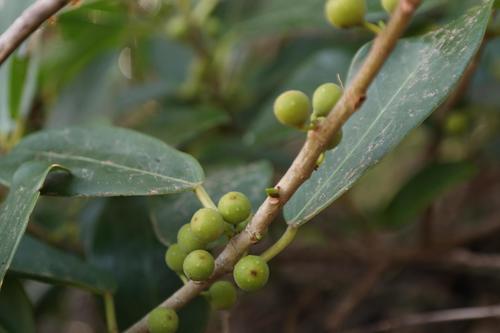
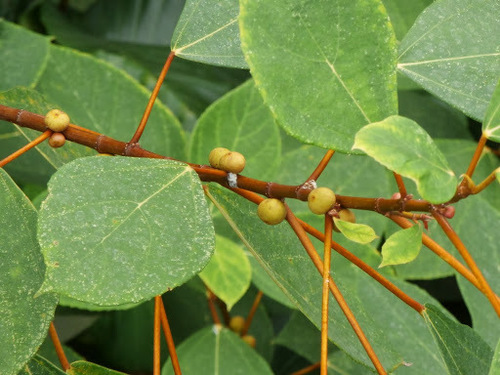
Ficus grossularioides Burm.fil. is a small dioecious evergreen tree or shrub. It reaches a maximum height of 13 m (43 ft) in natural conditions, with a trunk only 15 cm in diameter at most. Its bark is smooth, thornless, and light brown, and the tree produces large amounts of milky white latex. Its twigs are glabrous, reddish brown, and measure 0.2-0.5 cm thick. Leaves are spirally arranged on branches, and can be simple or trilobed. They range in shape from elliptic to obovate, have serrated edges from the middle of the margin to the tip, and are thin-coriaceous. The leaf underside is glaucous and covered in velvety hairs, while the topside has very rough hairs. Leaves are 11.5–19 cm long, 3.5–5.5 cm broad, with a petiole 1.5–11.5 cm long. Leaves have 4 to 6 pairs of lateral veins: these are sunken on the leaf topside and raised on the underside. The basal pair of lateral veins reaches roughly half the length of the leaf blade, with one oil gland in each vein axil on the leaf underside. Its fruits are small figs that grow along twigs, shaped from ellipsoid to subglobose, 0.8–1 cm in diameter. Unripe figs are light green, and ripen to yellowish brown, or sometimes orange or red. These figs closely resemble gooseberries. This species is distributed across Thailand, Sumatra, Peninsular Malaysia, Singapore, Borneo, and Java. It is common across most of Kalimantan (it is replaced by the much rarer F. tricolor in Kalimantan's mountains) and Sarawak, where it grows in most secondary forests. It is uncommon in Brunei, and does not occur in Sabah, where its ecological niche is filled by Ficus septica. The non-overlapping ranges of these two common secondary forest fig species in Borneo may be linked to the competitive exclusion principle, though this is unconfirmed, as there is a lack of existing studies on the ecology of both species. It grows in a wide variety of habitats up to 400 m in elevation, including dry disturbed sandy soils, kerangas forest, swamps, paddy fields, oil palm plantations, riverbanks, and sandy coastal forests. It is commonly found on forest edges, and is typically one of the first species to re-colonize disturbed habitats. This species has a specialized pollination relationship with an agaonid fig wasp, which acts as its only pollinator. The wasp only lays its eggs in Ficus grossularioides trees, which follows the unique fertilization pattern common to all fig trees: each fig species relies on a single specialized pollinating wasp species that in turn depends on the fig tree for its own reproduction. After the figs develop, they are eaten by birds, bats, and other mammals, which disperse the tree's seeds through their feces. Ficus grossularioides is not generally cultivated, as it is a common wild species, and any products used from the plant are collected from wild specimens. In traditional medicine, its latex is used to treat scorpion stings, and a decoction made from its leaf extract is used to treat kidney complaints. Its young shoots are reported to be edible, and can be eaten raw.