About Ficus carica L.
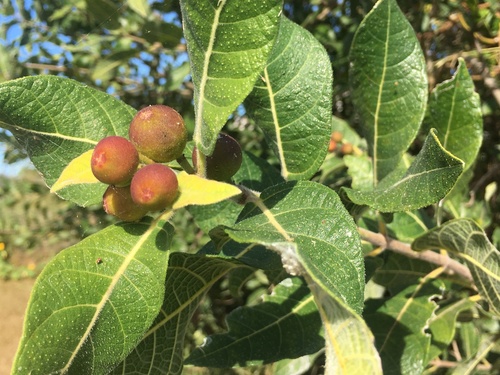
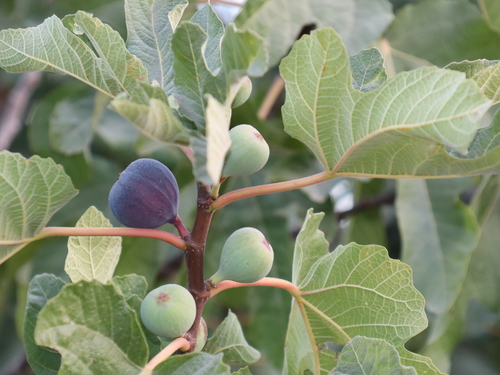
Ficus carica, the common fig, is a gynodioecious, deciduous tree or large shrub that reaches 7–10 m (23–33 ft) in height, with smooth white bark. Its fragrant leaves measure 12–25 cm (4+1⁄2–10 in) long and 10–18 cm (4–7 in) wide, and are deeply divided into three or five lobes. What is commonly called a fig fruit develops as a hollow, fleshy structure called a syconium, lined internally with many tiny unisexual flowers that bloom inside this cup-like structure. Botanically, the syconium is an infructescence, a type of multiple fruit, not a true single fruit. After pollination, each fertilized ovule (one per flower, held in the flower’s ovary) develops into a small, single-seeded true fruit that lines the syconium’s interior. A small opening called an ostiole, visible at the outer end of the syconium, forms a narrow passage that lets the specialized fig wasp Blastophaga psenes enter to pollinate the flowers. The edible mature syconium is a fleshy false fruit that holds the numerous one-seeded true fruits, which are technically classified as drupelets. The entire mature syconium is 3–5 cm (1–2 in) long, with green skin that often turns purple or brown when ripe. Ficus carica produces milky sap from specialized laticifer cells, and the sap of its green plant parts is an irritant to human skin. The common fig tree has been cultivated since ancient times. It grows wild in dry, sunny locations with deep, fresh soil, as well as in rocky sites from sea level up to 1,700 metres (5,600 ft) in elevation. It prefers relatively porous, freely draining soil, and can grow successfully in nutritionally poor soil. Unlike many other fig species, Ficus carica does not always require pollination by a wasp or another tree to produce edible fruit, though it can be pollinated by Blastophaga psenes to produce seeds. Fig wasps are not present to pollinate this species in colder regions such as the British Isles. Ficus carica has become naturalized in scattered locations across Asia and North America. It tolerates seasonal drought, and is particularly well-suited to Middle Eastern and Mediterranean climates. When growing in a favorable habitat, mature specimens can grow into large, dense, shade-providing trees of considerable size. Its aggressive root system makes it unsuitable for cultivation in many urban areas, but this trait helps the plant establish roots in very inhospitable natural locations. Because it has a high need for water, Ficus carica is mostly a phreatophyte that draws needed water from groundwater sources. As a result, it often grows in areas with standing or running water, such as river valleys and water-collecting ravines. Its deep roots search for groundwater in aquifers, ravines, or cracks in rock. With consistent access to this water, the tree cools the hot environments where it grows, creating a cool, pleasant shelter for many animals that rest in its shade during periods of intense heat. A wild variety called the mountain or rock fig (Persian: انجیر کوهی, romanized: anjīr kuhi) is tolerant of cold dry climates, and grows in the semi-arid rocky montane regions of Iran, especially in the Kūhestān mountains of Khorasan. In ecology, Ficus carica seeds are dispersed by birds and mammals that scatter the seeds in their droppings. Fig fruit is an important food source for much of the local fauna in some regions, and the tree’s natural range expansion is due to animals that consume its fruit. Common fig trees also resprout from root and stolon tissue. Like other species in the plant family Moraceae, contact with the milky sap of Ficus carica followed by exposure to ultraviolet light can cause phytophotodermatitis, a potentially serious skin inflammation. Although the plant is not poisonous in itself, F. carica is listed in the FDA Database of Poisonous Plants. Organic chemical compounds called furanocoumarins are known to cause phytophotodermatitis in humans. The common fig contains significant amounts of two furanocoumarins: psoralen and bergapten. The essential oil extracted from fig leaves contains more than 10% psoralen, which is the highest concentration of any organic compound isolated from fig leaves. Psoralen appears to be the primary furanocoumarin responsible for fig leaf-induced phytophotodermatitis. Psoralen and bergapten are found mostly in the milky sap of Ficus carica leaves and shoots, not in the edible fruit. Neither psoralen nor bergapten have been detected in the essential oil of fig fruits, so there is no conclusive evidence that fig fruits cause phytophotodermatitis. Figs can be eaten fresh or dried, and are used to make jam. Most commercial production focuses on dried or otherwise processed figs, because ripe fresh fruit does not transport well and does not keep long once picked. The widely produced fig roll is a biscuit (or cookie) with a fig-based filling; Fig Newton is a trademarked brand of this product held by Nabisco. In the Northern Hemisphere, fresh figs are in season from August through early October. Fresh figs selected for cooking should be plump and soft, with no bruising or splits. A sour smell indicates the figs have become over-ripe. Slightly under-ripe figs can be kept at room temperature for 1–2 days to ripen before serving, and figs are most flavorful when served at room temperature. Two distinct drying methods are commonly used to preserve freshly harvested figs. The first is natural sun-drying, where figs are exposed to the sun’s warmth and light. The second is oven-drying, where figs are held in a controlled temperature environment inside an oven. Each drying method produces unique changes to the final texture and flavor of the dried figs. In some old Mediterranean folk practices, the milky sap of the fig plant was used to soften calluses, remove warts, and deter parasites. Since the late 1800s, syrup of figs combined with senna has been available for use as a laxative.