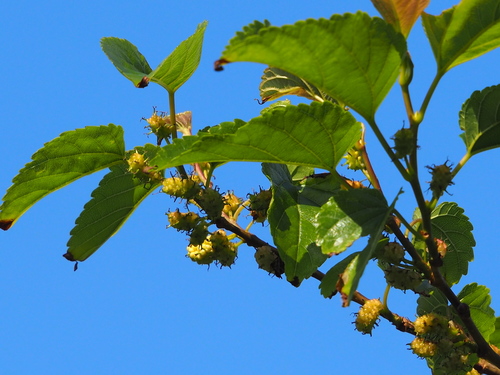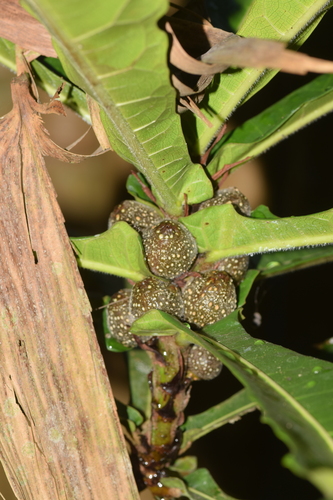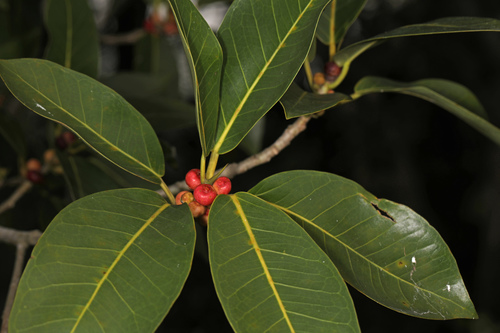
About Ficus aurea Nutt.
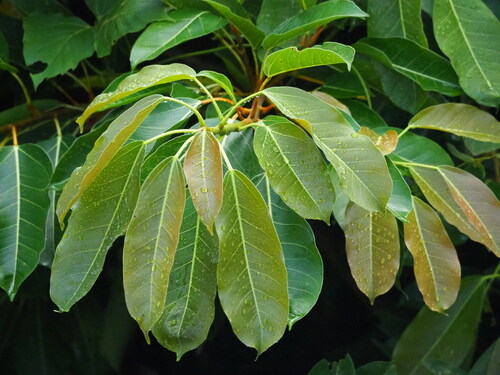
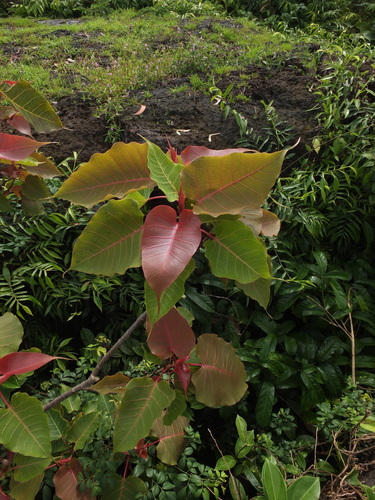
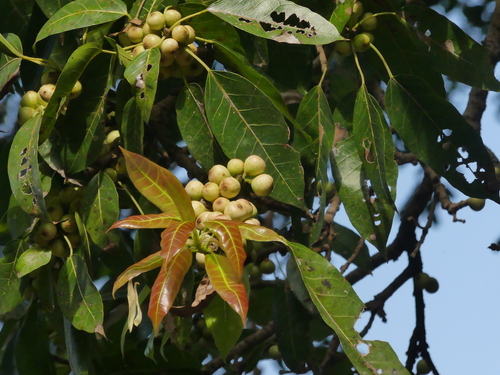
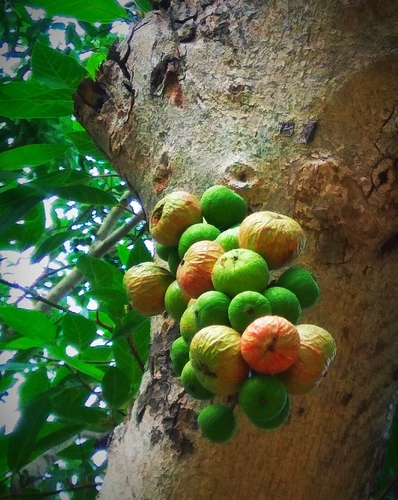
Ficus aurea Nutt. is a tree that can reach heights of 30 m (98 ft). It is monoecious, meaning each individual tree produces both functional male and functional female flowers. Its leaves vary in both size and shape: some individuals typically have leaves under 10 cm (4 in) long, while others have larger leaves. Leaf shape and base shape also differ between plants: some have oblong or elliptic leaves with wedge-shaped to rounded bases, while others have heart-shaped or ovate leaves with cordate to rounded bases. F. aurea produces paired figs that are green when unripe and turn yellow as they ripen. Fig diameter varies, falling into the ranges 0.6–0.8 cm (0.2–0.3 in), around 1 cm (0.4 in), or 1.0–1.2 cm (0.4–0.5 in). Figs are generally sessile, but populations in parts of northern Mesoamerica produce figs on short stalks called peduncles. The distribution of Ficus aurea extends from Florida, across the northern Caribbean to Mexico, and south through Central America. It is present in central and southern Florida, the Florida Keys, The Bahamas, the Caicos Islands, Hispaniola, Cuba, Jamaica, the Cayman Islands, San Andrés (a Colombian territory in the western Caribbean), southern Mexico, Belize, Guatemala, Honduras, Nicaragua, El Salvador, Costa Rica, and Panama. In Florida, it reaches as far north as Volusia County, and is one of only two native fig species native to the state. It occurs across a range of south Florida ecosystems, including coastal hardwood hammocks, cabbage palm hammocks, tropical hardwood hammocks and shrublands, temperate hardwood hammocks and shrublands, and along watercourses. In The Bahamas, it grows in tropical dry forests on North Andros, Great Exuma, and Bimini. In Mexico, it occurs in 10 states, mostly in the south but extending north as far as Jalisco, where it grows in tropical deciduous forest, tropical semi-evergreen forest, tropical evergreen forest, cloud forest, and aquatic or subaquatic habitats. Across its range, it grows from sea level up to 1,800 m (5,500 ft) above sea level, in habitats ranging from Bahamian dry forests to Costa Rican cloud forest. Ficus aurea has an obligate mutualism with fig wasps of the family Agaonidae: figs are only pollinated by these wasps, and the wasps can only reproduce inside fig flowers. Most fig species depend on a single wasp species for pollination, and the wasps similarly depend on their host fig species to reproduce. Ficus aurea is specifically pollinated by Pegoscapus mexicanus (Ashmead). Figs produce complex enclosed inflorescences called syconia, where all flowers are contained inside a closed structure that only connects to the outside through a small pore called an ostiole. As a monoecious fig, F. aurea holds both male and female flowers inside a single syconium. Female flowers mature first, and once mature produce a volatile chemical that attracts pollinating wasps. Female wasps squeeze through the ostiole into the syconium, where they pollinate the flowers, lay their eggs in some of the flowers, and die. The eggs hatch, and the larvae parasitise the flowers they were laid in. After four to seven weeks in F. aurea, adult wasps emerge. Males emerge first, mate with the females, and cut exit holes through the fig wall. Male flowers mature around the same time that female wasps emerge. Newly emerged female wasps actively collect pollen from the male flowers onto their bodies before leaving through the exit holes cut by males, then fly off to find a new syconium to lay their eggs in. Over one to five days after wasp emergence, figs ripen. Ripe figs are eaten by a variety of mammals and birds, which disperse the seeds. Ficus aurea exhibits asynchronous flowering and fruiting across its population, with flowering and fruiting staggered across different individual trees. This staggered production is critical for fig wasps, which need to find a receptive syconium within a few days of emergence — this would not be possible if all trees flowered and fruited at the same time. Asynchronous fruiting also makes figs an important food resource for frugivores (fruit-specialist animals), because figs produce fruit even during times of year when other fruit is scarce. In most fig species, while flowering is asynchronous across the whole population, it is synchronized within an individual tree, which forces newly emerged female wasps to leave their natal tree to find new figs, preventing self-pollination. However, in Florida, individual F. aurea trees have asynchronous flowering and fruiting even within a single tree. This within-tree asynchrony is more likely to increase self-pollination, but may be an adaptation that lets the species maintain a sufficient wasp population at low population densities or in strongly seasonal climates. Flowering phenology in Ficus is divided into five phases. In most figs, phase A is followed almost immediately by phase B, but immature F. aurea inflorescences can remain dormant for over nine months. Ficus aurea is a strangler fig: it typically establishes itself on a host tree, gradually encircles and strangles it, and eventually replaces the host tree in the forest canopy. While this process means F. aurea contributes to the death of other trees, there is little evidence that it prefers specific host tree species. An exception occurs in dry forests on Great Exuma in The Bahamas, where F. aurea only establishes on palms even though other large potential host trees are present. Researchers Eric Swagel and colleagues have attributed this pattern to the accumulation of humus on palm leaf bases, which creates a relatively moist microclimate in the dry environment that improves seedling survival. Because of their asynchronous fruiting, figs are sometimes considered potential keystone species in communities of fruit-eating animals. Nathaniel Wheelwright recorded that emerald toucanets fed on unripe F. aurea fruit during periods of fruit scarcity at Monteverde, Costa Rica, and also listed the species as a year-round food source for resplendent quetzals at the same site. In the Florida Keys, F. aurea is one of five fruit species that make up the majority of the diet white-crowned pigeons feed to their nestlings. It is also an important food for mammalian frugivores: black howler monkeys in Belize consume both its fruit and young leaves. In addition to its pollinator Pegoscapus mexicanus, F. aurea is used by a community of non-pollinating chalcidoid wasps whose larvae develop inside its figs. This group includes gallers, inquilines, kleptoparasites, and parasitoids of both pollinating and non-pollinating wasps. In southern Florida, the invertebrates found inside F. aurea syconia include the pollinating wasp P. mexicanus, up to eight or more species of non-pollinating wasp, a plant-parasitic nematode carried by the pollinator, mites, and a predatory rove beetle whose adults and larvae eat fig wasps. The nematode Schistonchus aureus (Aphelenchoididae) is a plant parasite associated with the pollinator P. mexicanus and F. aurea syconia. Mites from the family Tarsonemidae (Acarina) have been found in the syconia of F. aurea and F. citrifolia, but they have not been identified even to genus, and their behavior has not been described. The rove beetle Charoxus spinifer (Coleoptera: Staphylinidae) has adults that enter late-stage syconia of F. aurea and F. citrifolia. Adult C. spinifer eat fig wasps, while larvae develop inside syconia and also prey on fig wasps before pupating in the ground. As a large tree, F. aurea can be an important host for epiphytes. In Costa Rican cloud forests, where F. aurea is the most conspicuous component of intact forest, trees in continuous forest patches support more species-rich epiphytic bryophyte communities, while isolated trees have greater lichen cover. Ecologist Suzanne Koptur of Florida International University has recorded extrafloral nectaries on F. aurea figs in the Florida Everglades. Extrafloral nectaries are nectar-producing structures not associated with flowers, typically interpreted as defensive structures that are often produced in response to attack by herbivorous insects. They attract insects, primarily ants, which defend the nectaries and thus protect the plant from herbivores. Ficus aurea, along with other related Ficus species, has been a source of bark for making amate, the bark paper used for codices in Mesoamerican civilizations. The oldest known example of amate made from this species dates to 75 CE and was found at a shaft tomb culture site in Huitzilapa, Jalisco, Mexico. Its fruit is edible, and was used as food by Native Americans and early settlers in Florida; it is still eaten occasionally as a backyard source of native fruit. Its latex was used to make chewing gum, and its aerial roots may have been used to make lashings, arrows, bowstrings, and fishing lines. The fruit was used to produce a rose-coloured dye. F. aurea was also used in traditional medicine in The Bahamas and Florida. Researchers Allison Adonizio and colleagues screened F. aurea for anti-quorum sensing activity (tested as a potential route for antibacterial action), but found no such activity. Individual F. aurea trees are common on dairy farms in La Cruz, Cañitas, and Santa Elena in Costa Rica, because they are often left standing when forest is cleared to create pasture. Farmer interviews have identified the species as useful for fence posts, live fencing, and firewood, and as a food source for wild birds and mammals. Ficus aurea is used as an ornamental tree, an indoor tree, and a bonsai. Like other figs, it tends to invade built structures and foundations, so it must be removed to prevent structural damage. While young trees are described as rather ornamental, older trees are difficult to maintain due to adventitious roots that grow from branches, and are not recommended for planting in small areas. It has been recommended as a useful tree for energy-conserving enviroscaping in south Florida, because it is not as aggressive as many exotic fig species, though it requires enough space to grow.