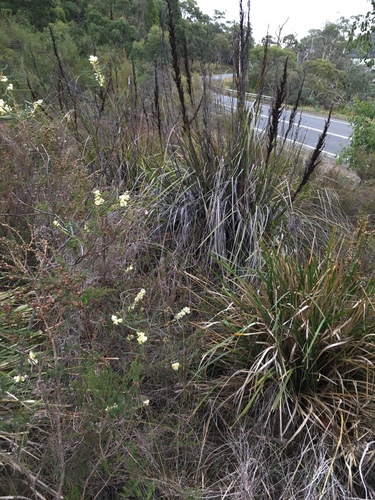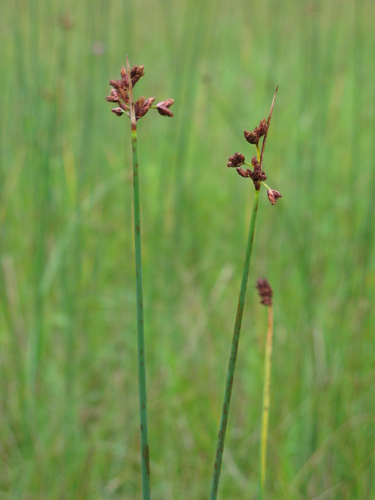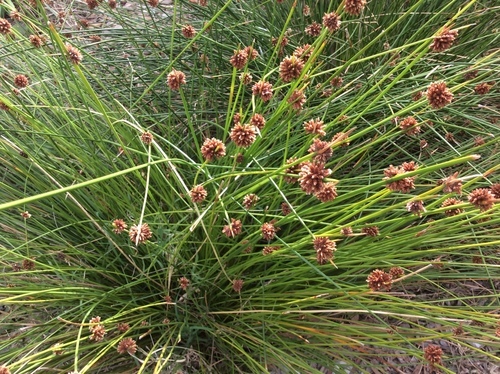
About Ficinia nodosa (Rottb.) Goetgh., Muasya & D.A.Simpson
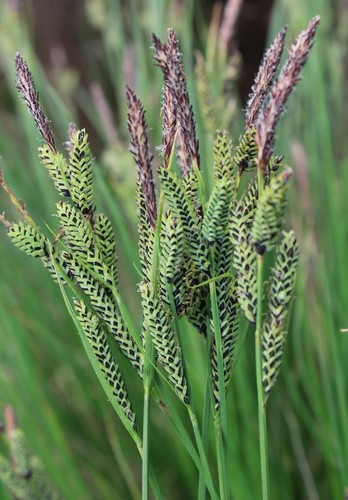
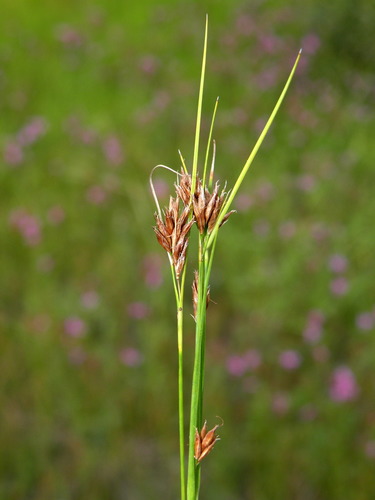
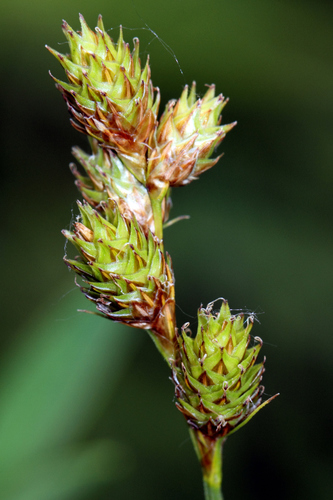
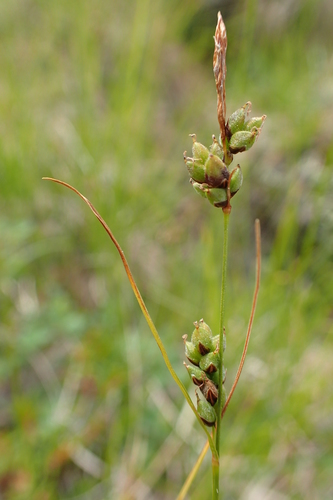
Ficinia nodosa is a grass-like sedge that grows to roughly 100 cm in height, with smooth, green-yellow stems that spread up to 200 cm in diameter. Individual stems reach between 15 and 100 cm in length and 1 to 2 mm in diameter. Its flowers form brown-orange clumps just below stem tips, with 7–20 mm diameter hemispherical spikelets that sit underneath a bract. The fruit, contained within the flower-heads, is an irregularly shaped dark brown to black nut approximately 1 mm in diameter. Ficinia nodosa flowers during the Southern Hemisphere summer, between September and December, while seeds develop over a longer period from November to May. The seedhead is often retained on the plant year-round. This species can be distinguished from similar plants like those in the genus Isolepsis by its larger overall growth and rigid, woody stems. It is commonly confused with Scirpus dioecus, and was once considered to be the same species. Ficinia nodosa is native to South Africa, Australia, and New Zealand, including New Zealand’s Kermadec, Three Kings, Stewart, and Chatham Islands. It also commonly occurs on Saint Helena, in temperate areas of South America, and in Namibia. Across its native range, it grows in sparsely populated coastal habitats such as sand dunes and sedgelands, but it also grows in New Zealand’s alpine climates up to 700 metres above sea level; other research records the species growing at elevations as high as 1500 metres above sea level. It is also very commonly found in salt marshes. In South Africa, Ficinia nodosa grows along the entire east coast, and is common in many locations on the Cape Peninsula and around the Orange River. No significant variation exists between specimens collected inside and outside Africa; instead, plant size differs within the same region. Specimens collected from the Orange Free State were shorter and smaller than those collected in Namibia, while specimens from the Cape Peninsula varied widely in size. In Australia, Ficinia nodosa occurs across most of the continent, found in coastal and saltwater habitats in all states except the Northern Territory, though some evidence suggests its distribution also includes the Northern Territory. It is also commonly found in wet, moist non-saline areas of Victoria. Ficinia nodosa can grow in a wide variety of habitats because it tolerates a broad range of soil conditions, water levels, water types, temperatures, and sun exposure. It thrives in sandy and gravelly soils with varying pH levels, and grows best in direct sunlight with access to some water. In sand dune environments, Ficinia nodosa often grows in dense clumps on backdunes. New populations establish from wind-dispersed seeds, then expand via rhizomes and additional new seed production. There are reports of Ficinia nodosa growing in Chile, but more research is needed to confirm whether the species is native to this region. Ficinia nodosa is a long-lived rhizomatous perennial. Its flowers develop in summer and often remain on the plant year-round, creating the appearance of continuous flowering. In New Zealand dune ecosystems, it grows alongside several native plant species, including sand coprosma (Coprosma acerosa), prostrate snowberry (Pernettya macrostigma), and tauhinu (Ozothamnus leptophyllus). One study found that Ficinia nodosa growth is inhibited by allelopathy, a process where chemicals produced by one plant species limit the growth of surrounding species. On the New South Wales coast of Australia, Ficinia nodosa growth was inhibited by bitou bush extracts in the surrounding soil. Bitou bush is an invasive species that was planted to stabilize sand dunes between 1946 and 1964. Additional testing found that chemicals extracted from Acacia longifolia roots and soil also inhibit the growth of Ficinia nodosa seedlings. Even though Ficinia nodosa is widespread and common across the Southern Hemisphere, in coastal regions of New South Wales it competes with both invasive bitou bush and the native dominant species Acacia longifolia. Research indicates Ficinia nodosa can be used in biofiltration systems such as constructed wetlands to remove heavy metals, phosphorus, and nitrogen from storm water runoff, especially in the saline environments where the species grows natively. Its ability to grow well in saltwater conditions, paired with its capacity to store large amounts of nitrogen in its shoots, makes it an excellent candidate for constructed floating wetlands in its native regions. When grown alongside Phragmites australis, Sarcocornia quinqueflora, and Baumea juncea, its shoots and roots can be harvested to reduce nitrogen and phosphorus concentrations. Ficinia nodosa is particularly effective at nitrogen removal, as it can maintain consistent nitrogen removal rates at salt concentrations below 10.4 mS cm-1. Māori people traditionally used this and other native sedges to thatch the roofs of wharenui. Ficinia nodosa is commonly recommended as a sand binder, or as a landscape feature around water features such as filtration beds and ponds in the native regions of Victoria and South Australia. It is also used to control sand movement in dune slacks thanks to its binding ability, and is often included in dune restoration projects across its native range.