About Ficedula albicollis (Temminck, 1815)
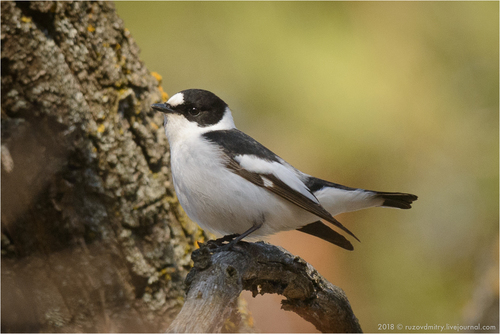
The collared flycatcher, scientific name Ficedula albicollis (Temminck, 1815), is a small passerine bird belonging to the Old World flycatcher family. It is one of four species of Western Palearctic black-and-white flycatchers. This migratory species breeds across southeast Europe, ranging from Eastern France to the Balkan Peninsula and Ukraine; isolated breeding populations are also found on the Baltic Sea islands of Gotland and Öland, Sweden. It winters in Sub-Saharan Africa, and is a rare vagrant in western Europe. Collared flycatchers measure 12–13.5 cm in length. Breeding males are primarily black above and white below, with a distinct white collar, large white wing patch, black tail (some males have white tail sides), a large white forehead patch, and a pale rump. Their bill is black, with the broad but pointed shape typical of aerial insectivores. In addition to catching insects in flight, this species hunts caterpillars in oak foliage and also eats berries. Non-breeding males, females, and juveniles have pale brown plumage in place of the breeding male’s black, making them very difficult to distinguish from other Ficedula flycatchers, particularly the European pied flycatcher (F. hypoleuca) and the semicollared flycatcher (F. semitorquata). Collared flycatchers hybridize with these species to a limited extent. F. albicollis and F. hypoleuca are undergoing speciation via reinforcement, a conclusion supported by observed differences in coloration between sympatric and allopatric populations. This species inhabits deciduous woodlands, parks, and gardens, and prefers old trees with cavities for nesting. They build an open nest in natural tree holes or man-made nest boxes, and normally lay 5 to 7 eggs per clutch. The collared flycatcher’s song consists of slow, strained whistles that are quite distinct from the song of the pied flycatcher; in sympatric populations, pied flycatchers are able to mimic the collared flycatcher’s song. The genus name Ficedula comes from Latin, referring to a small fig-eating bird linked to the Latin word ficus (fig), which was thought to transform into a blackcap during winter. The specific epithet albicollis combines the Latin words albus (white) and collum (neck). The collared flycatcher is widely used as a model species in both ecology and genetics, and was one of the first bird species to have its full genome sequenced. Repeated spectrometric measurements taken from male collared flycatchers show that plumage reflectance should be measured during courtship, the primary period of sexual signalling, because spectral traits decline over the course of the breeding season. In natural collared flycatcher populations, inbreeding is rare, but when it does occur, it causes severe negative impacts on fitness traits such as hatching success rate. In the 1960s, collared flycatchers expanded their breeding range northward in response to climate change, and successfully colonized the Swedish Baltic Sea island of Öland. This range shift brought the species into sympatry with the European pied flycatcher. Since 2002, breeding population dynamics and hybridization between the two species have been continuously monitored on the island, giving scientists a rare opportunity to study life-history traits, hybridization, climate adaptation, and speciation in action. On Öland, collared flycatchers are socially dominant and rely heavily on high-quality habitat, so they have displaced most European pied flycatchers to lower-quality breeding habitats. Although hybridization occurs in approximately 4% of the combined Öland population, there is strong selection against hybrids. Resulting F1 hybrids of both sexes have lower fitness and are sterile: females experience complete hatching failure, while males have impaired sperm morphology.