About Ferocactus wislizeni (Engelm.) Britton & Rose
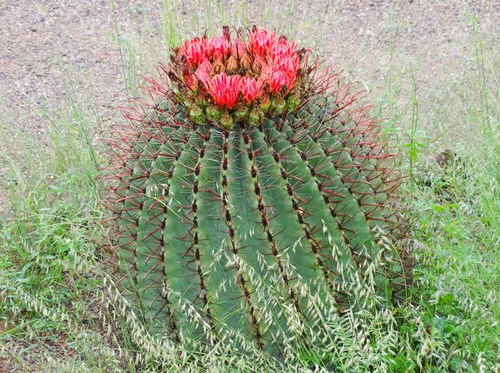
Ferocactus wislizeni, commonly called the fishhook barrel cactus, typically reaches roughly 2.25 feet (0.69 meters) in diameter and 3 to 6 feet (0.91 to 1.83 meters) in height. Exceptional specimens have been recorded up to 3 feet (0.91 meters) wide and 10 feet (3.0 meters) tall. Its common name comes from its thick, hooked spines. It has a leathery asparagus-green outer skin (cortex), with approximately 15 to 28 ribs per individual. Its flowers range from yellow to red-orange, and grow on top of the cactus fruit during the summer. Unripe fruits are green, turning yellow once the flower dries out. Fruits remain atop the cactus long after the flower is gone, sometimes persisting for more than a year. Mature fishhook barrel cacti usually lean southward toward the sun, giving them the alternate nickname "compass barrel cactus." One common theory for this southward lean is that intense afternoon sun slows growth on the exposed southern side, leading to uneven overall growth. Older cacti can lean so far that they uproot and fall over, particularly after heavy rains loosen the surrounding soil. This species has a lifespan of 50 to 100 years. Like other members of the genus Ferocactus, it typically grows in areas with irregular water flow, or in depressions where water can accumulate for short periods. Unlike many cacti of the region, it is not associated with washes and arroyos, and instead grows along rocky ridges and open bajadas. Its hooked fishhook spines, and the armored web of spines that cover the cactus body, act as a defense against herbivores. Mature cacti are rarely hollowed out by javelina, and overall prickly pear experience far higher damage from a greater number of species. The spines of the fishhook barrel cactus are an extreme hazard when handling the plant, as they can penetrate boots and gloves. Its roots are quite long but very shallow. The fishhook barrel cactus is native to the southwestern United States and northwestern Mexico. Specifically, it occurs in southern Arizona, southern New Mexico, and El Paso County, Texas in the United States, and in northern Sonora, Sinaloa, and Chihuahua in Mexico. It grows in gravelly or sandy soil, occurring more often on bajadas than on steep slopes, at elevations between 1000 and 5300 feet (300 to 1600 meters). It prefers full sun, and grows well in hot arid climates, and is frost tolerant to temperatures as low as 5 °F (-15 °C). The species' flowers are pollinated by cactus bees of the genus Lithurge. Mule deer, birds, Antelope Ground Squirrels, and javelina eat its fruit, with birds particularly favoring the seeds. Indigenous peoples of the Sonoran Desert use the cactus's fruit to make candy and jelly. The Seri and O'odham peoples eat the flowers, and use the sour fruit as emergency food. There is a long-held tradition that this barrel cactus can provide water for people lost without water in the desert, and there are recorded instances of southwestern Native Americans using it for this purpose. However, the stored water contains oxalic acid, and is likely to cause diarrhea if consumed on an empty stomach. The cactus's skin thickens with age, making older individuals more fire resistant. Even with this adaptation, average mortality from fire is between 50 and 67 percent within the first two years after a fire event. In urban areas, the fishhook barrel cactus is valued as an ornamental plant. It is drought tolerant, well suited for xeriscaping, and is a low-maintenance plant that requires full sun.