About Ferocactus mathssonii (Berge ex K.Schum.) N.P.Taylor
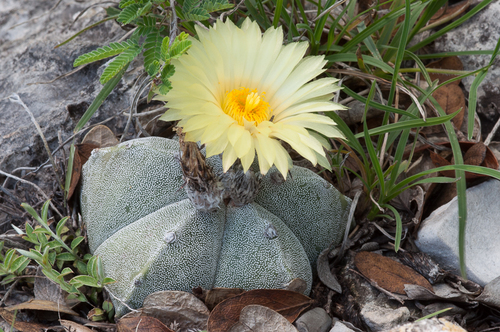
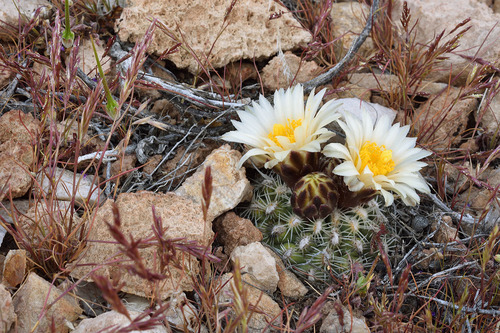
Ferocactus mathssonii is a generally solitary cactus that occasionally branches from its base, and it features attractive hooked central spines. Its stems are flattened globular to egg-shaped, green to bluish-green with a grey glaucescence. Stems grow up to 15 cm (5.9 in) tall and 8 cm (3.1 in) wide, with 9-13 prominent ribs bearing strongly tubercles. The tubercles are approximately 6-9 mm (0.35 in) broad and 9-15 mm (0.59 in) tall. Areoles are roundish, 3-5 mm (0.20 in) in diameter, spaced around 2-2.5 mm (0.098 in) apart, and covered with greyish-yellowish wool. Each areole has 1-4 curving, prominently hooked central spines that are 5-9 cm (3.5 in) long and 1-1.5 mm (0.059 in) wide, along with 3-8 radial spines. The spines are strong, tannish-white to greyish-pink or purple, slightly flattened, and do not obscure the stem. Several buds grow in spirals at the stem apex, and usually 3-5 or more flowers open at a time. The flowers are cylindrical to funnel shaped, 2-4 cm (1.6 in) long and 2-3 cm (1.2 in) wide. Inner petals are tannish to brick red, and outer tepals have brownish midribs. Filaments are yellow or maroon, reaching up to 6 mm (0.24 in) long, with yellow anthers. The style is 1.2 cm (0.47 in) long and reddish, with 10-14 yellow or orange stigma lobes. The pericarpel has toothed scales up to 6 mm (0.24 in) long. Flowering occurs from March to May. Flowers open in the morning, partially close at night, and reopen for 2-3 days. They have a distinctive unique coppery color. Fruits are 1.5-2.5 cm (0.98 in) long, ovate to globose, fleshy, and red, containing black seeds 1.3-1.5 mm (0.059 in) long. This cactus grows in desert hills and flats, often on limestone-rich substrates. It can be found among desert shrubs or in open grassland, usually near grass clumps, ranging from Guanajuato to San Luis Potosí, Mexico.