About Feralia jocosa Guenée, 1852
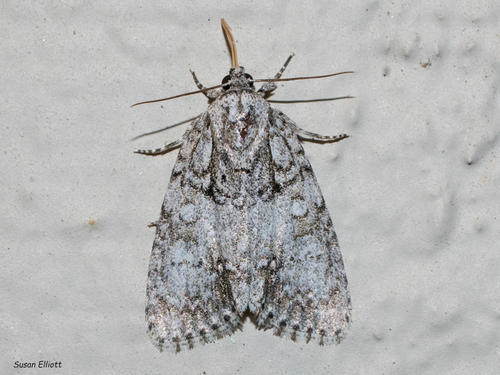
Feralia jocosa, commonly known as the jocose sallow or the joker moth, is a moth species belonging to the family Noctuidae. This species was first formally described by Achille Guenée in 1852. It is distributed from the northeastern United States south to Maryland and Ohio, north to Newfoundland, and extends west across the boreal forest to coastal British Columbia. On British Columbia's lower mainland and Vancouver Island, this species is replaced by the related species Feralia deceptiva. The wingspan of Feralia jocosa measures 30 to 32 millimeters. Adult moths fly from April to June, with flight timing varying by location. The larvae of Feralia jocosa feed on Pinus, or pine, species. While Feralia jocosa larvae primarily feed on Pinus species, historical observations also link them to Tsuga canadensis, or Eastern Hemlock. On Eastern Hemlock, the larvae show a strong preference for developing staminate aments before they move on to feed on newly sprouted leaves.