About Felis silvestris lybica Forster, 1780
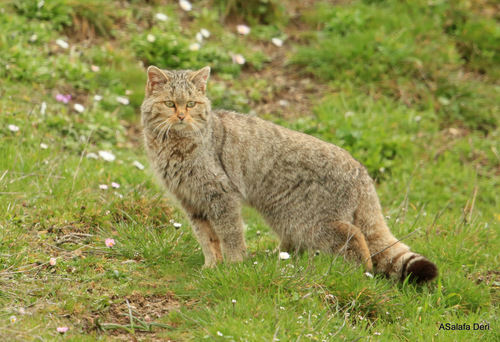
Characteristics: The European wildcat's fur ranges in colour from brownish to grey, with paler contour hairs. It has five broken stripes on its forehead that split into small spots. A dark stripe behind the shoulders widens into a spinal stripe that runs to the base of the tail. Irregular dark stripes on its sides break up on the hind legs, forming a blotched pattern. Its tail is bushy, marked with two to three black transverse rings, and rounded at the black tip. The top of the head and forehead have four well-developed dark bands that also split into small spots. Two short, narrow stripes are typically present on the shoulders, in front of the dorsal band. Some individuals have a small number of light spots on the throat, between the forelegs, or in the inguinal region. The dorsal surface of the neck and head matches the colour of the trunk, but the area around the eyes, lips, cheeks, and chin is lighter grey. A slight ochreous tint can be seen on the undersides of the flanks. A narrow black dorsal band starts on the shoulders and runs along the back to the base of the tail. In some individuals, the summer coat is ashen coloured. The markings on the head and neck are as well-defined as those on the tail, while the markings on the flanks are almost invisible. In winter, guard hairs measure 7 cm (3 in), tip hairs measure 5.5–6 cm (2+1⁄8–2+3⁄8 in), and underfur measures 11–14 cm (4+1⁄2–5+1⁄2 in). Corresponding summer measurements are 5–6.7 cm (2–2+5⁄8 in) for guard hairs, 4.5–6 cm (1+3⁄4–2+1⁄4 in) for tip hairs, and 5.3 cm (2+1⁄8 in) for underfur. Large male wildcats in Spain reach 65 cm (26 in) in body length, with a 34.5 cm (13+1⁄2 in) tail, and weigh up to 7.5 kg (17 lb). They also have a less diffuse stripe pattern, proportionally larger teeth, and prey on rabbits more often than wildcats living north of the Douro-Ebro, which rely more heavily on small rodents. On average, the European wildcat is larger and stouter than the domestic cat, with longer fur and a shorter, non-tapering, bushy tail. It has striped fur and a dark dorsal band. Males have an average weight of 5 kg (11 lb), ranging up to 8 kg (18 lb), while females average 3.5 kg (8 lb). Individual weights can fluctuate seasonally by up to 2.5 kg (6 lb). Compared to African wildcats, European wildcats have proportionately shorter cheek tooth rows with smaller teeth, but a broader muzzle. Because European wildcats and domestic cats interbreed opportunistically, it is difficult to correctly distinguish wildcats from striped hybrids using only physical characteristics. Distribution and habitat: The European wildcat lives primarily in broad-leaved and mixed forests, and avoids intensively cultivated areas and human settlements. The northernmost population is found in northern and eastern Scotland; the species has been extirpated in England and Wales. In Ireland, wildcats were first recorded around 3500 BC and died out by the 19th century AD, due to deforestation and competition from domestic cats. There are two separate populations in France: the population in the northeastern Ardennes extends into Luxembourg, Germany, and Belgium, while the other population in southern France may connect via the Pyrenees to populations in Spain and Portugal. In the Netherlands, European wildcats were recorded near Nijmegen in 1999 and in North Brabant in 2004; these individuals likely dispersed from Germany. In Germany, the Rhine forms a major barrier between the population west of the river in the Eifel and Hunsrück mountains and populations east of the river, where a six-lane highway also blocks dispersal. In 2025, an individual was observed in Schleswig-Holstein that is thought to have crossed the Elbe river, which had previously acted as a natural barrier for populations further north. In Switzerland, European wildcats occur in the Jura Mountains. Three fragmented populations exist in Italy: one in central and southern Italy, one in the eastern Alps that may connect to populations in Slovenia and Croatia, and a third on Sicily. The Sicilian population is the only Mediterranean island population that is not introduced. The population in the Polish Carpathian Mountains extends into northern Slovakia and western Ukraine. Behaviour and ecology: In France and Italy, the European wildcat is primarily active at night; it is also active during the day in undisturbed areas. In Sicily, one individual was photographed in 2009 and again in 2018 at roughly the same location, and was probably at least 10 years old when it was recaptured.