About Felimida krohni (Vérany, 1846)
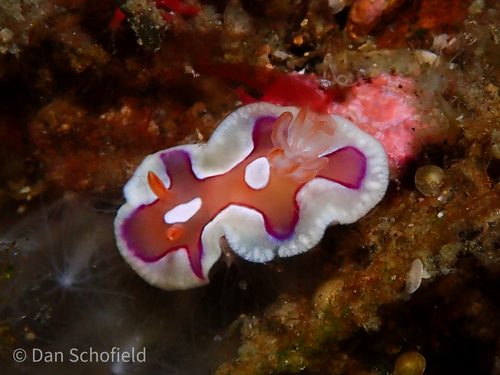
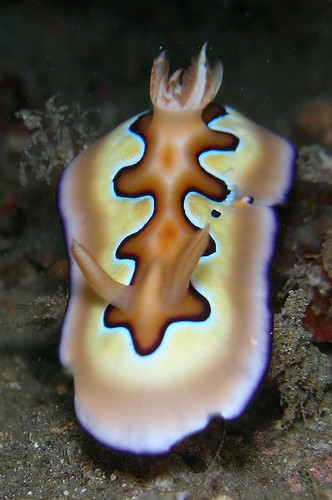
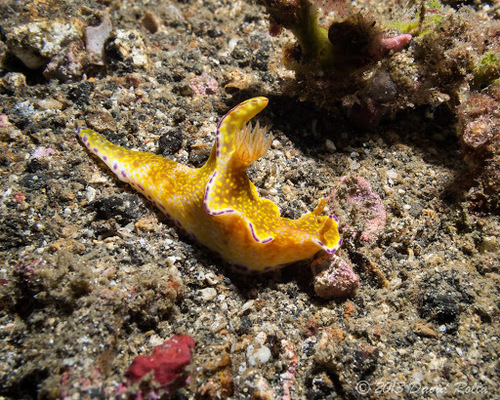
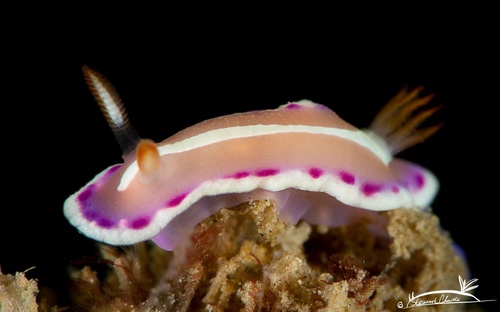
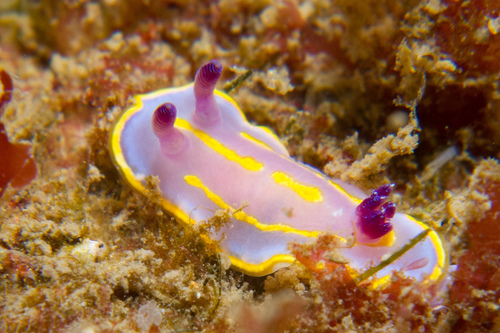
This species of nudibranch, Felimida krohni, reaches a maximum total length of 30 mm (1.2 in), with a more typical adult size of 15 mm (0.6 in). Its colouration is quite variable: the base colour is pink, mauve, or purple, with an iridescent pale blue or mauve inner border, and an outer yellow border. Three longitudinal, slightly raised white or yellow lines run along its dorsal surface; these lines may be continuous or interrupted, and they join together at the posterior end, near where purple branchial plumes emerge to form a ring around the anus. Yellow spots are commonly present in the areas between these lines. At the anterior end of the body, the rhinophores are deep purple, lamellar, and have between 12 and 20 gills. Both the rhinophores and branchial plumes can be retracted when the animal is disturbed. Felimida krohni is native to the eastern Atlantic Ocean and the Mediterranean Sea. In the eastern Atlantic, its range extends from the British Isles south to Cape Verde. It occurs in habitats that support its food sponges, at depths between 5 and 30 m (16 to 98 ft). This nudibranch feeds primarily on sponges of the genus Ircinia, and occasionally feeds on the crumb-of-bread sponge, Hymeniacidon sanguinea. It grinds off sponge fragments using its radula. The bright, conspicuous colouration of these nudibranchs comes from pigments and toxins that they sequester from sponge tissue, and this colouration acts as aposematism, warning potential predators that the nudibranch is distasteful. Like all nudibranchs, Felimida krohni is hermaphroditic, with each individual possessing both male and female reproductive organs. Mating pairs align with their right sides adjacent, and each individual transfers a sperm-containing spermatophore to the other. Between April and September, individuals lay eggs in a gelatinous spiral attached to the substrate. The eggs hatch into planktonic larvae.