About Felimare picta (R.A.Philippi, 1836)
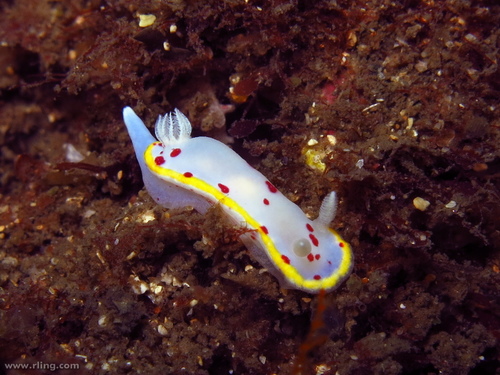
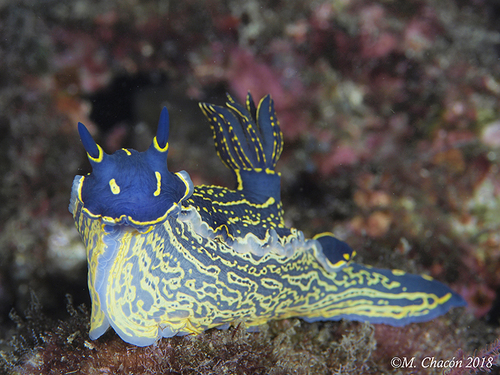
Felimare picta is a species of nudibranch that reaches a maximum length of approximately 13 centimetres (5.1 inches), with most mature individuals measuring 50 to 80 millimetres long. This species feeds exclusively on sponges from the genus Dysidea. Its body background colour is dark blue, which appears almost black in some Atlantic specimens. In the Mediterranean Sea, older individuals typically lose their original dark pigmentation, fading to pale blue with a slight violet tint. The species' colour pattern changes consistently as individuals grow. The smallest individuals, at just 10 millimetres (0.39 inches) long, have an irregular-width white mantle edge, with the exception of a yellowish band along the middle of the back; this small colour pattern makes them visually similar to Felimare gasconi or Felimare orsinii. Small individuals also have scattered rounded blackish spots along the inner side of the mantle edge. When individuals grow to 15–20 millimetres (0.59–0.79 inches), the mantle edge becomes yellow in the area in front of the rhinophores and behind the gill, with white patches remaining between these yellow sections and the mid-lateral region. Once individuals reach 20–25 millimetres (0.79–0.98 inches), the entire mantle edge becomes yellow. The yellow colouration on the dorsum (back) develops from three roughly discontinuous lines. These lines end at the branchial (gill) opening, do not form a complete circle around the opening, and only the middle line extends behind the gill. On the head, the two outer lateral lines fully surround the rhinophore openings in adult individuals, but do not form a closed ring in the youngest individuals. In all age groups, these lines tend to extend forward past the rhinophores. In specimens from the Azores, the back has no continuous orange lines, and only has slightly aligned or irregularly distributed orange spots; all Azorean specimens have this spotted pattern. Specimens from the Canary Islands have both lines and spots, while specimens from Madeira show an intermediate pattern between the two. As individuals grow larger, the dorsal lines break into fragments, their total number increases, and more yellow spots develop between the fragments. These spots sometimes merge to form irregular circles. The mantle edge is also pigmented, and in large individuals yellow pigment can spread across the back to form a cloud of yellow spots, leaving only fragments of the original lines on the branchial sheath, and in front of and behind the rhinophores; even these remaining fragments may disappear completely over time. On the side of the foot, there is a roughly distinct yellow line, plus numerous spots and circles; the number of these markings increases as the animal grows. Smaller individuals only have a single simple line, but by 15 millimetres in length, a second broken line of elongated spots forms below the first. The anterior end of the foot has a yellow or orange line. The rhinophores are solidly coloured, dark blue in Atlantic populations and violet blue in Mediterranean populations. The gills are dark blue with a yellow rachis (central axis). In Mediterranean individuals, the rachis usually has two convergent lines near its tip, while the rachis is uniformly coloured in Atlantic individuals. The maximum number of gills observed was 12, recorded in individuals longer than 60 millimetres (2.4 inches). Large individuals frequently have bifurcated, or even branched, gill tips. At 15–20 millimetres long, which is the typical adult size of many related nudibranch species, Felimare picta already has 7 gill leaves. This species has defensive gland structures along the mantle edge. The most well-developed glands are located level with the rhinophores, and in the lateral and posterior areas around the gill, but glands are present along almost the entire mantle edge, with the exception of the middle body region. In 15 millimetre long individuals, there are 4 to 5 glands on each side of the rhinophores and 6 to 7 glands behind the gill, plus similar-looking white spots along the middle of the mantle edge. In specimens measuring 60–65 millimetres (2.4–2.6 inches), 5 to 12 mantle glands can be counted on the sides of the rhinophores, and 7 to 24 glands can be counted in the gill area. The type locality of Felimare picta is Palermo, Sicily. This species inhabits rocky seabeds throughout the Mediterranean Sea (including Greece), European coastal waters of Spain and Portugal, the Eastern North Atlantic Ocean (including the Azores and Canary Islands), and the Gulf of Mexico. Its recorded depth range is from 0 metres (0 feet) to 55 metres (180 feet).