About Felicia tenella (L.) Nees
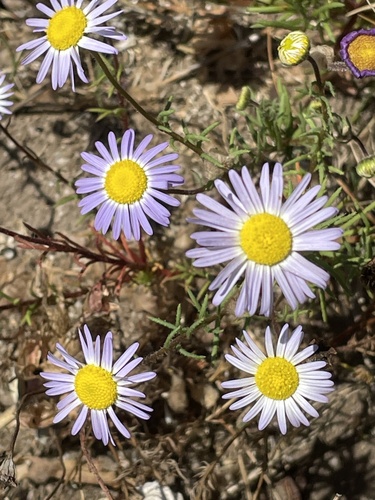
Felicia tenella subsp. tenella is a delicate, often heavily branched annual herbaceous plant that can reach up to 45 cm (1 2/5 ft) in height. Its leaves are arranged alternately along the stems, linear in outline, broadly attached to the stem without a stalk, growing up to 2 1/2 cm (1 in) long and 1 mm wide, rarely up to 1 1/2 mm (0.04–0.06 in) wide. Most leaves are dusky, rarely hairless; they are somewhat succulent with distinctly bristly margins, and no visible veins. Leaves on the upper sections of stems are only slightly shorter than leaves on the lower sections. Medium-sized flower heads grow individually at the tip of an indistinct inflorescence stalk, which can be up to 6 cm (2 2/5 in) long and covered in bristly glands. The involucre that encloses the florets reaches up to 5 mm (0.20 in) in diameter, and is made of approximately three rows of overlapping bracts that range from lance-shaped to inverted lance-shaped. Bracts in the outer whorl measure around 3 mm (0.12 in) long and 0.3 mm (0.012 in) wide, while bracts in the inner whorl measure around 4 mm (0.16 in) long and 1 mm (0.039 in) wide. All inner bracts end abruptly in a narrow pointed tip, all bracts are covered in bristly glands, and all contain resin ducts. Around thirty female ray florets have light blue straps approximately 1 cm (0.4 in) long and 1 1/2 mm (0.06 in) wide. The center of the flower head holds many yellow bisexual disc florets about 2 1/2 mm (0.1 in) long. In the center of the corolla of each disc floret, five anthers are merged into a tube. When the floret opens, the style grows through this tube, collecting pollen onto its shaft. The style in both ray and disc florets is forked, and the tip of each style branch has a broadly triangular appendage. Surrounding the base of the corolla are many white, deciduous pappus bristles about 2 1/2 mm (0.1 in) long that have distinct serrations. The mature dry, one-seeded, indehiscent fruits (called cypselae) are black, inverted egg-shaped, about 1 1/2 mm (0.06 in) long and 1/2 mm (0.02 in) wide, lack a ridge along the margin, and are covered in spoon-shaped hairs. This species is diploid, with a base chromosome number of 9, giving a full chromosome count of 2n=18. For distribution, conservation status, and cultivation: Felicia tenella subsp. tenella is most abundant on the Cape Peninsula, and also occurs near Worcester and Hopefield. F. tenella subsp. cotuloides grows in a strip extending from Calvinia in the north to Bredasdorp in the south. F. tenella subsp. longifolia occurs from the Cape Peninsula east to Riversdale, where it grows in dunes. F. tenella subsp. pusilla ranges from the Cape Peninsula north to Vanrhynsdorp. All four subspecies of Felicia tenella are classified as least concern for continued survival, as their populations are stable. The species has been cultivated in Europe for a long time.